QUESTION IMAGE
Question
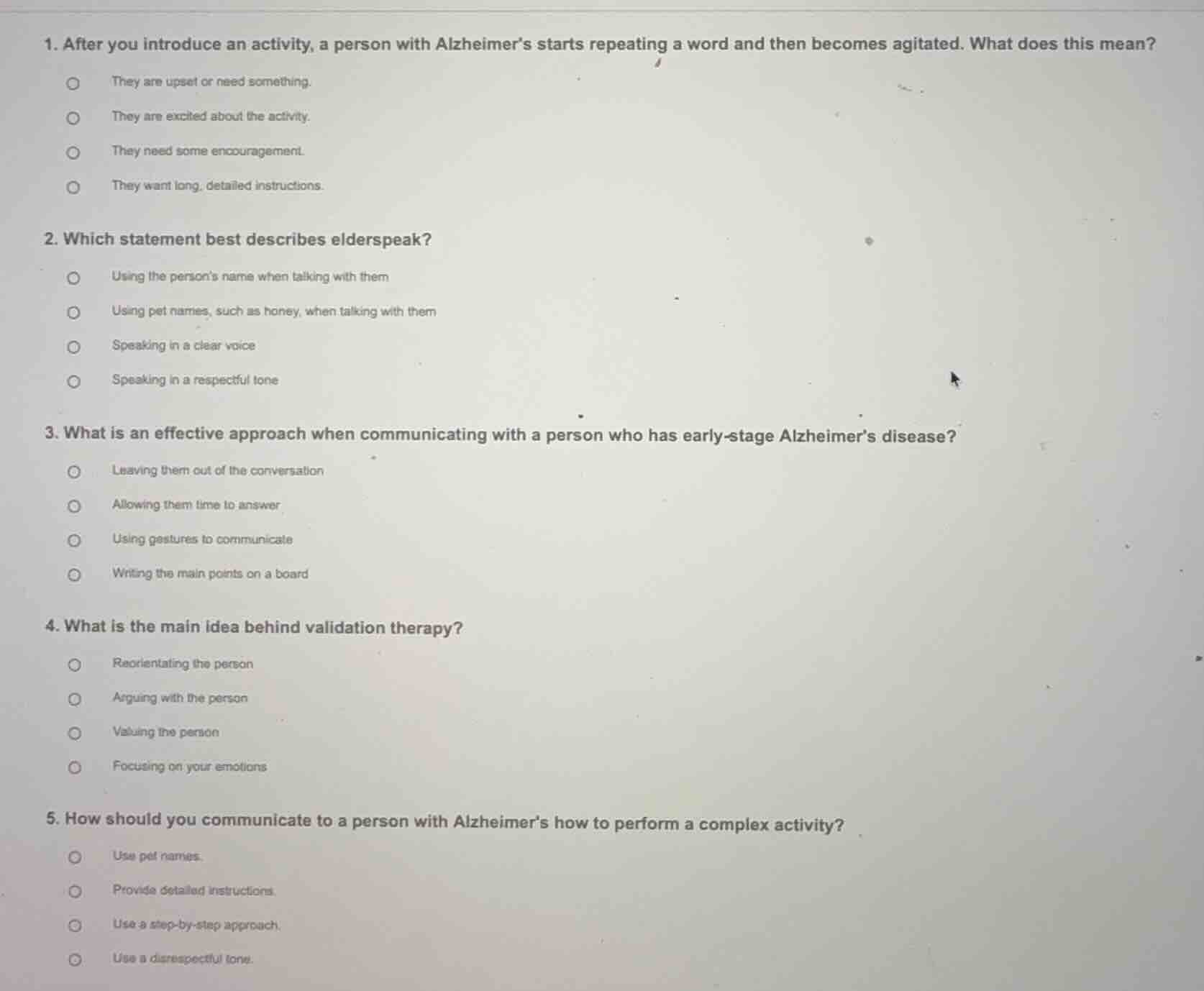
- after you introduce an activity, a person with alzheimers starts repeating a word and then becomes agitated. what does this mean?
they are upset or need something.
they are excited about the activity.
they need some encouragement.
they want long, detailed instructions.
- which statement best describes elderspeak?
using the persons name when talking with them
using pet names, such as honey, when talking with them
speaking in a clear voice
speaking in a respectful tone
- what is an effective approach when communicating with a person who has early-stage alzheimers disease?
leaving them out of the conversation
allowing them time to answer
using gestures to communicate
writing the main points on a board
- what is the main idea behind validation therapy?
reorientating the person
arguing with the person
valuing the person
focusing on your emotions
- how should you communicate to a person with alzheimers how to perform a complex activity?
use pet names.
provide detailed instructions.
use a step-by-step approach.
use a disrespectful tone.
Analyze behavioral changes in Alzheimer's
When a person with Alzheimer's repeats words and becomes agitated after an activity is introduced, it indicates distress. This behavior is a form of non-verbal communication showing they are upset or have an unmet need. We apply Alzheimers Care principles to recognize that agitation is a signal of distress rather than excitement or a desire for complex instructions.
Define elderspeak characteristics
Elderspeak is a specialized speech style characterized by using patronizing, overly familiar language, such as pet names (e.g., "honey", "sweetie"), when addressing older adults. This concept is a key element of Dementia Communication training, as avoiding elderspeak is essential for maintaining dignity.
Determine early-stage communication strategies
In the early stages of Alzheimer's, individuals can still participate in conversations but may experience word-finding difficulties. An effective approach in Dementia Communication is to allow them sufficient time to process information and formulate their answers, rather than excluding them or relying solely on non-verbal gestures.
Identify the core of validation therapy
Validation therapy is an empathetic communication approach that focuses on validating and valuing the person's feelings and reality, rather than trying to reorient them to actual reality or arguing with them. This is a fundamental technique in advanced Alzheimers Care.
Formulate instructions for complex activities
When explaining a complex activity to someone with Alzheimer's, breaking the task down into small, manageable steps is the most effective strategy. Providing detailed, multi-step instructions all at once can overwhelm their cognitive capacity, making a step-by-step approach the standard in Alzheimers Care.

Snap & solve any problem in the app
Get step-by-step solutions on Sovi AI
Photo-based solutions with guided steps
Explore more problems and detailed explanations
Question 1
- (A) They are upset or need something. (Correct answer)
- (B) They are excited about the activity.
- (C) They need some encouragement.
- (D) They want long, detailed instructions.
Question 2
- (A) Using the person's name when talking with them
- (B) Using pet names, such as honey, when talking with them (Correct answer)
- (C) Speaking in a clear voice
- (D) Speaking in a respectful tone
Question 3
- (A) Leaving them out of the conversation
- (B) Allowing them time to answer (Correct answer)
- (C) Using gestures to communicate
- (D) Writing the main points on a board
Question 4
- (A) Reorientating the person
- (B) Arguing with the person
- (C) Valuing the person (Correct answer)
- (D) Focusing on your emotions
Question 5
- (A) Use pet names.
- (B) Provide detailed instructions.
- (C) Use a step-by-step approach. (Correct answer)
- (D) Use a disrespectful tone.