QUESTION IMAGE
Question
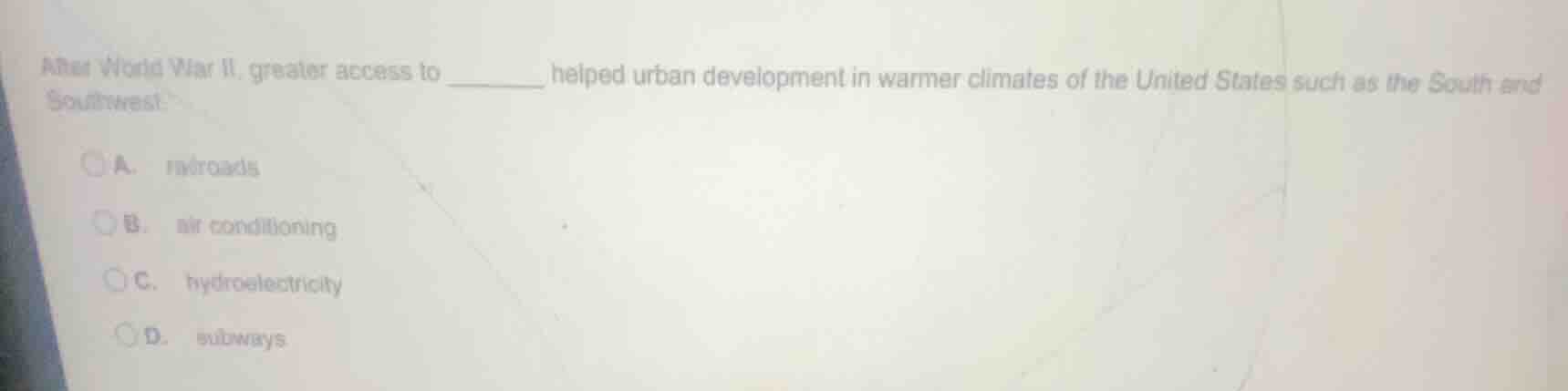
after world war ii, greater access to ______ helped urban development in warmer climates of the united states such as the south and southwest.
a. railroads
b. air conditioning
c. hydroelectricity
d. subways
<pre_analysis>
{
"quality": "clear",
"question_count": 1,
"skills_matched": [
"direct_cot",
"multiple_choice_formatter",
"explain_then_answer",
"tutor"
],
"needs_drawing": false,
"concepts_used": [
"Technological Evolution"
],
"new_concepts": [
"Post-WWII Urbanization",
"Sun Belt Migration"
],
"current_concepts": [
"Technological Evolution",
"Post-WWII Urbanization",
"Sun Belt Migration"
]
}
</pre_analysis>
<reasoning>
Analyze the historical context
The question asks about a factor that helped urban development in warmer climates of the United States, specifically the South and Southwest (often called the Sun Belt), after World War II. This period saw a massive demographic shift as populations migrated to these regions.
Evaluate the technological factors
We can use our understanding of Technological Evolution to evaluate how different innovations impacted living conditions:
- Railroads (A) were crucial in the 19th century but were not the primary driver of post-WWII Sun Belt urbanization.
- Air conditioning (B) made living and working in extremely hot southern and southwestern climates comfortable year-round, enabling rapid population and business growth.
- Hydroelectricity (C) provided power but was not the direct catalyst for widespread residential and commercial urban comfort in these specific climates.
- Subways (D) are urban transit systems mostly associated with older, densely populated northern cities rather than the sprawling post-war cities of the South and Southwest.
Connect evidence to the correct option
The widespread adoption of residential and commercial air conditioning after WWII fundamentally transformed the American South and Southwest, making these regions highly attractive for migration and economic development.
</reasoning>
<answer>
<mcq-option>(A) railroads</mcq-option>
<mcq-correct>(B) air conditioning</mcq-correct>
<mcq-option>(C) hydroelectricity</mcq-option>
<mcq-option>(D) subways</mcq-option>
</answer>
<post_analysis>
{
"subject": "Social Science",
"question_type": "Multiple Choice",
"knowledge_point": [
"Social Science",
"US History",
"Post-WWII Urbanization"
]
}
</post_analysis>
Snap & solve any problem in the app
Get step-by-step solutions on Sovi AI
Photo-based solutions with guided steps
Explore more problems and detailed explanations
<pre_analysis>
{
"quality": "clear",
"question_count": 1,
"skills_matched": [
"direct_cot",
"multiple_choice_formatter",
"explain_then_answer",
"tutor"
],
"needs_drawing": false,
"concepts_used": [
"Technological Evolution"
],
"new_concepts": [
"Post-WWII Urbanization",
"Sun Belt Migration"
],
"current_concepts": [
"Technological Evolution",
"Post-WWII Urbanization",
"Sun Belt Migration"
]
}
</pre_analysis>
<reasoning>
Analyze the historical context
The question asks about a factor that helped urban development in warmer climates of the United States, specifically the South and Southwest (often called the Sun Belt), after World War II. This period saw a massive demographic shift as populations migrated to these regions.
Evaluate the technological factors
We can use our understanding of Technological Evolution to evaluate how different innovations impacted living conditions:
- Railroads (A) were crucial in the 19th century but were not the primary driver of post-WWII Sun Belt urbanization.
- Air conditioning (B) made living and working in extremely hot southern and southwestern climates comfortable year-round, enabling rapid population and business growth.
- Hydroelectricity (C) provided power but was not the direct catalyst for widespread residential and commercial urban comfort in these specific climates.
- Subways (D) are urban transit systems mostly associated with older, densely populated northern cities rather than the sprawling post-war cities of the South and Southwest.
Connect evidence to the correct option
The widespread adoption of residential and commercial air conditioning after WWII fundamentally transformed the American South and Southwest, making these regions highly attractive for migration and economic development.
</reasoning>
<answer>
<mcq-option>(A) railroads</mcq-option>
<mcq-correct>(B) air conditioning</mcq-correct>
<mcq-option>(C) hydroelectricity</mcq-option>
<mcq-option>(D) subways</mcq-option>
</answer>
<post_analysis>
{
"subject": "Social Science",
"question_type": "Multiple Choice",
"knowledge_point": [
"Social Science",
"US History",
"Post-WWII Urbanization"
]
}
</post_analysis>