QUESTION IMAGE
Question
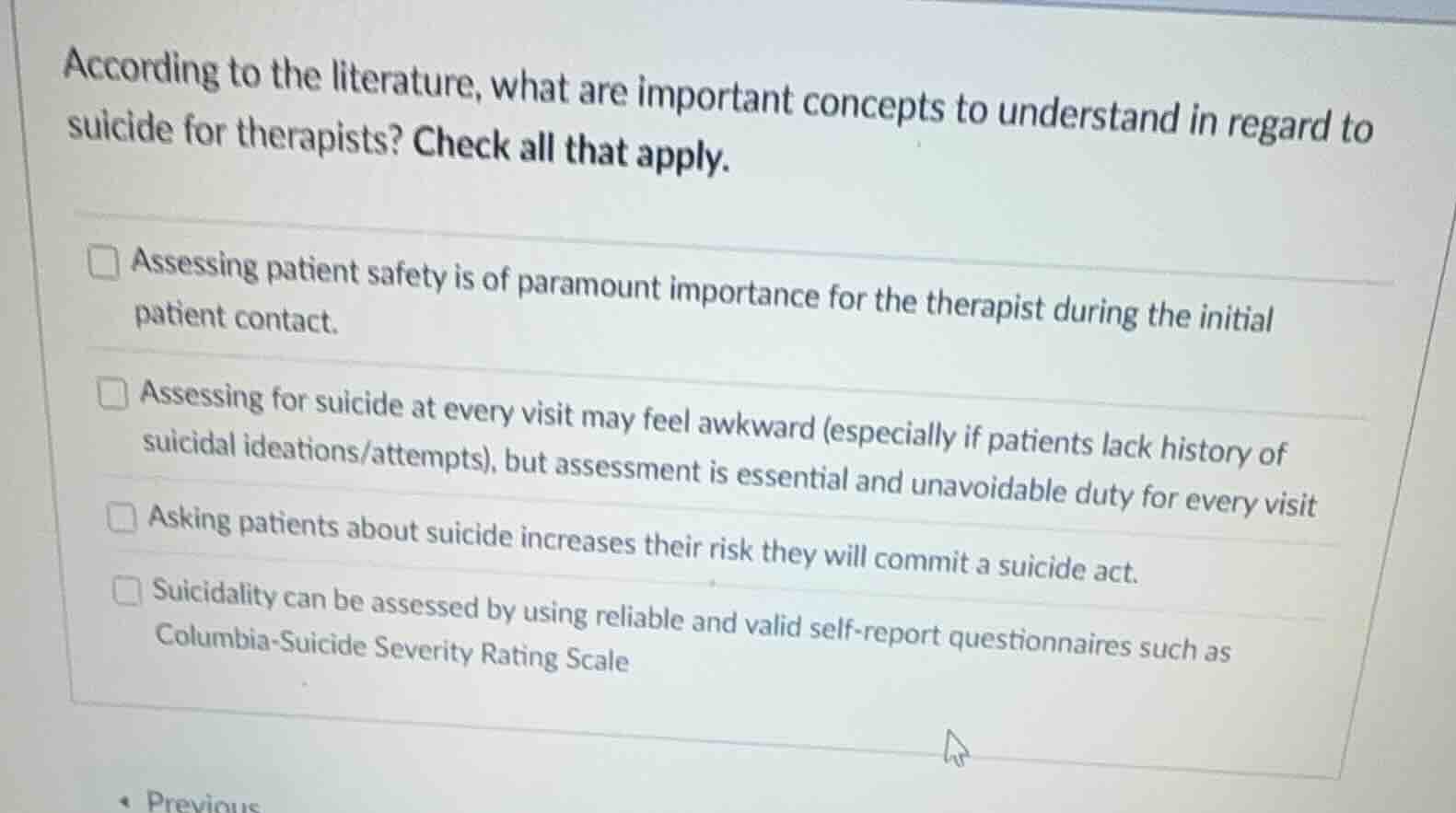
according to the literature, what are important concepts to understand in regard to suicide for therapists? check all that apply.
assessing patient safety is of paramount importance for the therapist during the initial patient contact.
assessing for suicide at every visit may feel awkward (especially if patients lack history of suicidal ideations/attempts), but assessment is essential and unavoidable duty for every visit
asking patients about suicide increases their risk they will commit a suicide act.
suicidality can be assessed by using reliable and valid self-report questionnaires such as columbia-suicide severity rating scale
🆕 New Concept Discovered: Clinical Suicide Risk Assessment
Best practices for evaluating and managing self-harm risk.
Step 1: Evaluate the first statement
- Statement: "Assessing patient safety is of paramount importance for the therapist during the initial patient contact."
- Analysis: In clinical practice and literature, establishing safety is the foundational first step of any therapeutic relationship. During the initial intake or contact, a therapist must determine if the patient is in immediate danger to themselves or others to decide the appropriate level of care.
- Conclusion: True (Select this option).
Step 2: Evaluate the second statement
- Statement: "Assessing for suicide at every visit may feel awkward (especially if patients lack history of suicidal ideations/attempts), but assessment is essential and unavoidable duty for every visit."
- Analysis: Standard clinical guidelines emphasize that suicide risk is dynamic and can change rapidly. Even if a patient has no prior history, therapists have an ongoing ethical and professional duty to monitor and assess safety regularly, particularly when there are changes in life circumstances or clinical presentation.
- Conclusion: True (Select this option).
Step 3: Evaluate the third statement
- Statement: "Asking patients about suicide increases their risk they will commit a suicide act."
- Analysis: This is a well-known myth in psychology and psychiatry. Extensive empirical literature has demonstrated that asking directly about suicidal ideation does not induce or increase suicidal thoughts or behaviors; rather, it often provides relief and opens a safe space for communication.
- Conclusion: False (Do not select this option).
Step 4: Evaluate the fourth statement
- Statement: "Suicidality can be assessed by using reliable and valid self-report questionnaires such as Columbia-Suicide Severity Rating Scale"
- Analysis: The Columbia-Suicide Severity Rating Scale (C-SSRS) is widely recognized in clinical literature as a highly reliable and valid tool used to evaluate both suicidal ideation and behavior.
- Conclusion: True (Select this option).

Snap & solve any problem in the app
Get step-by-step solutions on Sovi AI
Photo-based solutions with guided steps
Explore more problems and detailed explanations
The correct options to check are:
- [x] Assessing patient safety is of paramount importance for the therapist during the initial patient contact.
- [x] Assessing for suicide at every visit may feel awkward (especially if patients lack history of suicidal ideations/attempts), but assessment is essential and unavoidable duty for every visit.
- [x] Suicidality can be assessed by using reliable and valid self-report questionnaires such as Columbia-Suicide Severity Rating Scale