QUESTION IMAGE
Question
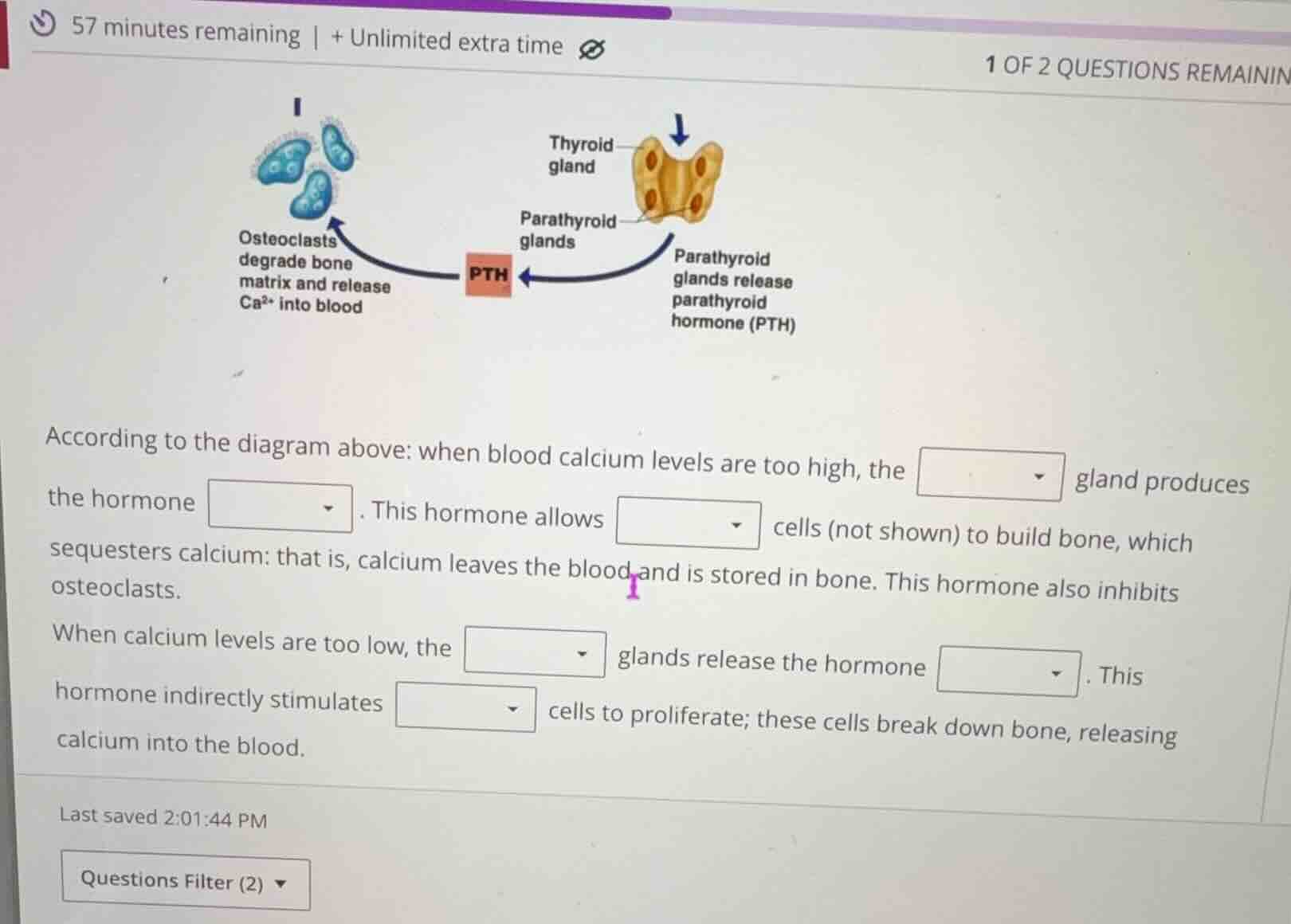
according to the diagram above: when blood calcium levels are too high, the dropdown gland produces the hormone dropdown. this hormone allows dropdown cells (not shown) to build bone, which sequesters calcium: that is, calcium leaves the blood and is stored in bone. this hormone also inhibits osteoclasts.
when calcium levels are too low, the dropdown glands release the hormone dropdown. this hormone indirectly stimulates dropdown cells to proliferate; these cells break down bone, releasing calcium into the blood.
🆕 New Concept Discovered: Calcium Homeostasis Feedback Loops
How the body balances blood calcium levels using opposing hormones.
Step 1: High Blood Calcium Regulation
When blood calcium levels are too high, the body needs to lower them by storing calcium in the bones.
- Gland and Hormone: The thyroid gland senses high calcium levels and produces the hormone calcitonin (which acts in opposition to parathyroid hormone).
- Target Cells: Calcitonin stimulates osteoblast cells (the bone-building cells, which are not shown in the diagram) to take calcium out of the blood and deposit it into the bone matrix. It also inhibits osteoclasts (bone-destroying cells) to prevent further calcium release.
Step 2: Low Blood Calcium Regulation
When blood calcium levels are too low, the body must release stored calcium back into the bloodstream.
- Gland and Hormone: As shown in the diagram, the parathyroid glands release the hormone parathyroid hormone (PTH).
- Target Cells: PTH indirectly stimulates osteoclast cells to proliferate and degrade the bone matrix, which releases \( \text{Ca}^{2+} \) ions back into the blood.
---

Snap & solve any problem in the app
Get step-by-step solutions on Sovi AI
Photo-based solutions with guided steps
Explore more problems and detailed explanations
According to the diagram above: when blood calcium levels are too high, the thyroid gland produces the hormone calcitonin. This hormone allows osteoblast cells (not shown) to build bone, which sequesters calcium: that is, calcium leaves the blood and is stored in bone. This hormone also inhibits osteoclasts.
When calcium levels are too low, the parathyroid glands release the hormone parathyroid hormone (PTH). This hormone indirectly stimulates osteoclast cells to proliferate; these cells break down bone, releasing calcium into the blood.