QUESTION IMAGE
Question
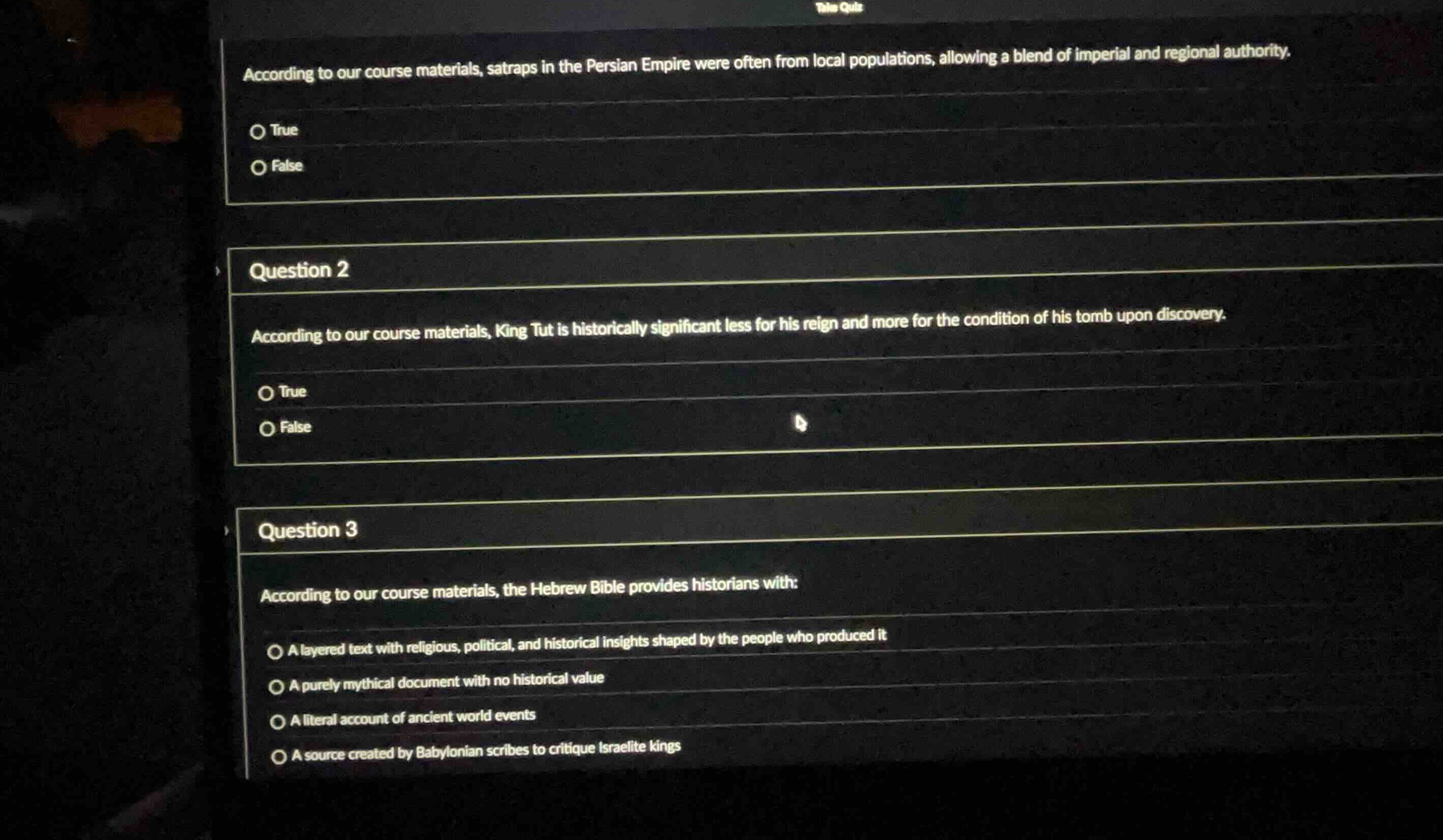
according to our course materials, satraps in the persian empire were often from local populations, allowing a blend of imperial and regional authority.
true
false
question 2
according to our course materials, king tut is historically significant less for his reign and more for the condition of his tomb upon discovery.
true
false
question 3
according to our course materials, the hebrew bible provides historians with:
a layered text with religious, political, and historical insights shaped by the people who produced it
a purely mythical document with no historical value
a literal account of ancient world events
a source created by babylonian scribes to critique israelite kings
Analyze Persian satraps and local authority
Satraps in the Achaemenid Persian Empire were typically royal family members or high-ranking Persian nobles appointed by the king, rather than members of the local conquered populations, to ensure loyalty and centralized control.
Analyze King Tutankhamun's historical significance
King Tutankhamun died young and had a relatively minor reign with limited geopolitical impact, but his significance skyrocketed because his tomb (KV62) was discovered nearly intact in 1922, providing unprecedented archaeological evidence.
Analyze the historical value of the Hebrew Bible
Modern historical methodology views the Hebrew Bible not as a literal transcription or a purely mythical text, but as a complex, multi-layered document reflecting the evolving religious, political, and cultural perspectives of its ancient authors.

Snap & solve any problem in the app
Get step-by-step solutions on Sovi AI
Photo-based solutions with guided steps
Explore more problems and detailed explanations
Question 1
- True
- False (Correct answer)
Question 2
- True (Correct answer)
- False
Question 3
- A layered text with religious, political, and historical insights shaped by the people who produced it (Correct answer)
- A purely mythical document with no historical value
- A literal account of ancient world events
- A source created by Babylonian scribes to critique Israelite kings