QUESTION IMAGE
Question
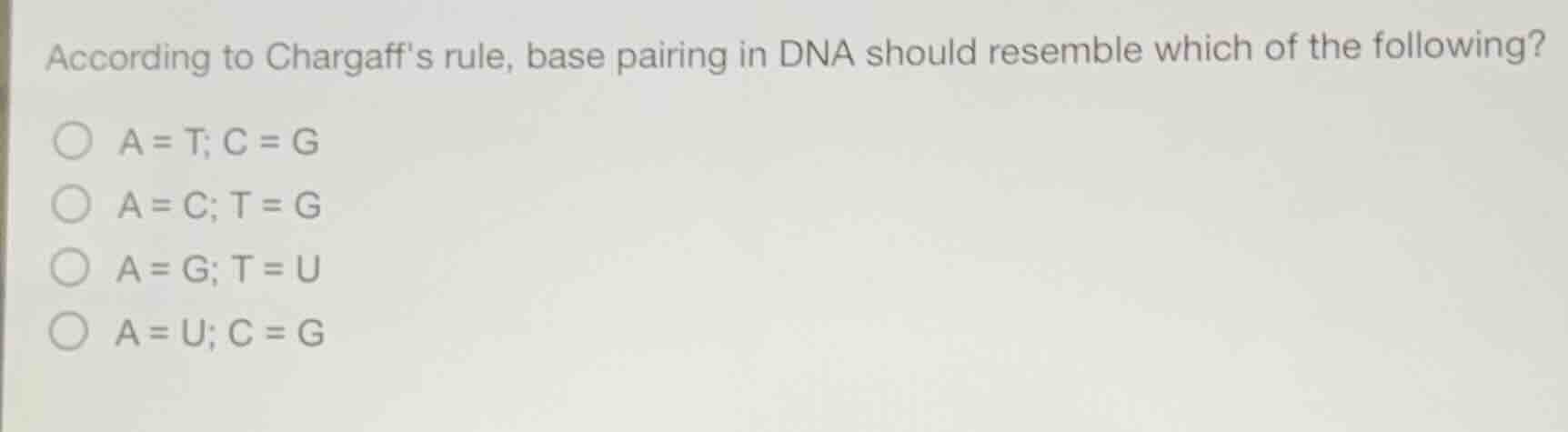
according to chargaffs rule, base pairing in dna should resemble which of the following?
\\(a = t; c = g\\)
\\(a = c; t = g\\)
\\(a = g; t = u\\)
\\(a = u; c = g\\)
<pre_analysis>
{
"quality": "clear",
"question_count": 1,
"skills_matched": [
"direct_cot",
"multiple_choice_formatter",
"explain_then_answer",
"quick"
],
"needs_drawing": false,
"concepts_used": [
"DNA Base Pairing"
],
"new_concepts": [],
"current_concepts": [
"DNA Base Pairing",
"DNA Structure",
"Nitrogenous Bases"
]
}
</pre_analysis>
<reasoning>
Identify the core principle of Chargaff's rules
Chargaff's rules state that in DNA, the amount of adenine (A) equals thymine (T), and the amount of cytosine (C) equals guanine (G).
Match the rules to base pairing
This 1:1 ratio reflects the specific complementary base pairing where adenine pairs with thymine, and cytosine pairs with guanine.
Evaluate the given options
- \(A = T; C = G\): Correctly represents Chargaff's rules.
- \(A = C; T = G\): Incorrect pairing.
- \(A = G; T = U\): Incorrect pairing, and uracil (U) is found in RNA, not DNA.
- \(A = U; C = G\): Uracil (U) is not a standard base in DNA.
</reasoning>
<answer>
<mcq-correct>(A) A = T; C = G</mcq-correct>
<mcq-option>(B) A = C; T = G</mcq-option>
<mcq-option>(C) A = G; T = U</mcq-option>
<mcq-option>(D) A = U; C = G</mcq-option>
</answer>
<post_analysis>
{
"subject": "Natural Science",
"question_type": "Multiple Choice",
"knowledge_point": [
"Natural Science",
"Biology",
"DNA Base Pairing"
]
}
</post_analysis>
Snap & solve any problem in the app
Get step-by-step solutions on Sovi AI
Photo-based solutions with guided steps
Explore more problems and detailed explanations
<pre_analysis>
{
"quality": "clear",
"question_count": 1,
"skills_matched": [
"direct_cot",
"multiple_choice_formatter",
"explain_then_answer",
"quick"
],
"needs_drawing": false,
"concepts_used": [
"DNA Base Pairing"
],
"new_concepts": [],
"current_concepts": [
"DNA Base Pairing",
"DNA Structure",
"Nitrogenous Bases"
]
}
</pre_analysis>
<reasoning>
Identify the core principle of Chargaff's rules
Chargaff's rules state that in DNA, the amount of adenine (A) equals thymine (T), and the amount of cytosine (C) equals guanine (G).
Match the rules to base pairing
This 1:1 ratio reflects the specific complementary base pairing where adenine pairs with thymine, and cytosine pairs with guanine.
Evaluate the given options
- \(A = T; C = G\): Correctly represents Chargaff's rules.
- \(A = C; T = G\): Incorrect pairing.
- \(A = G; T = U\): Incorrect pairing, and uracil (U) is found in RNA, not DNA.
- \(A = U; C = G\): Uracil (U) is not a standard base in DNA.
</reasoning>
<answer>
<mcq-correct>(A) A = T; C = G</mcq-correct>
<mcq-option>(B) A = C; T = G</mcq-option>
<mcq-option>(C) A = G; T = U</mcq-option>
<mcq-option>(D) A = U; C = G</mcq-option>
</answer>
<post_analysis>
{
"subject": "Natural Science",
"question_type": "Multiple Choice",
"knowledge_point": [
"Natural Science",
"Biology",
"DNA Base Pairing"
]
}
</post_analysis>