QUESTION IMAGE
Question
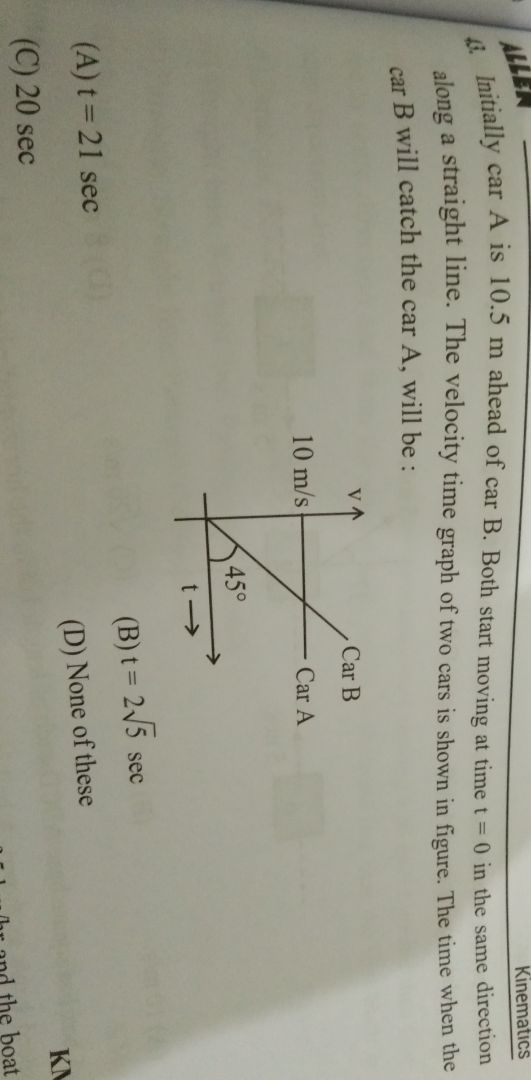
- initially car a is (10.5\text{ m}) ahead of car b. both start moving at time (t = 0) in the same direction along a straight line. the velocity time graph of two cars is shown in figure. the time when the car b will catch the car a, will be :
(a) (t = 21\text{ sec})
(b) (t = 2\sqrt{5}\text{ sec})
(c) (t = 20\text{ sec})
(d) none of these
🆕 New Concept Discovered: Relative Motion and Area under v-t Graph
Using relative displacement and velocity-time graph geometry to find catch-up time.
Step 1: Understand the Motion of Car A
Car A has a constant velocity because its line on the velocity-time graph is horizontal.
The displacement of Car A at any time \( t \) is the area under its \( v\text{-}t \) graph:
Step 2: Determine the Motion of Car B
The velocity of Car B starts from \( 0 \) at \( t = 0 \) and increases linearly. The line makes an angle of \( 45^\circ \) with the vertical velocity axis (\( v \)-axis).
This means the angle with the horizontal time axis (\( t \)-axis) is:
The acceleration \( a_B \) of Car B is the slope of its \( v\text{-}t \) line:
Since Car B starts from rest (\( u_B = 0 \)), its displacement at any time \( t \) is:
Step 3: Set up the Catch-up Condition
Initially, Car A is \( 10.5\text{ m} \) ahead of Car B. For Car B to catch Car A, the displacement of Car B must equal the displacement of Car A plus this initial gap:
Substitute the displacement expressions into the equation:
Step 4: Solve the Quadratic Equation
Multiply the entire equation by \( 2 \) to clear the decimal:
Factor the quadratic equation:
This gives two possible solutions for \( t \):
Since time \( t \) must be positive, we choose:

Snap & solve any problem in the app
Get step-by-step solutions on Sovi AI
Photo-based solutions with guided steps
Explore more problems and detailed explanations
(A) t = 21 sec