QUESTION IMAGE
Question
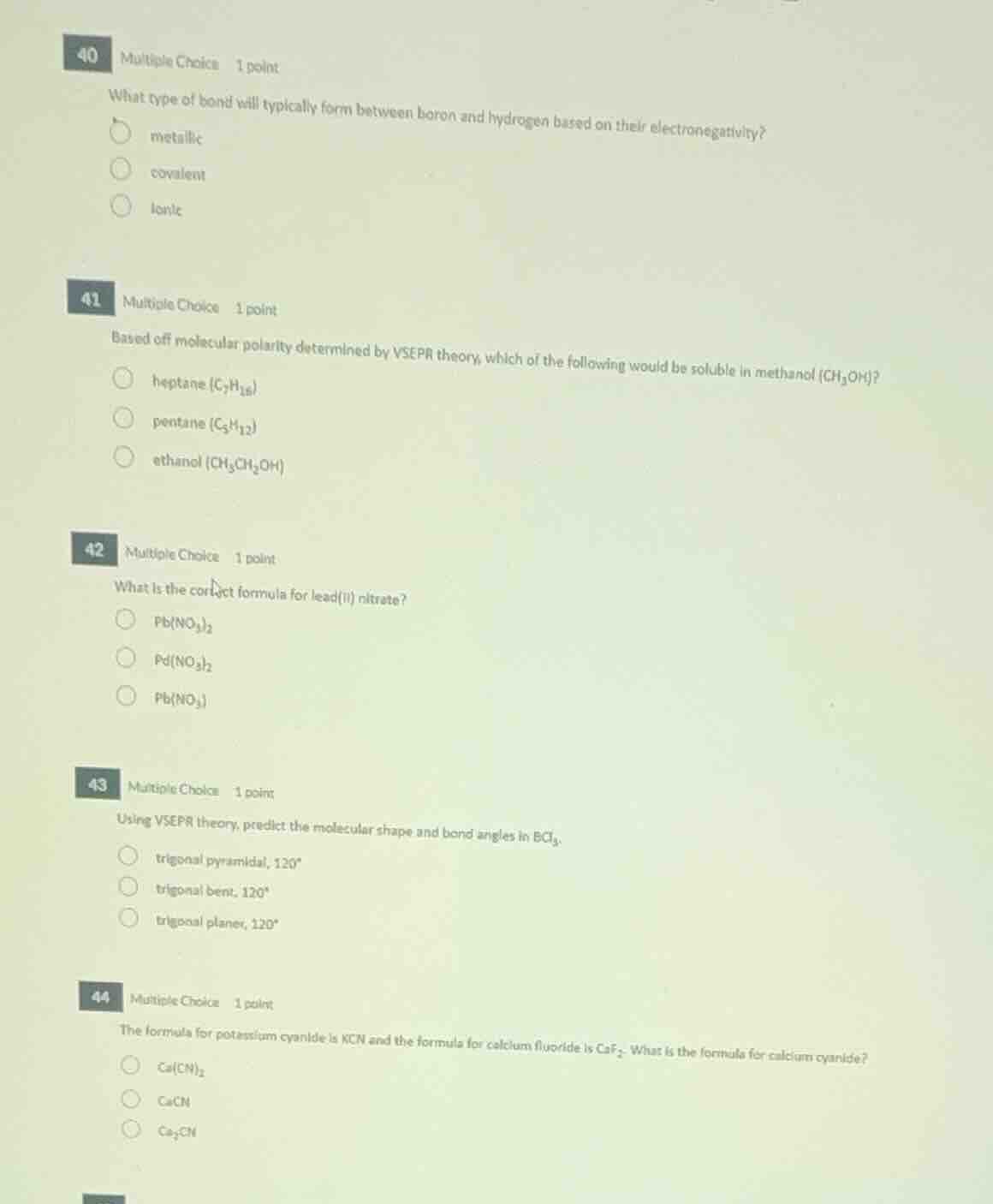
40 multiple choice 1 point
what type of bond will typically form between boron and hydrogen based on their electronegativity?
metallic
covalent
ionic
41 multiple choice 1 point
based off molecular polarity determined by vsepr theory, which of the following would be soluble in methanol (\\(\text{ch}_3\text{oh}\\))?
heptane (\\(\text{c}_7\text{h}_{16}\\))
pentane (\\(\text{c}_5\text{h}_{12}\\))
ethanol (\\(\text{ch}_3\text{ch}_2\text{oh}\\))
42 multiple choice 1 point
what is the correct formula for lead(ii) nitrate?
\\(\text{pb}(\text{no}_3)_2\\)
\\(\text{pd}(\text{no}_3)_2\\)
\\(\text{pb}(\text{no}_3)\\)
43 multiple choice 1 point
using vsepr theory, predict the molecular shape and bond angles in \\(\text{bcl}_3\\).
trigonal pyramidal, \\(120^\circ\\)
trigonal bent, \\(120^\circ\\)
trigonal planar, \\(120^\circ\\)
44 multiple choice 1 point
the formula for potassium cyanide is \\(\text{kcn}\\) and the formula for calcium fluoride is \\(\text{caf}_2\\). what is the formula for calcium cyanide?
\\(\text{ca}(\text{cn})_2\\)
\\(\text{cacn}\\)
\\(\text{ca}_2\text{cn}\\)
Analyze bond type between boron and hydrogen
Using the Covalent Bond Sharing knowledge point:
Boron (\(\text{B}\)) has an electronegativity of approximately \(2.04\), and hydrogen (\(\text{H}\)) is \(2.20\). The electronegativity difference is very small (\(0.16\)), meaning electrons are shared relatively equally. Therefore, they typically form a covalent bond.
Determine solubility in methanol
Using the VSEPR Theory knowledge point:
Methanol (\(\text{CH}_3\text{OH}\)) is a highly polar solvent capable of hydrogen bonding. According to the "like dissolves like" rule, polar solutes dissolve in polar solvents. Ethanol (\(\text{CH}_3\text{CH}_2\text{OH}\)) is polar and can hydrogen bond, making it highly soluble in methanol, whereas heptane and pentane are nonpolar hydrocarbons.
Determine formula for lead(II) nitrate
Using the Chemical Nomenclature knowledge point:
Lead(II) indicates a \(\text{Pb}^{2+}\) cation. Nitrate is a polyatomic anion with the formula \(\text{NO}_3^-\). To balance the charges, two nitrate ions are needed for every lead(II) ion, yielding \(\text{Pb(NO}_3)_2\).
Predict molecular shape of BCl3
Using the VSEPR Theory knowledge point:
Boron has 3 valence electrons and forms 3 single bonds with chlorine atoms, leaving no lone pairs on the central boron atom. This steric number of 3 results in a trigonal planar geometry with ideal bond angles of \(120^\circ\).
Determine formula for calcium cyanide
Using the Chemical Nomenclature knowledge point:
From \(\text{KCN}\), we identify the cyanide ion as \(\text{CN}^-\). From \(\text{CaF}_2\), we identify the calcium ion as \(\text{Ca}^{2+}\). Combining one \(\text{Ca}^{2+}\) with two \(\text{CN}^-\) to balance the charge gives \(\text{Ca(CN)}_2\).

Snap & solve any problem in the app
Get step-by-step solutions on Sovi AI
Photo-based solutions with guided steps
Explore more problems and detailed explanations
Question 40
- metallic
- covalent (Correct answer)
- ionic
Question 41
- heptane (\(\text{C}_7\text{H}_{16}\))
- pentane (\(\text{C}_5\text{H}_{12}\))
- ethanol (\(\text{CH}_3\text{CH}_2\text{OH}\)) (Correct answer)
Question 42
- \(\text{Pb(NO}_3)_2\) (Correct answer)
- \(\text{Pd(NO}_3)_2\)
- \(\text{Pb(NO}_3)\)
Question 43
- trigonal pyramidal, \(120^\circ\)
- trigonal bent, \(120^\circ\)
- trigonal planar, \(120^\circ\) (Correct answer)
Question 44
- \(\text{Ca(CN)}_2\) (Correct answer)
- \(\text{CaCN}\)
- \(\text{Ca}_2\text{CN}\)