Sovi.AI - AI Math Tutor

Scan to solve math questions

QUESTION IMAGE

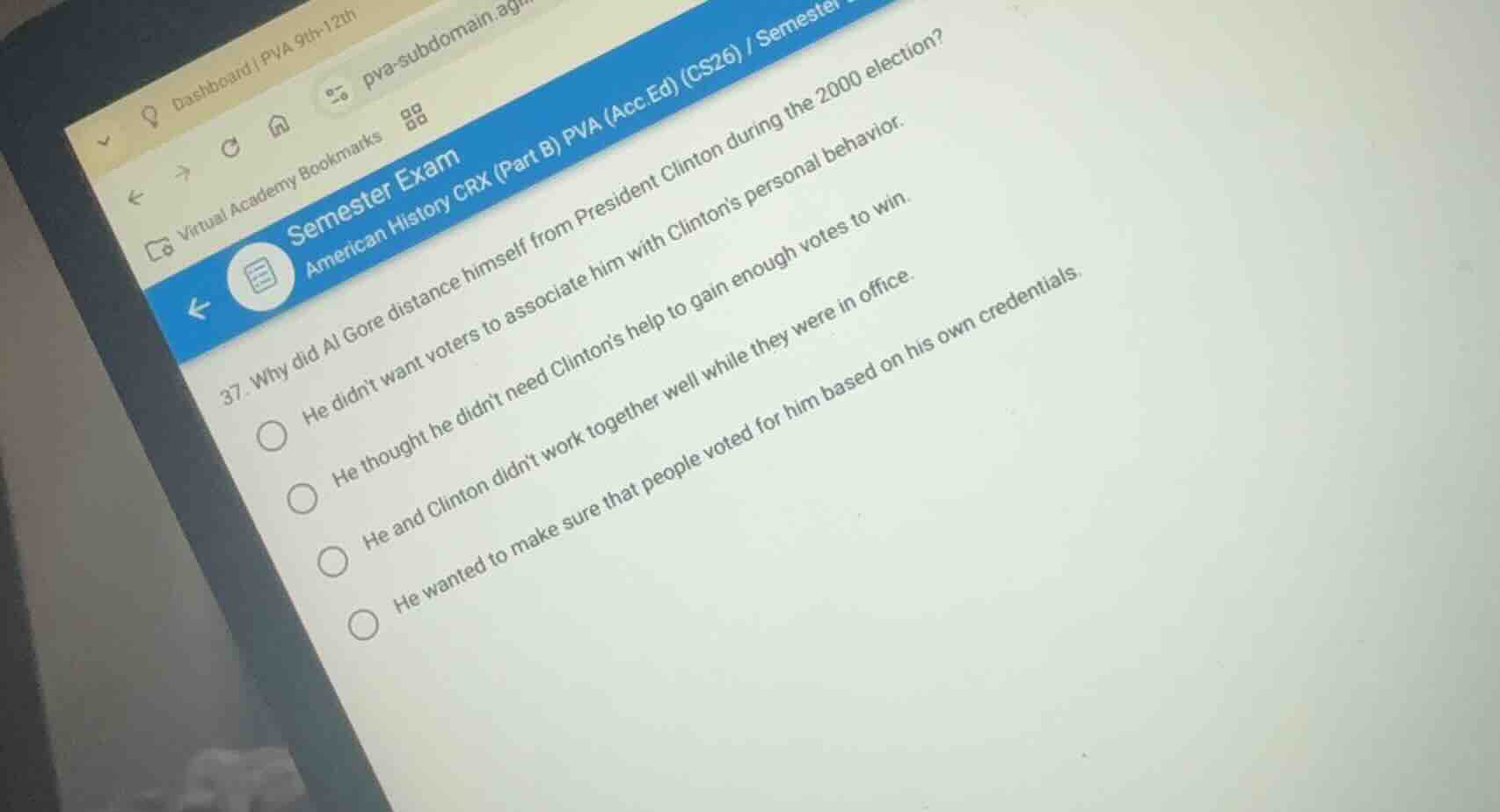
37. why did al gore distance himself from president clinton during the …

Question

  1. why did al gore distance himself from president clinton during the 2000 election?

he didnt want voters to associate him with clintons personal behavior.
he thought he didnt need clintons help to gain enough votes to win.
he and clinton didnt work together well while they were in office.
he wanted to make sure that people voted for him based on his own credentials.

Explanation:

Response

<pre_analysis>
{
"quality": "clear",
"question_count": 1,
"skills_matched": [
"direct_cot",
"multiple_choice_formatter",
"explain_then_answer",
"tutor"
],
"needs_drawing": false,
"concepts_used": [
"Clinton Impeachment"
],
"new_concepts": [
"2000 Presidential Election",
"Al Gore Campaign Strategy"
],
"current_concepts": [
"Clinton Impeachment",
"2000 Presidential Election",
"Al Gore Campaign Strategy"
]
}
</pre_analysis>

<reasoning>

Analyze the historical context

During the 2000 presidential election, Vice President Al Gore ran as the Democratic nominee. While President Bill Clinton's economic record was highly popular, his second term had been severely overshadowed by personal scandals, leading to the Clinton Impeachment process.

Evaluate Gore's campaign strategy

To win over moderate and swing voters, Al Gore made a strategic decision to distance himself from Bill Clinton. He feared that Clinton's personal conduct and the scandals surrounding his presidency would alienate voters who valued moral character and personal integrity in public office.

Assess the given options

  • Option 1: "He didn't want voters to associate him with Clinton's personal behavior." This directly aligns with the historical consensus that Gore wanted to avoid the moral fallout of Clinton's scandals.
  • Option 2: "He thought he didn't need Clinton's help to gain enough votes to win." This is incorrect; Gore knew the race would be extremely tight.
  • Option 3: "He and Clinton didn't work together well while they were in office." This is incorrect; they had a highly collaborative and productive working relationship for eight years.
  • Option 4: "He wanted to make sure that people voted for him based on his own credentials." While partially true in a general sense, the primary strategic reason for actively distancing himself was to avoid the negative associations with Clinton's personal scandals.

</reasoning>

<answer>
<mcq-correct>(A) He didn't want voters to associate him with Clinton's personal behavior.</mcq-correct>
<mcq-option>(B) He thought he didn't need Clinton's help to gain enough votes to win.</mcq-option>
<mcq-option>(C) He and Clinton didn't work together well while they were in office.</mcq-option>
<mcq-option>(D) He wanted to make sure that people voted for him based on his own credentials.</mcq-option>
</answer>

<post_analysis>
{
"subject": "Social Science",
"question_type": "Multiple Choice",
"knowledge_point": [
"Social Science",
"U.S. History",
"2000 Presidential Election"
]
}
</post_analysis>

Answer:

<pre_analysis>
{
"quality": "clear",
"question_count": 1,
"skills_matched": [
"direct_cot",
"multiple_choice_formatter",
"explain_then_answer",
"tutor"
],
"needs_drawing": false,
"concepts_used": [
"Clinton Impeachment"
],
"new_concepts": [
"2000 Presidential Election",
"Al Gore Campaign Strategy"
],
"current_concepts": [
"Clinton Impeachment",
"2000 Presidential Election",
"Al Gore Campaign Strategy"
]
}
</pre_analysis>

<reasoning>

Analyze the historical context

During the 2000 presidential election, Vice President Al Gore ran as the Democratic nominee. While President Bill Clinton's economic record was highly popular, his second term had been severely overshadowed by personal scandals, leading to the Clinton Impeachment process.

Evaluate Gore's campaign strategy

To win over moderate and swing voters, Al Gore made a strategic decision to distance himself from Bill Clinton. He feared that Clinton's personal conduct and the scandals surrounding his presidency would alienate voters who valued moral character and personal integrity in public office.

Assess the given options

  • Option 1: "He didn't want voters to associate him with Clinton's personal behavior." This directly aligns with the historical consensus that Gore wanted to avoid the moral fallout of Clinton's scandals.
  • Option 2: "He thought he didn't need Clinton's help to gain enough votes to win." This is incorrect; Gore knew the race would be extremely tight.
  • Option 3: "He and Clinton didn't work together well while they were in office." This is incorrect; they had a highly collaborative and productive working relationship for eight years.
  • Option 4: "He wanted to make sure that people voted for him based on his own credentials." While partially true in a general sense, the primary strategic reason for actively distancing himself was to avoid the negative associations with Clinton's personal scandals.

</reasoning>

<answer>
<mcq-correct>(A) He didn't want voters to associate him with Clinton's personal behavior.</mcq-correct>
<mcq-option>(B) He thought he didn't need Clinton's help to gain enough votes to win.</mcq-option>
<mcq-option>(C) He and Clinton didn't work together well while they were in office.</mcq-option>
<mcq-option>(D) He wanted to make sure that people voted for him based on his own credentials.</mcq-option>
</answer>

<post_analysis>
{
"subject": "Social Science",
"question_type": "Multiple Choice",
"knowledge_point": [
"Social Science",
"U.S. History",
"2000 Presidential Election"
]
}
</post_analysis>