QUESTION IMAGE
Question
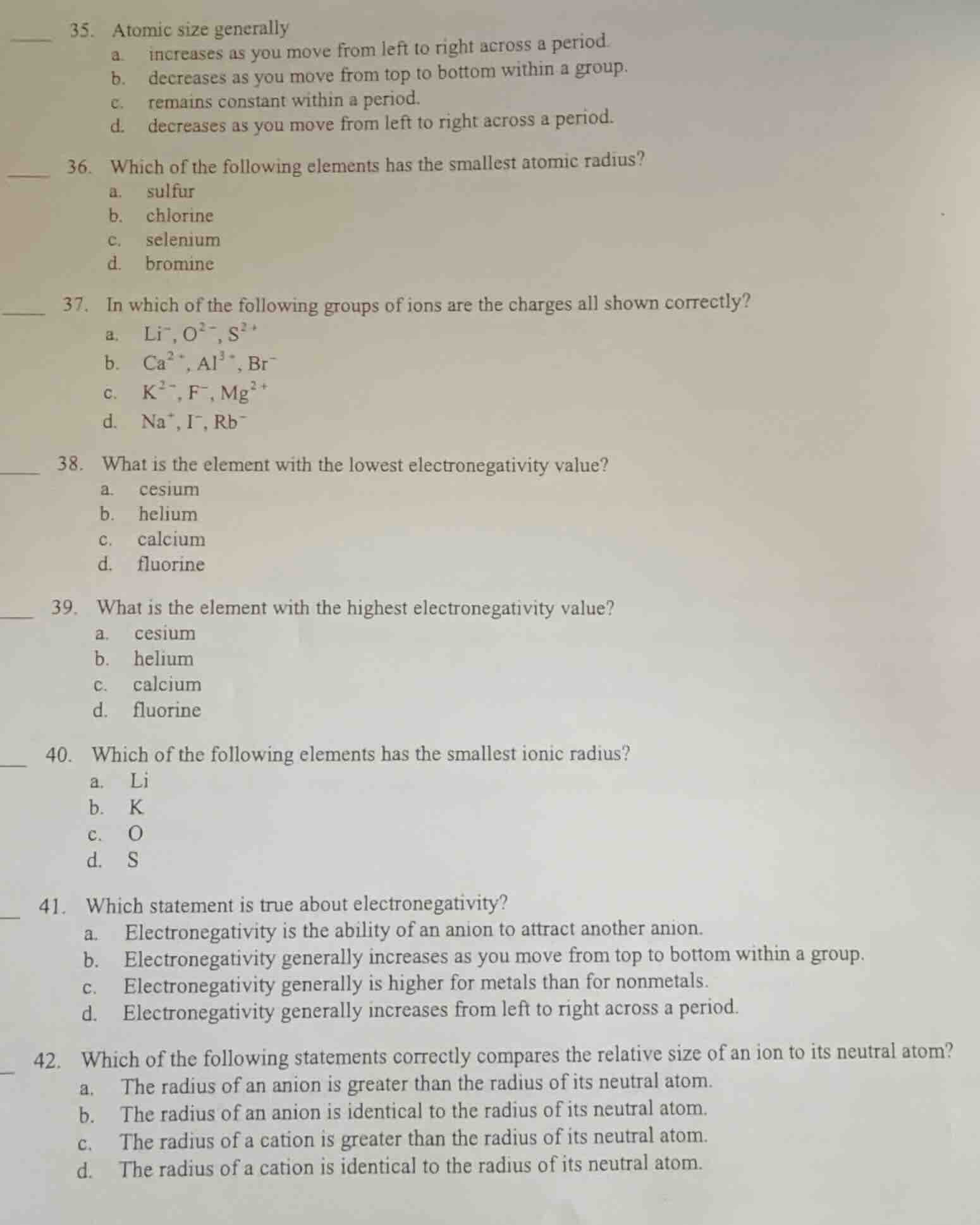
- atomic size generally
a. increases as you move from left to right across a period.
b. decreases as you move from top to bottom within a group.
c. remains constant within a period.
d. decreases as you move from left to right across a period.
- which of the following elements has the smallest atomic radius?
a. sulfur
b. chlorine
c. selenium
d. bromine
- in which of the following groups of ions are the charges all shown correctly?
a. \\(\text{li}^{-}\\), \\(\text{o}^{2-}\\), \\(\text{s}^{2+}\\)
b. \\(\text{ca}^{2+}\\), \\(\text{al}^{3+}\\), \\(\text{br}^{-}\\)
c. \\(\text{k}^{2-}\\), \\(\text{f}^{-}\\), \\(\text{mg}^{2+}\\)
d. \\(\text{na}^{+}\\), \\(\text{i}^{-}\\), \\(\text{rb}^{-}\\)
- what is the element with the lowest electronegativity value?
a. cesium
b. helium
c. calcium
d. fluorine
- what is the element with the highest electronegativity value?
a. cesium
b. helium
c. calcium
d. fluorine
- which of the following elements has the smallest ionic radius?
a. li
b. k
c. o
d. s
- which statement is true about electronegativity?
a. electronegativity is the ability of an anion to attract another anion.
b. electronegativity generally increases as you move from top to bottom within a group.
c. electronegativity generally is higher for metals than for nonmetals.
d. electronegativity generally increases from left to right across a period.
- which of the following statements correctly compares the relative size of an ion to its neutral atom?
a. the radius of an anion is greater than the radius of its neutral atom.
b. the radius of an anion is identical to the radius of its neutral atom.
c. the radius of a cation is greater than the radius of its neutral atom.
d. the radius of a cation is identical to the radius of its neutral atom.
Analyze atomic size trends
Using the Periodic Table Trends knowledge point
- Atomic size decreases from left to right across a period due to increasing effective nuclear charge drawing electrons closer.
- Atomic size increases from top to bottom down a group as new electron shells are added.
- Therefore, atomic size generally decreases as you move from left to right across a period (Option d).
Compare atomic radii of specific elements
Using the Periodic Table Trends knowledge point
- The elements are sulfur (\(\text{S}\)), chlorine (\(\text{Cl}\)), selenium (\(\text{Se}\)), and bromine (\(\text{Br}\)).
- \(\text{S}\) and \(\text{Cl}\) are in Period 3; \(\text{Se}\) and \(\text{Br}\) are in Period 4. Period 3 atoms are smaller than Period 4 atoms.
- Between \(\text{S}\) and \(\text{Cl}\) in Period 3, size decreases from left to right, making \(\text{Cl}\) smaller than \(\text{S}\).
- Thus, chlorine has the smallest atomic radius (Option b).
Evaluate charges of common ions
Using the Periodic Table Trends knowledge point
- Group 1 metals form \(1+\) cations (e.g., \(\text{Li}^+\), \(\text{Na}^+\), \(\text{K}^+\), \(\text{Rb}^+\)).
- Group 2 metals form \(2+\) cations (e.g., \(\text{Ca}^{2+}\), \(\text{Mg}^{2+}\)).
- Group 13 metals form \(3+\) cations (e.g., \(\text{Al}^{3+}\)).
- Group 17 nonmetals form \(1-\) anions (e.g., \(\text{F}^-\), \(\text{Cl}^-\), \(\text{Br}^-\), \(\text{I}^-\)).
- Group 16 nonmetals form \(2-\) anions (e.g., \(\text{O}^{2-}\), \(\text{S}^{2-}\)).
- Looking at option b: \(\text{Ca}^{2+}\), \(\text{Al}^{3+}\), \(\text{Br}^-\) are all correct (Option b).
Determine electronegativity extremes
Using the Periodic Table Trends knowledge point
- Electronegativity increases up and to the right, excluding noble gases like helium which generally do not form bonds.
- Cesium (\(\text{Cs}\)) is at the bottom-left of the reactive elements, giving it the lowest electronegativity (Question 38, Option a).
- Fluorine (\(\text{F}\)) is at the top-right of the reactive elements, giving it the highest electronegativity (Question 39, Option d).
Compare ionic sizes and ion-to-atom relationships
Using the Periodic Table Trends knowledge point
- For Question 40, we compare \(\text{Li}^+\), \(\text{K}^+\), \(\text{O}^{2-}\), and \(\text{S}^{2-}\). Cations lose shells and are smaller than anions. \(\text{Li}^+\) has only 2 electrons in 1 shell, making it the smallest ionic radius (Option a).
- For Question 41, electronegativity generally increases from left to right across a period (Option d).
- For Question 42, adding electrons to form an anion increases electron-electron repulsion, making the anion radius greater than its neutral atom (Option a).

Snap & solve any problem in the app
Get step-by-step solutions on Sovi AI
Photo-based solutions with guided steps
Explore more problems and detailed explanations
Question 35
- a. increases as you move from left to right across a period.
- b. decreases as you move from top to bottom within a group.
- c. remains constant within a period.
- d. decreases as you move from left to right across a period. (Correct answer)
Question 36
- a. sulfur
- b. chlorine (Correct answer)
- c. selenium
- d. bromine
Question 37
- a. \(\text{Li}^-\), \(\text{O}^{2-}\), \(\text{S}^{2+}\)
- b. \(\text{Ca}^{2+}\), \(\text{Al}^{3+}\), \(\text{Br}^-\) (Correct answer)
- c. \(\text{K}^{2-}\), \(\text{F}^-\), \(\text{Mg}^{2+}\)
- d. \(\text{Na}^+\), \(\text{I}^-\), \(\text{Rb}^-\)
Question 38
- a. cesium (Correct answer)
- b. helium
- c. calcium
- d. fluorine
Question 39
- a. cesium
- b. helium
- c. calcium
- d. fluorine (Correct answer)
Question 40
- a. \(\text{Li}\) (Correct answer)
- b. \(\text{K}\)
- c. \(\text{O}\)
- d. \(\text{S}\)
Question 41
- a. Electronegativity is the ability of an anion to attract another anion.
- b. Electronegativity generally increases as you move from top to bottom within a group.
- c. Electronegativity generally is higher for metals than for nonmetals.
- d. Electronegativity generally increases from left to right across a period. (Correct answer)
Question 42
- a. The radius of an anion is greater than the radius of its neutral atom. (Correct answer)
- b. The radius of an anion is identical to the radius of its neutral atom.
- c. The radius of a cation is greater than the radius of its neutral atom.
- d. The radius of a cation is identical to the radius of its neutral atom.