Sovi.AI - AI Math Tutor

Scan to solve math questions

QUESTION IMAGE

26. the following shows some properties of two hydrocarbons x and y. * …

Question

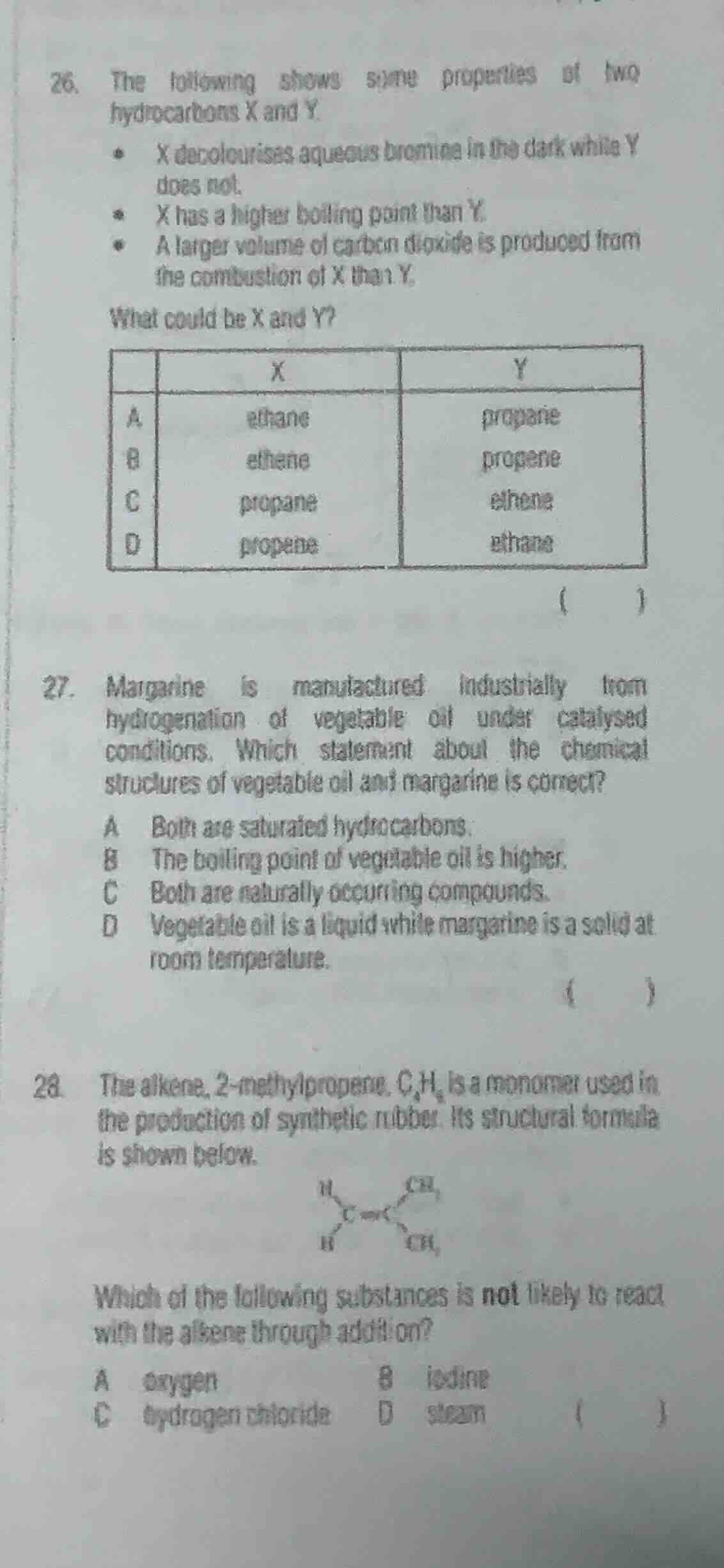
  1. the following shows some properties of two hydrocarbons x and y.
  • x decolourises aqueous bromine in the dark while y does not.
  • x has a higher boiling point than y.
  • a larger volume of carbon dioxide is produced from the combustion of x than y.

what could be x and y?
\

$$\begin{array}{|c|c|c|} \\hline & x & y \\\\ \\hline a & \\text{ethane} & \\text{propane} \\\\ b & \\text{ethene} & \\text{propene} \\\\ c & \\text{propane} & \\text{ethene} \\\\ d & \\text{propene} & \\text{ethane} \\\\ \\hline \\end{array}$$
  1. margarine is manufactured industrially from hydrogenation of vegetable oil under catalysed conditions. which statement about the chemical structures of vegetable oil and margarine is correct?

a both are saturated hydrocarbons.
b the boiling point of vegetable oil is higher.
c both are naturally occurring compounds.
d vegetable oil is a liquid while margarine is a solid at room temperature.

  1. the alkene, 2-methylpropene, \\(c_4h_8\\), is a monomer used in the production of synthetic rubber. its structural formula is shown below.

which of the following substances is not likely to react with the alkene through addition?
a oxygen
b iodine
c hydrogen chloride
d steam

Explanation:

Response

<pre_analysis>
{
"quality": "clear",
"question_count": 3,
"skills_matched": [
"direct_cot",
"multiple_choice_formatter",
"explain_then_answer",
"quick"
],
"needs_drawing": false,
"concepts_used": [
"Alkene Properties"
],
"new_concepts": [
"Hydrogenation of Fats",
"Addition Reactions of Alkenes"
],
"current_concepts": [
"Alkene Properties",
"Hydrogenation of Fats",
"Addition Reactions of Alkenes"
]
}
</pre_analysis>

<reasoning>

Analyze Question 26

  • Property 1: \(X\) decolourises aqueous bromine in the dark, so \(X\) is an unsaturated hydrocarbon (alkene). \(Y\) does not, so \(Y\) is a saturated hydrocarbon (alkane).
  • Property 2: \(X\) has a higher boiling point than \(Y\), meaning \(X\) has a larger molecular size/mass than \(Y\).
  • Property 3: A larger volume of \(\text{CO}_2\) is produced from the combustion of \(X\) than \(Y\), confirming \(X\) contains more carbon atoms per molecule than \(Y\).
  • Evaluating options:
  • (A) \(X\) is ethane (alkane), \(Y\) is propane (alkane) — Incorrect.
  • (B) \(X\) is ethene (alkene, 2 carbons), \(Y\) is propene (alkene, 3 carbons) — Incorrect.
  • (C) \(X\) is propane (alkane, 3 carbons), \(Y\) is ethene (alkene, 2 carbons) — Incorrect.
  • (D) \(X\) is propene (alkene, 3 carbons), \(Y\) is ethane (alkane, 2 carbons) — Correct.

Analyze Question 27

  • Vegetable oil contains unsaturated fatty acid chains (liquid at room temperature).
  • Hydrogenation converts unsaturated carbon-carbon double bonds into saturated single bonds, raising the melting point to make margarine a solid/semi-solid at room temperature.
  • Evaluating options:
  • (A) Both are saturated hydrocarbons — Incorrect (they are esters/triglycerides, not hydrocarbons).
  • (B) The boiling point of vegetable oil is higher — Incorrect.
  • (C) Both are naturally occurring compounds — Incorrect (margarine is synthetic/manufactured).
  • (D) Vegetable oil is a liquid while margarine is a solid at room temperature — Correct.

Analyze Question 28

  • Alkenes undergo addition reactions across the \(\text{C}=\text{C}\) double bond with halogens (iodine), hydrogen halides (hydrogen chloride), and steam (water).
  • Combustion with oxygen is an oxidation/combustion reaction, not an addition reaction.
  • Evaluating options:
  • (A) oxygen — Correct (does not react through addition).
  • (B) iodine — Incorrect (undergoes addition).
  • (C) hydrogen chloride — Incorrect (undergoes addition).
  • (D) steam — Incorrect (undergoes addition).

</reasoning>

<answer>

Question 26

<mcq-option>(A) X: ethane, Y: propane</mcq-option>
<mcq-option>(B) X: ethene, Y: propene</mcq-option>
<mcq-option>(C) X: propane, Y: ethene</mcq-option>
<mcq-correct>(D) X: propene, Y: ethane</mcq-correct>

Question 27

<mcq-option>(A) Both are saturated hydrocarbons.</mcq-option>
<mcq-option>(B) The boiling point of vegetable oil is higher.</mcq-option>
<mcq-option>(C) Both are naturally occurring compounds.</mcq-option>
<mcq-correct>(D) Vegetable oil is a liquid while margarine is a solid at room temperature.</mcq-correct>

Question 28

<mcq-correct>(A) oxygen</mcq-correct>
<mcq-option>(B) iodine</mcq-option>
<mcq-option>(C) hydrogen chloride</mcq-option>
<mcq-option>(D) steam</mcq-option>
</answer>

<post_analysis>
{
"subject": "Natural Science",
"question_type": "Multiple Choice",
"knowledge_point": [
"Natural Science",
"Chemistry",
"Organic Chemistry"
]
}
</post_analysis>

Answer:

<pre_analysis>
{
"quality": "clear",
"question_count": 3,
"skills_matched": [
"direct_cot",
"multiple_choice_formatter",
"explain_then_answer",
"quick"
],
"needs_drawing": false,
"concepts_used": [
"Alkene Properties"
],
"new_concepts": [
"Hydrogenation of Fats",
"Addition Reactions of Alkenes"
],
"current_concepts": [
"Alkene Properties",
"Hydrogenation of Fats",
"Addition Reactions of Alkenes"
]
}
</pre_analysis>

<reasoning>

Analyze Question 26

  • Property 1: \(X\) decolourises aqueous bromine in the dark, so \(X\) is an unsaturated hydrocarbon (alkene). \(Y\) does not, so \(Y\) is a saturated hydrocarbon (alkane).
  • Property 2: \(X\) has a higher boiling point than \(Y\), meaning \(X\) has a larger molecular size/mass than \(Y\).
  • Property 3: A larger volume of \(\text{CO}_2\) is produced from the combustion of \(X\) than \(Y\), confirming \(X\) contains more carbon atoms per molecule than \(Y\).
  • Evaluating options:
  • (A) \(X\) is ethane (alkane), \(Y\) is propane (alkane) — Incorrect.
  • (B) \(X\) is ethene (alkene, 2 carbons), \(Y\) is propene (alkene, 3 carbons) — Incorrect.
  • (C) \(X\) is propane (alkane, 3 carbons), \(Y\) is ethene (alkene, 2 carbons) — Incorrect.
  • (D) \(X\) is propene (alkene, 3 carbons), \(Y\) is ethane (alkane, 2 carbons) — Correct.

Analyze Question 27

  • Vegetable oil contains unsaturated fatty acid chains (liquid at room temperature).
  • Hydrogenation converts unsaturated carbon-carbon double bonds into saturated single bonds, raising the melting point to make margarine a solid/semi-solid at room temperature.
  • Evaluating options:
  • (A) Both are saturated hydrocarbons — Incorrect (they are esters/triglycerides, not hydrocarbons).
  • (B) The boiling point of vegetable oil is higher — Incorrect.
  • (C) Both are naturally occurring compounds — Incorrect (margarine is synthetic/manufactured).
  • (D) Vegetable oil is a liquid while margarine is a solid at room temperature — Correct.

Analyze Question 28

  • Alkenes undergo addition reactions across the \(\text{C}=\text{C}\) double bond with halogens (iodine), hydrogen halides (hydrogen chloride), and steam (water).
  • Combustion with oxygen is an oxidation/combustion reaction, not an addition reaction.
  • Evaluating options:
  • (A) oxygen — Correct (does not react through addition).
  • (B) iodine — Incorrect (undergoes addition).
  • (C) hydrogen chloride — Incorrect (undergoes addition).
  • (D) steam — Incorrect (undergoes addition).

</reasoning>

<answer>

Question 26

<mcq-option>(A) X: ethane, Y: propane</mcq-option>
<mcq-option>(B) X: ethene, Y: propene</mcq-option>
<mcq-option>(C) X: propane, Y: ethene</mcq-option>
<mcq-correct>(D) X: propene, Y: ethane</mcq-correct>

Question 27

<mcq-option>(A) Both are saturated hydrocarbons.</mcq-option>
<mcq-option>(B) The boiling point of vegetable oil is higher.</mcq-option>
<mcq-option>(C) Both are naturally occurring compounds.</mcq-option>
<mcq-correct>(D) Vegetable oil is a liquid while margarine is a solid at room temperature.</mcq-correct>

Question 28

<mcq-correct>(A) oxygen</mcq-correct>
<mcq-option>(B) iodine</mcq-option>
<mcq-option>(C) hydrogen chloride</mcq-option>
<mcq-option>(D) steam</mcq-option>
</answer>

<post_analysis>
{
"subject": "Natural Science",
"question_type": "Multiple Choice",
"knowledge_point": [
"Natural Science",
"Chemistry",
"Organic Chemistry"
]
}
</post_analysis>