QUESTION IMAGE
Question
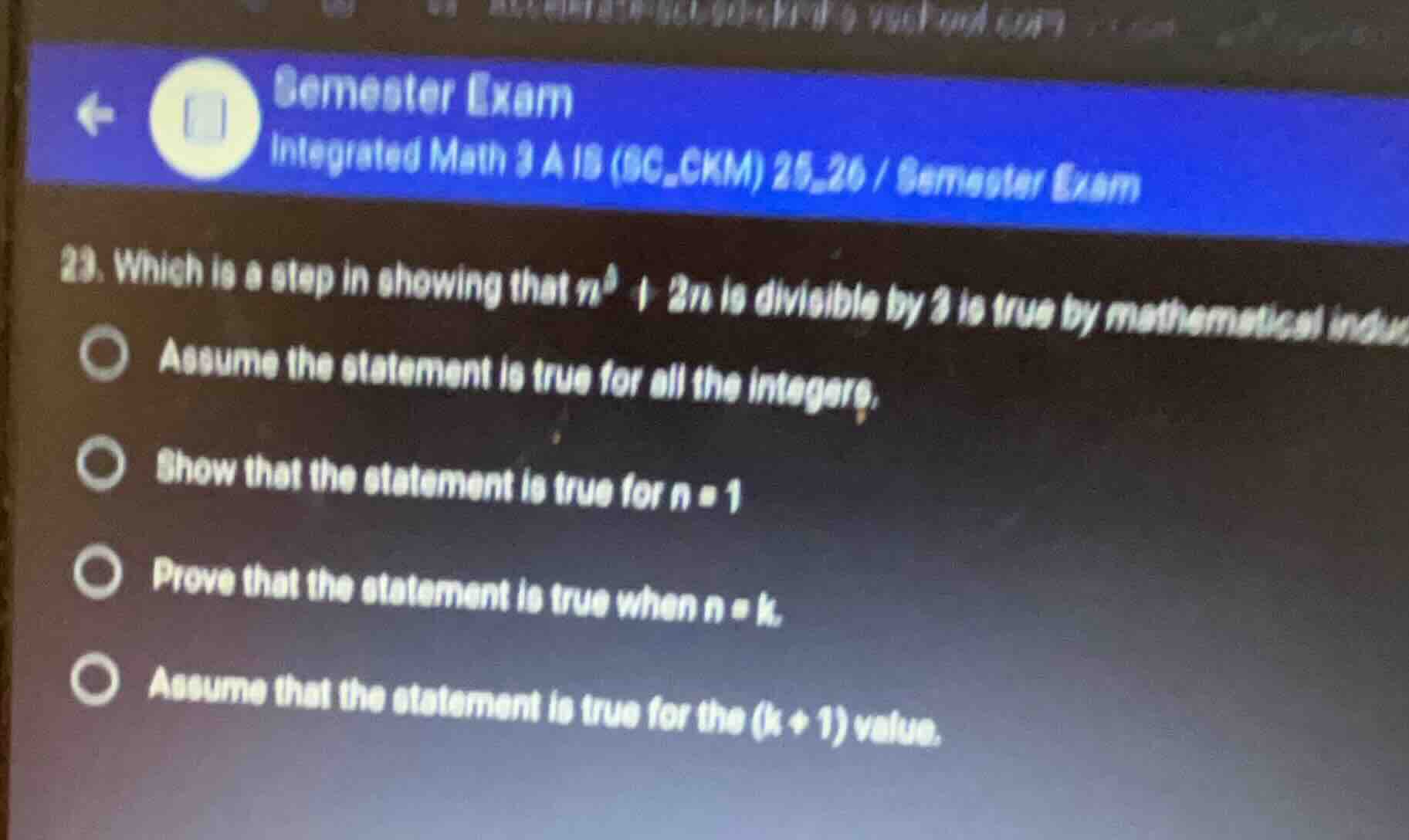
- which is a step in showing that \\(n^3 + 2n\\) is divisible by 3 is true by mathematical induction?
- assume the statement is true for all the integers.
- show that the statement is true for \\(n = 1\\)
- prove that the statement is true when \\(n = k\\).
- assume that the statement is true for the \\((k + 1)\\) value.
🆕 New Concept Discovered: Mathematical Induction
Proving statements step-by-step for all integers.
Step 1: Understand Mathematical Induction
Mathematical induction is a proof technique used to show that a statement is true for all positive integers \( n \). It consists of two main steps:
- Base Case: Show that the statement is true for the first value, typically \( n = 1 \).
- Inductive Step: Assume the statement is true for an arbitrary integer \( n = k \) (the induction hypothesis), and then prove that the statement must also be true for \( n = k + 1 \).
Step 2: Evaluate the Options
Let's analyze each of the given choices to see which one correctly describes a valid step in a proof by mathematical induction:
- "Assume the statement is true for all the integers."
- Incorrect: If we assume it is true for all integers from the start, there is nothing left to prove. We only assume it is true for a single arbitrary integer \( k \).
- "Show that the statement is true for \( n = 1 \)"
- Correct: This is the essential first step of any induction proof, known as the Base Case. For this problem, substituting \( n = 1 \) gives:
$$ 1^3 + 2(1) = 1 + 2 = 3 $$
Since \( 3 \) is divisible by \( 3 \), the base case is true.
- "Prove that the statement is true when \( n = k \)."
- Incorrect: We do not prove it is true for \( n = k \); instead, we assume it is true for \( n = k \) to help us prove the next case.
- "Assume that the statement is true for the \( (k + 1) \) value."
- Incorrect: We do not assume it is true for \( k + 1 \); this is the target statement that we must actively prove using our assumption for \( n = k \).

Snap & solve any problem in the app
Get step-by-step solutions on Sovi AI
Photo-based solutions with guided steps
Explore more problems and detailed explanations
Show that the statement is true for \( n = 1 \)