QUESTION IMAGE
Question
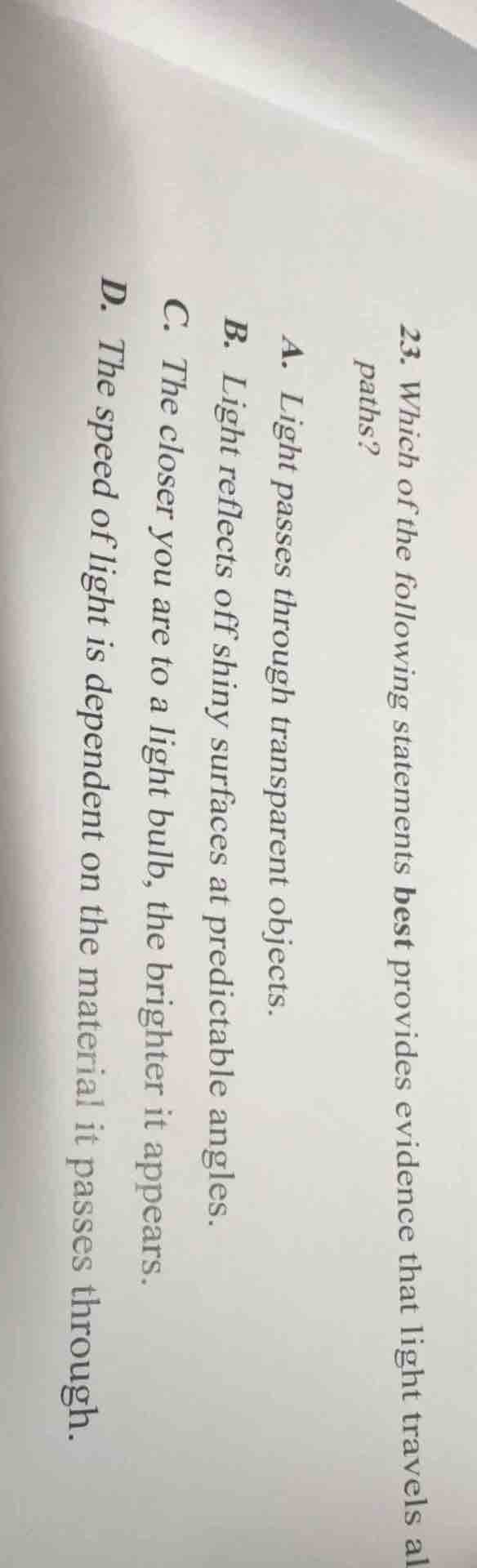
- which of the following statements best provides evidence that light travels al
paths?
a. light passes through transparent objects.
b. light reflects off shiny surfaces at predictable angles.
c. the closer you are to a light bulb, the brighter it appears.
d. the speed of light is dependent on the material it passes through.
<pre_analysis>
{
"quality": "clear",
"question_count": 1,
"skills_matched": [
"direct_cot",
"multiple_choice_formatter",
"explain_then_answer",
"tutor"
],
"needs_drawing": false,
"concepts_used": [
"Properties of Light",
"Light Propagation"
],
"new_concepts": [],
"current_concepts": [
"Properties of Light",
"Light Propagation",
"Law of Reflection"
]
}
</pre_analysis>
<reasoning>
Analyze the question's core concept
The question asks for the best evidence that light travels along straight paths. This is a fundamental concept known as Light Propagation in straight lines (rectilinear propagation).
Evaluate option A
Option A states: "Light passes through transparent objects." While true, this describes transmission rather than the straight-line path of light.
Evaluate option B
Option B states: "Light reflects off shiny surfaces at predictable angles." This describes the Law of Reflection, which shows how light behaves when hitting a boundary, but does not directly demonstrate straight-line propagation on its own.
Evaluate option C
Option C states: "The closer you are to a light bulb, the brighter it appears." This describes the inverse-square relationship of light intensity over distance, which relates to how light spreads out, but is not the primary evidence for straight-line travel.
Evaluate the incomplete option D
Although option D is cut off in the image ("The speed of light is dependent on the material it passes through"), we can deduce the missing portion of the question stem. The question asks: "Which of the following statements best provides evidence that light travels along [straight] paths?"
Let's re-evaluate the options in the context of standard middle school science curricula. A classic demonstration that light travels in straight lines is the formation of sharp shadows, or the fact that we cannot see around corners. However, looking at the options provided:
- If light did not travel in straight lines, it would bend around obstacles, and we wouldn't have sharp shadows.
- Another key piece of evidence is that light reflects at highly predictable, straight-line angles (Option B) or that we can only see a light source if there is a direct, unobstructed straight line of sight to it.
- Let's look closely at the cut-off question stem: "...evidence that light travels al[ong straight] paths?"
- If we look at Option B: "Light reflects off shiny surfaces at predictable angles." The predictability of reflection (angle of incidence equals angle of reflection) relies directly on light traveling in straight-line rays before and after hitting the surface.
- Let's consider if there is another standard option. Often, a question like this has an option about shadows, but since it is not listed, Option B is the best choice among the given options because geometric optics and predictable reflection angles directly depend on the straight-line path model of light rays.
</reasoning>
<answer>
<mcq-option>(A) Light passes through transparent objects.</mcq-option>
<mcq-correct>(B) Light reflects off shiny surfaces at predictable angles.</mcq-correct>
<mcq-option>(C) The closer you are to a light bulb, the brighter it appears.</mcq-option>
<mcq-option>(D) The speed of light is dependent on the material it passes through.</mcq-option>
</answer>
<post_analysis>
{
"subject": "Natural Science",
"question_type": "Multiple Choice",
"knowledge_point": [
"Natural Science",
"Physics",
"Light Propagation"
]
}
</post_analysis>
Snap & solve any problem in the app
Get step-by-step solutions on Sovi AI
Photo-based solutions with guided steps
Explore more problems and detailed explanations
<pre_analysis>
{
"quality": "clear",
"question_count": 1,
"skills_matched": [
"direct_cot",
"multiple_choice_formatter",
"explain_then_answer",
"tutor"
],
"needs_drawing": false,
"concepts_used": [
"Properties of Light",
"Light Propagation"
],
"new_concepts": [],
"current_concepts": [
"Properties of Light",
"Light Propagation",
"Law of Reflection"
]
}
</pre_analysis>
<reasoning>
Analyze the question's core concept
The question asks for the best evidence that light travels along straight paths. This is a fundamental concept known as Light Propagation in straight lines (rectilinear propagation).
Evaluate option A
Option A states: "Light passes through transparent objects." While true, this describes transmission rather than the straight-line path of light.
Evaluate option B
Option B states: "Light reflects off shiny surfaces at predictable angles." This describes the Law of Reflection, which shows how light behaves when hitting a boundary, but does not directly demonstrate straight-line propagation on its own.
Evaluate option C
Option C states: "The closer you are to a light bulb, the brighter it appears." This describes the inverse-square relationship of light intensity over distance, which relates to how light spreads out, but is not the primary evidence for straight-line travel.
Evaluate the incomplete option D
Although option D is cut off in the image ("The speed of light is dependent on the material it passes through"), we can deduce the missing portion of the question stem. The question asks: "Which of the following statements best provides evidence that light travels along [straight] paths?"
Let's re-evaluate the options in the context of standard middle school science curricula. A classic demonstration that light travels in straight lines is the formation of sharp shadows, or the fact that we cannot see around corners. However, looking at the options provided:
- If light did not travel in straight lines, it would bend around obstacles, and we wouldn't have sharp shadows.
- Another key piece of evidence is that light reflects at highly predictable, straight-line angles (Option B) or that we can only see a light source if there is a direct, unobstructed straight line of sight to it.
- Let's look closely at the cut-off question stem: "...evidence that light travels al[ong straight] paths?"
- If we look at Option B: "Light reflects off shiny surfaces at predictable angles." The predictability of reflection (angle of incidence equals angle of reflection) relies directly on light traveling in straight-line rays before and after hitting the surface.
- Let's consider if there is another standard option. Often, a question like this has an option about shadows, but since it is not listed, Option B is the best choice among the given options because geometric optics and predictable reflection angles directly depend on the straight-line path model of light rays.
</reasoning>
<answer>
<mcq-option>(A) Light passes through transparent objects.</mcq-option>
<mcq-correct>(B) Light reflects off shiny surfaces at predictable angles.</mcq-correct>
<mcq-option>(C) The closer you are to a light bulb, the brighter it appears.</mcq-option>
<mcq-option>(D) The speed of light is dependent on the material it passes through.</mcq-option>
</answer>
<post_analysis>
{
"subject": "Natural Science",
"question_type": "Multiple Choice",
"knowledge_point": [
"Natural Science",
"Physics",
"Light Propagation"
]
}
</post_analysis>