Sovi.AI - AI Math Tutor

Scan to solve math questions

QUESTION IMAGE

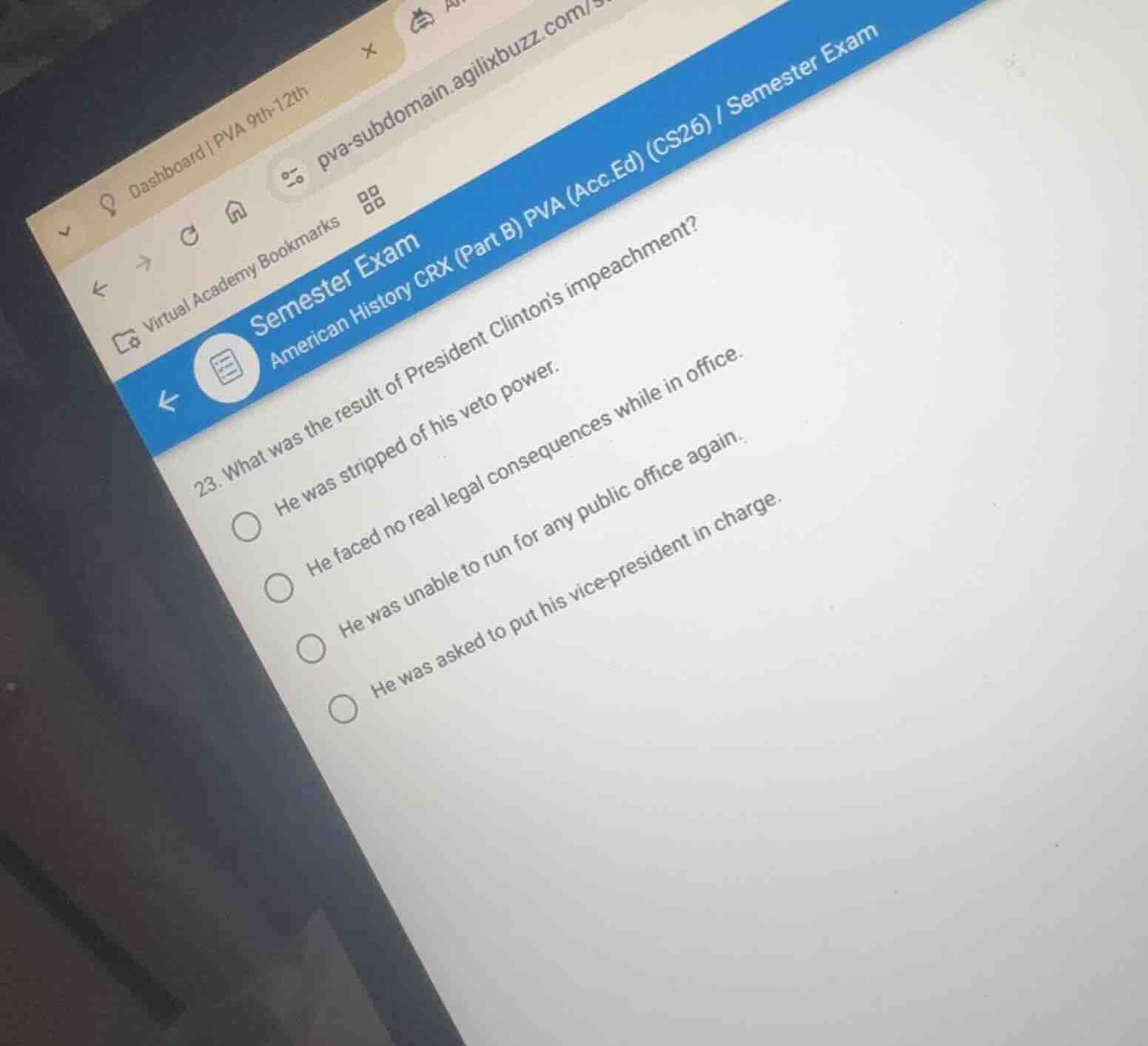
23. what was the result of president clintons impeachment? he was strip…

Question

  1. what was the result of president clintons impeachment?

he was stripped of his veto power.
he faced no real legal consequences while in office.
he was unable to run for any public office again.
he was asked to put his vice-president in charge.

Explanation:

Response

<pre_analysis>
{
"quality": "clear",
"question_count": 1,
"skills_matched": [
"direct_cot",
"multiple_choice_formatter",
"explain_then_answer",
"tutor"
],
"needs_drawing": false,
"concepts_used": [],
"new_concepts": [
"Clinton Impeachment",
"Impeachment Process",
"Presidential History"
],
"current_concepts": [
"Clinton Impeachment",
"Impeachment Process",
"Presidential History"
]
}
</pre_analysis>

<reasoning>

Analyze the constitutional process of impeachment

Impeachment by the House of Representatives is an accusation, similar to an indictment in criminal law. It does not automatically remove a president from office. To remove a president, the Senate must conduct a trial and convict the president by a two-thirds majority vote.

Examine the outcome of President Clinton's trial

In December 1998, the House of Representatives voted to impeach President Bill Clinton on charges of perjury and obstruction of justice. However, during the Senate trial in February 1999, the Senate voted to acquit him on both charges, falling short of the required two-thirds majority.

Evaluate the options based on historical facts

  • He was stripped of his veto power: Incorrect. The Constitution does not allow a president to be stripped of veto powers while remaining in office.
  • He faced no real legal consequences while in office: Correct. Because he was acquitted by the Senate, he remained in office and served out the remainder of his term without facing removal or other legal penalties while in office.
  • He was unable to run for any public office again: Incorrect. He was not convicted or disqualified from holding future office.
  • He was asked to put his vice-president in charge: Incorrect. The Vice President only takes over if the President is removed, resigns, or is temporarily disabled under the 25th Amendment.

</reasoning>

<answer>
<mcq-option>He was stripped of his veto power.</mcq-option>
<mcq-correct>He faced no real legal consequences while in office.</mcq-correct>
<mcq-option>He was unable to run for any public office again.</mcq-option>
<mcq-option>He was asked to put his vice-president in charge.</mcq-option>
</answer>

<post_analysis>
{
"subject": "Social Science",
"question_type": "Multiple Choice",
"knowledge_point": [
"Social Science",
"U.S. History",
"Clinton Impeachment"
]
}
</post_analysis>

Answer:

<pre_analysis>
{
"quality": "clear",
"question_count": 1,
"skills_matched": [
"direct_cot",
"multiple_choice_formatter",
"explain_then_answer",
"tutor"
],
"needs_drawing": false,
"concepts_used": [],
"new_concepts": [
"Clinton Impeachment",
"Impeachment Process",
"Presidential History"
],
"current_concepts": [
"Clinton Impeachment",
"Impeachment Process",
"Presidential History"
]
}
</pre_analysis>

<reasoning>

Analyze the constitutional process of impeachment

Impeachment by the House of Representatives is an accusation, similar to an indictment in criminal law. It does not automatically remove a president from office. To remove a president, the Senate must conduct a trial and convict the president by a two-thirds majority vote.

Examine the outcome of President Clinton's trial

In December 1998, the House of Representatives voted to impeach President Bill Clinton on charges of perjury and obstruction of justice. However, during the Senate trial in February 1999, the Senate voted to acquit him on both charges, falling short of the required two-thirds majority.

Evaluate the options based on historical facts

  • He was stripped of his veto power: Incorrect. The Constitution does not allow a president to be stripped of veto powers while remaining in office.
  • He faced no real legal consequences while in office: Correct. Because he was acquitted by the Senate, he remained in office and served out the remainder of his term without facing removal or other legal penalties while in office.
  • He was unable to run for any public office again: Incorrect. He was not convicted or disqualified from holding future office.
  • He was asked to put his vice-president in charge: Incorrect. The Vice President only takes over if the President is removed, resigns, or is temporarily disabled under the 25th Amendment.

</reasoning>

<answer>
<mcq-option>He was stripped of his veto power.</mcq-option>
<mcq-correct>He faced no real legal consequences while in office.</mcq-correct>
<mcq-option>He was unable to run for any public office again.</mcq-option>
<mcq-option>He was asked to put his vice-president in charge.</mcq-option>
</answer>

<post_analysis>
{
"subject": "Social Science",
"question_type": "Multiple Choice",
"knowledge_point": [
"Social Science",
"U.S. History",
"Clinton Impeachment"
]
}
</post_analysis>