Sovi.AI - AI Math Tutor

Scan to solve math questions

QUESTION IMAGE

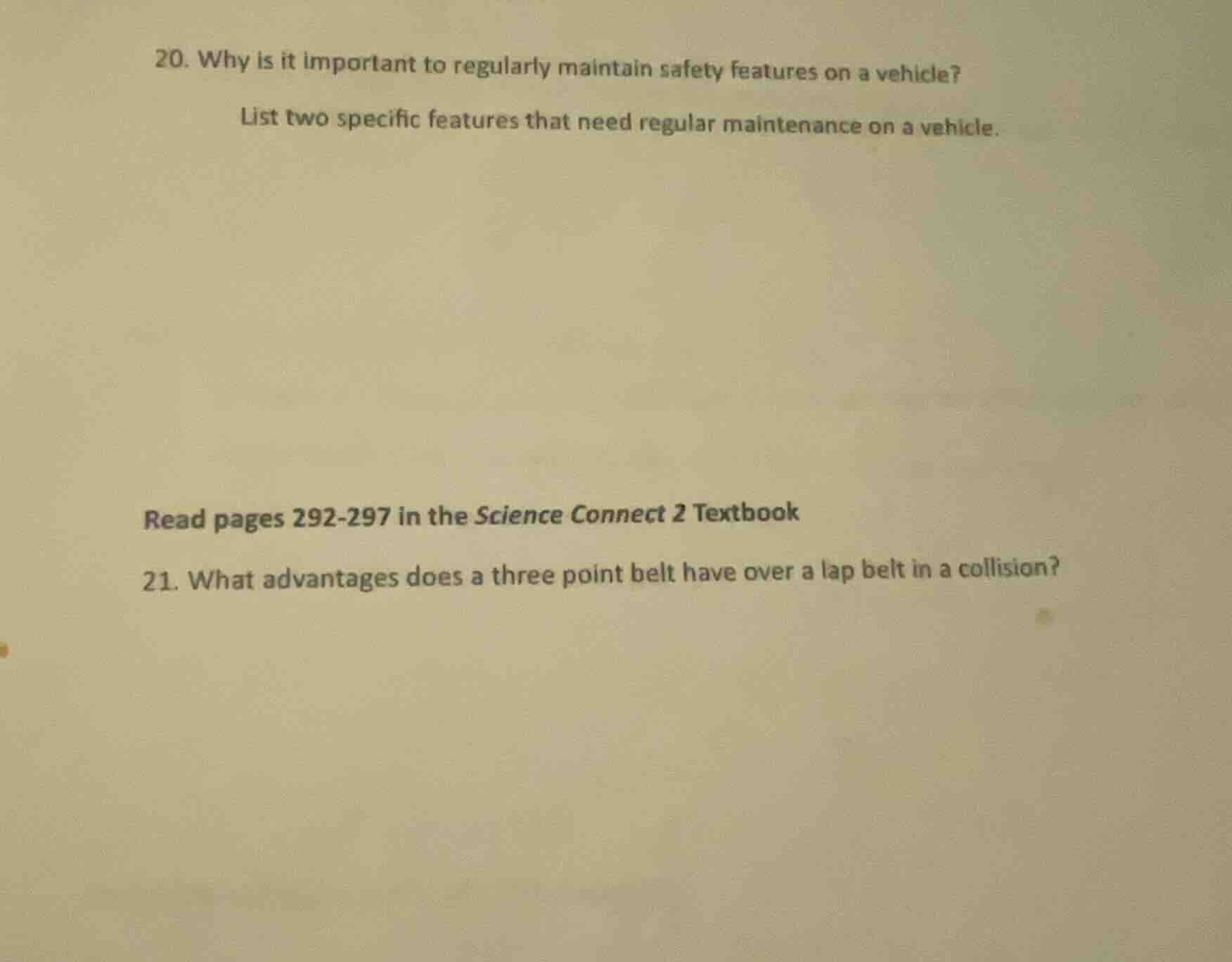
20. why is it important to regularly maintain safety features on a vehi…

Question

  1. why is it important to regularly maintain safety features on a vehicle?

list two specific features that need regular maintenance on a vehicle.

read pages 292-297 in the science connect 2 textbook

  1. what advantages does a three point belt have over a lap belt in a collision?

Explanation:

Response

<pre_analysis>
{
"quality": "clear",
"question_count": 2,
"skills_matched": [
"direct_cot",
"explain_then_answer",
"quick"
],
"needs_drawing": false,
"concepts_used": [],
"new_concepts": [
"Vehicle Safety Systems",
"Seatbelt Mechanics"
],
"current_concepts": [
"Vehicle Safety Systems",
"Seatbelt Mechanics",
"Collision Safety"
]
}
</pre_analysis>

<reasoning>

Question 20

  • Regular maintenance ensures safety features function correctly during a crash to prevent failure.
  • Two specific features requiring maintenance: brakes and airbags/seatbelts.

Question 21

  • A three-point belt secures both the upper body (torso) and lower body (pelvis), whereas a lap belt only secures the pelvis.
  • It distributes the impact force over a wider area of the body (chest, shoulders, and pelvis) and prevents the upper body from flying forward and hitting the steering wheel or dashboard.

</reasoning>

<answer>

Question 20

Regular maintenance ensures that safety systems function reliably during an emergency or collision, preventing mechanical failure when they are needed most.

Two specific features that need regular maintenance:

  1. Brakes (to ensure adequate stopping power and prevent wear)
  2. Seatbelts (to check for fraying, tensioner function, and locking mechanism reliability)

Question 21

A three-point belt secures both the pelvis and the upper torso, whereas a lap belt only secures the pelvis. This provides two main advantages:

  1. Force Distribution: It spreads the impact force over stronger skeletal areas (shoulders, chest, and pelvis) rather than concentrating it solely on the abdomen.
  2. Movement Prevention: It keeps the upper body from whipping forward, preventing the head and chest from colliding with the dashboard, steering wheel, or front seats.

</answer>

<post_analysis>
{
"subject": "Natural Science",
"question_type": "Multi-part",
"knowledge_point": [
"Natural Science",
"Physics",
"Collision Safety"
]
}
</post_analysis>

Answer:

<pre_analysis>
{
"quality": "clear",
"question_count": 2,
"skills_matched": [
"direct_cot",
"explain_then_answer",
"quick"
],
"needs_drawing": false,
"concepts_used": [],
"new_concepts": [
"Vehicle Safety Systems",
"Seatbelt Mechanics"
],
"current_concepts": [
"Vehicle Safety Systems",
"Seatbelt Mechanics",
"Collision Safety"
]
}
</pre_analysis>

<reasoning>

Question 20

  • Regular maintenance ensures safety features function correctly during a crash to prevent failure.
  • Two specific features requiring maintenance: brakes and airbags/seatbelts.

Question 21

  • A three-point belt secures both the upper body (torso) and lower body (pelvis), whereas a lap belt only secures the pelvis.
  • It distributes the impact force over a wider area of the body (chest, shoulders, and pelvis) and prevents the upper body from flying forward and hitting the steering wheel or dashboard.

</reasoning>

<answer>

Question 20

Regular maintenance ensures that safety systems function reliably during an emergency or collision, preventing mechanical failure when they are needed most.

Two specific features that need regular maintenance:

  1. Brakes (to ensure adequate stopping power and prevent wear)
  2. Seatbelts (to check for fraying, tensioner function, and locking mechanism reliability)

Question 21

A three-point belt secures both the pelvis and the upper torso, whereas a lap belt only secures the pelvis. This provides two main advantages:

  1. Force Distribution: It spreads the impact force over stronger skeletal areas (shoulders, chest, and pelvis) rather than concentrating it solely on the abdomen.
  2. Movement Prevention: It keeps the upper body from whipping forward, preventing the head and chest from colliding with the dashboard, steering wheel, or front seats.

</answer>

<post_analysis>
{
"subject": "Natural Science",
"question_type": "Multi-part",
"knowledge_point": [
"Natural Science",
"Physics",
"Collision Safety"
]
}
</post_analysis>