QUESTION IMAGE
Question
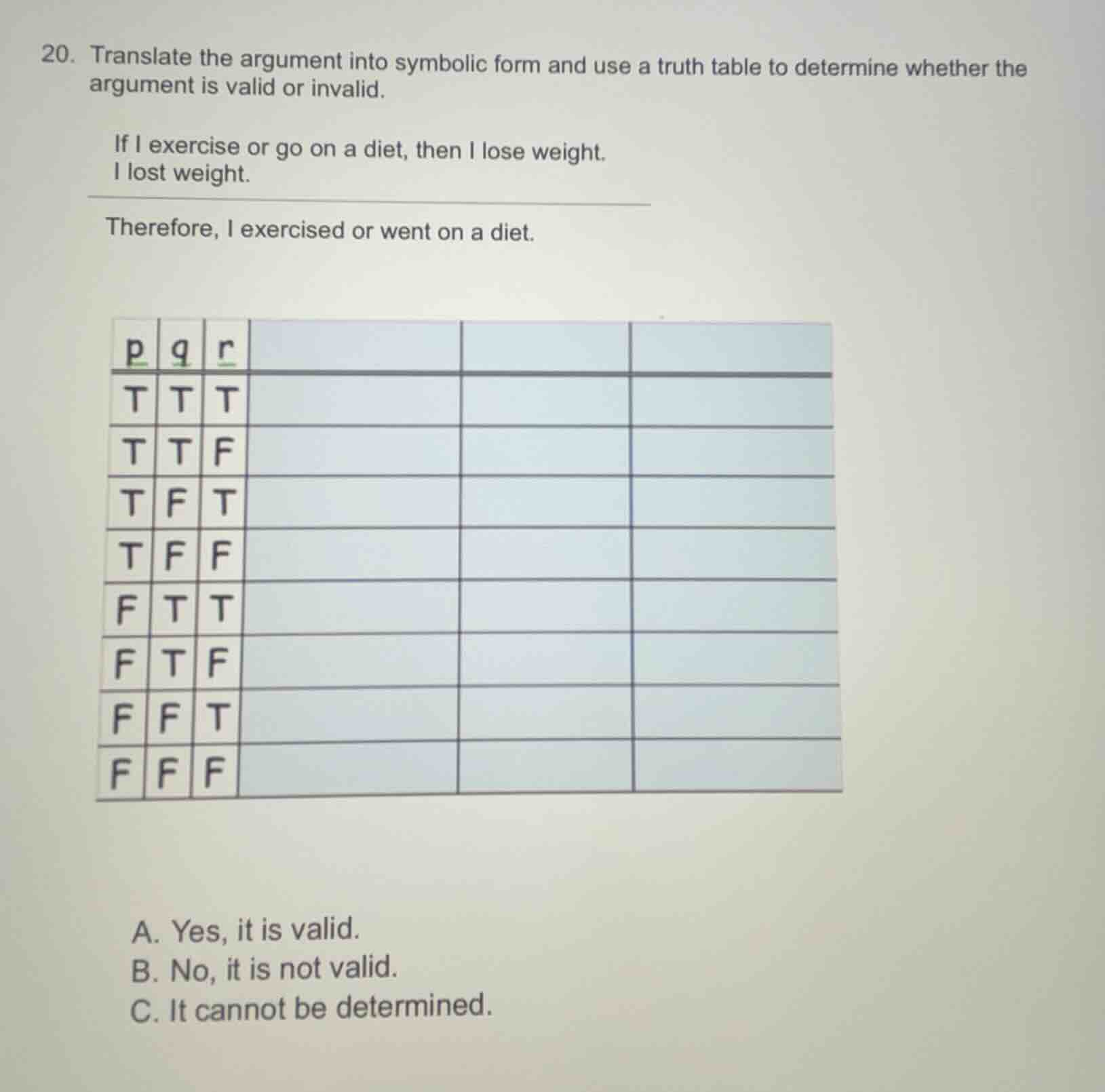
- translate the argument into symbolic form and use a truth table to determine whether the argument is valid or invalid.
if i exercise or go on a diet, then i lose weight.
i lost weight.
therefore, i exercised or went on a diet.
a. yes, it is valid.
b. no, it is not valid.
c. it cannot be determined.
<pre_analysis>
{
"quality": "clear",
"question_count": 1,
"skills_matched": [
"step_cot",
"multiple_choice_formatter",
"explain_then_answer",
"tutor"
],
"needs_drawing": false,
"concepts_used": [
"Symbolic Translation",
"Truth Tables",
"Argument Validity"
],
"new_concepts": [],
"current_concepts": [
"Symbolic Translation",
"Truth Tables",
"Argument Validity"
]
}
</pre_analysis>
<reasoning>
Define the simple statements
Let the simple statements be:
- \(p\): I exercise.
- \(q\): I go on a diet.
- \(r\): I lose weight.
Translate the argument into symbolic form
Using Symbolic Translation:
- Premise 1: "If I exercise or go on a diet, then I lose weight."
\[(p \lor q)
ightarrow r\]
- Premise 2: "I lost weight."
\[r\]
- Conclusion: "Therefore, I exercised or went on a diet."
\[p \lor q\]
The argument form is:
\[
\]
Construct the truth table
Using Truth Tables to evaluate the premises and conclusion for all truth values of \(p\), \(q\), and \(r\):
| \(p\) | \(q\) | \(r\) | \(p \lor q\) | Premise 1: \((p \lor q) |
ightarrow r\) | Premise 2: \(r\) | Conclusion: \(p \lor q\) |
| T | T | T | T | T | T | T |
| T | T | F | T | F | F | T |
| T | F | T | T | T | T | T |
| T | F | F | T | F | F | T |
| F | T | T | T | T | T | T |
| F | T | F | T | F | F | T |
| F | F | T | F | T | T | F |
| F | F | F | F | T | F | F |
Analyze argument validity
Using Argument Validity:
An argument is valid if and only if there is no row where all premises are true and the conclusion is false.
Let us examine the row where \(p = \text{F}\), \(q = \text{F}\), and \(r = \text{T}\):
- Premise 1 \(((p \lor q)
ightarrow r)\) is True (\(\text{F}
ightarrow \text{T}\) is \(\text{T}\)).
- Premise 2 \((r)\) is True.
- Conclusion \((p \lor q)\) is False.
Since we have a row (row 7) where both premises are true but the conclusion is false, the argument is invalid.
Match with the given options
The question asks whether the argument is valid or invalid.
- Option A: Yes, it is valid.
- Option B: No, it is not valid.
- Option C: It cannot be determined.
Therefore, the correct option is B.
</reasoning>
<answer>
<mcq-option>(A) Yes, it is valid.</mcq-option>
<mcq-correct>(B) No, it is not valid.</mcq-correct>
<mcq-option>(C) It cannot be determined.</mcq-option>
</answer>
<post_analysis>
{
"subject": "Mathematics",
"question_type": "Multiple Choice",
"knowledge_point": [
"Mathematics",
"Algebra",
"Mathematical Logic"
]
}
</post_analysis>
Snap & solve any problem in the app
Get step-by-step solutions on Sovi AI
Photo-based solutions with guided steps
Explore more problems and detailed explanations
<pre_analysis>
{
"quality": "clear",
"question_count": 1,
"skills_matched": [
"step_cot",
"multiple_choice_formatter",
"explain_then_answer",
"tutor"
],
"needs_drawing": false,
"concepts_used": [
"Symbolic Translation",
"Truth Tables",
"Argument Validity"
],
"new_concepts": [],
"current_concepts": [
"Symbolic Translation",
"Truth Tables",
"Argument Validity"
]
}
</pre_analysis>
<reasoning>
Define the simple statements
Let the simple statements be:
- \(p\): I exercise.
- \(q\): I go on a diet.
- \(r\): I lose weight.
Translate the argument into symbolic form
Using Symbolic Translation:
- Premise 1: "If I exercise or go on a diet, then I lose weight."
\[(p \lor q)
ightarrow r\]
- Premise 2: "I lost weight."
\[r\]
- Conclusion: "Therefore, I exercised or went on a diet."
\[p \lor q\]
The argument form is:
\[
\]
Construct the truth table
Using Truth Tables to evaluate the premises and conclusion for all truth values of \(p\), \(q\), and \(r\):
| \(p\) | \(q\) | \(r\) | \(p \lor q\) | Premise 1: \((p \lor q) |
ightarrow r\) | Premise 2: \(r\) | Conclusion: \(p \lor q\) |
| T | T | T | T | T | T | T |
| T | T | F | T | F | F | T |
| T | F | T | T | T | T | T |
| T | F | F | T | F | F | T |
| F | T | T | T | T | T | T |
| F | T | F | T | F | F | T |
| F | F | T | F | T | T | F |
| F | F | F | F | T | F | F |
Analyze argument validity
Using Argument Validity:
An argument is valid if and only if there is no row where all premises are true and the conclusion is false.
Let us examine the row where \(p = \text{F}\), \(q = \text{F}\), and \(r = \text{T}\):
- Premise 1 \(((p \lor q)
ightarrow r)\) is True (\(\text{F}
ightarrow \text{T}\) is \(\text{T}\)).
- Premise 2 \((r)\) is True.
- Conclusion \((p \lor q)\) is False.
Since we have a row (row 7) where both premises are true but the conclusion is false, the argument is invalid.
Match with the given options
The question asks whether the argument is valid or invalid.
- Option A: Yes, it is valid.
- Option B: No, it is not valid.
- Option C: It cannot be determined.
Therefore, the correct option is B.
</reasoning>
<answer>
<mcq-option>(A) Yes, it is valid.</mcq-option>
<mcq-correct>(B) No, it is not valid.</mcq-correct>
<mcq-option>(C) It cannot be determined.</mcq-option>
</answer>
<post_analysis>
{
"subject": "Mathematics",
"question_type": "Multiple Choice",
"knowledge_point": [
"Mathematics",
"Algebra",
"Mathematical Logic"
]
}
</post_analysis>