QUESTION IMAGE
Question
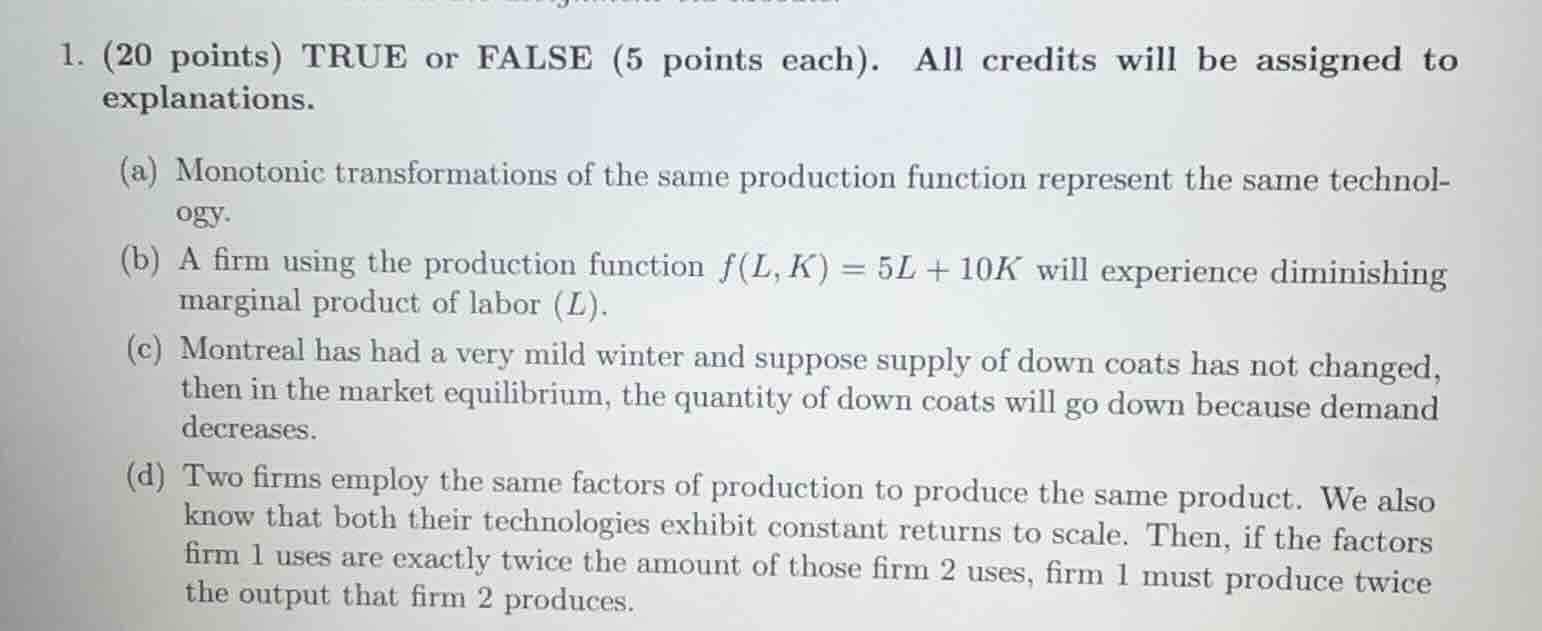
- (20 points) true or false (5 points each). all credits will be assigned to explanations.
(a) monotonic transformations of the same production function represent the same technology.
(b) a firm using the production function \\(f(l, k) = 5l + 10k\\) will experience diminishing marginal product of labor (\\(l\\)).
(c) montreal has had a very mild winter and suppose supply of down coats has not changed, then in the market equilibrium, the quantity of down coats will go down because demand decreases.
(d) two firms employ the same factors of production to produce the same product. we also know that both their technologies exhibit constant returns to scale. then, if the factors firm 1 uses are exactly twice the amount of those firm 2 uses, firm 1 must produce twice the output that firm 2 produces.
Analyze monotonic transformations of production functions
Monotonic transformations preserve the ordinal ranking of inputs but do not preserve the cardinal output levels. In consumer theory, utility functions are ordinal, so monotonic transformations represent the same preferences. However, production functions are cardinal because output is a physically measurable quantity. Therefore, monotonic transformations of a production function represent different technologies with different output levels and returns to scale.
Evaluate marginal product of labor
The production function is:
The marginal product of labor is the partial derivative with respect to \(L\):
Since \(MP_L\) is a constant value of \(5\), it does not decrease as \(L\) increases. Thus, the firm experiences constant marginal product of labor, not diminishing.
Analyze market equilibrium for down coats
A mild winter reduces consumers' willingness to buy down coats, causing a leftward shift in the demand curve. Assuming the supply curve is upward-sloping and does not change, a decrease in demand leads to a lower equilibrium price and a lower equilibrium quantity. Therefore, the equilibrium quantity of down coats goes down because demand decreases.
Evaluate constant returns to scale
Let the production function for both firms be \(f(L, K)\), which exhibits constant returns to scale (CRS). By definition of CRS, scaling all inputs by a factor of \(t > 0\) scales the output by the same factor:
Firm 1 uses exactly twice the inputs of Firm 2:
Using the CRS property with \(t = 2\):
Thus, Firm 1 must produce exactly twice the output of Firm 2.

Snap & solve any problem in the app
Get step-by-step solutions on Sovi AI
Photo-based solutions with guided steps
Explore more problems and detailed explanations
Question 1
(a) FALSE. Production functions are cardinal because output is physically measurable. A monotonic transformation changes the actual output levels and the returns to scale, meaning it represents a different technology.
(b) FALSE. The marginal product of labor is \(MP_L = \frac{\partial f}{\partial L} = 5\), which is constant and does not diminish as labor increases.
(c) TRUE. A mild winter decreases the demand for down coats (shifting the demand curve to the left). With an unchanged supply curve, this shift results in a lower equilibrium quantity.
(d) TRUE. By definition, a production function with constant returns to scale satisfies \(f(2L, 2K) = 2f(L, K)\). Since Firm 1 uses exactly twice the inputs of Firm 2, its output must be exactly twice that of Firm 2.