QUESTION IMAGE
Question
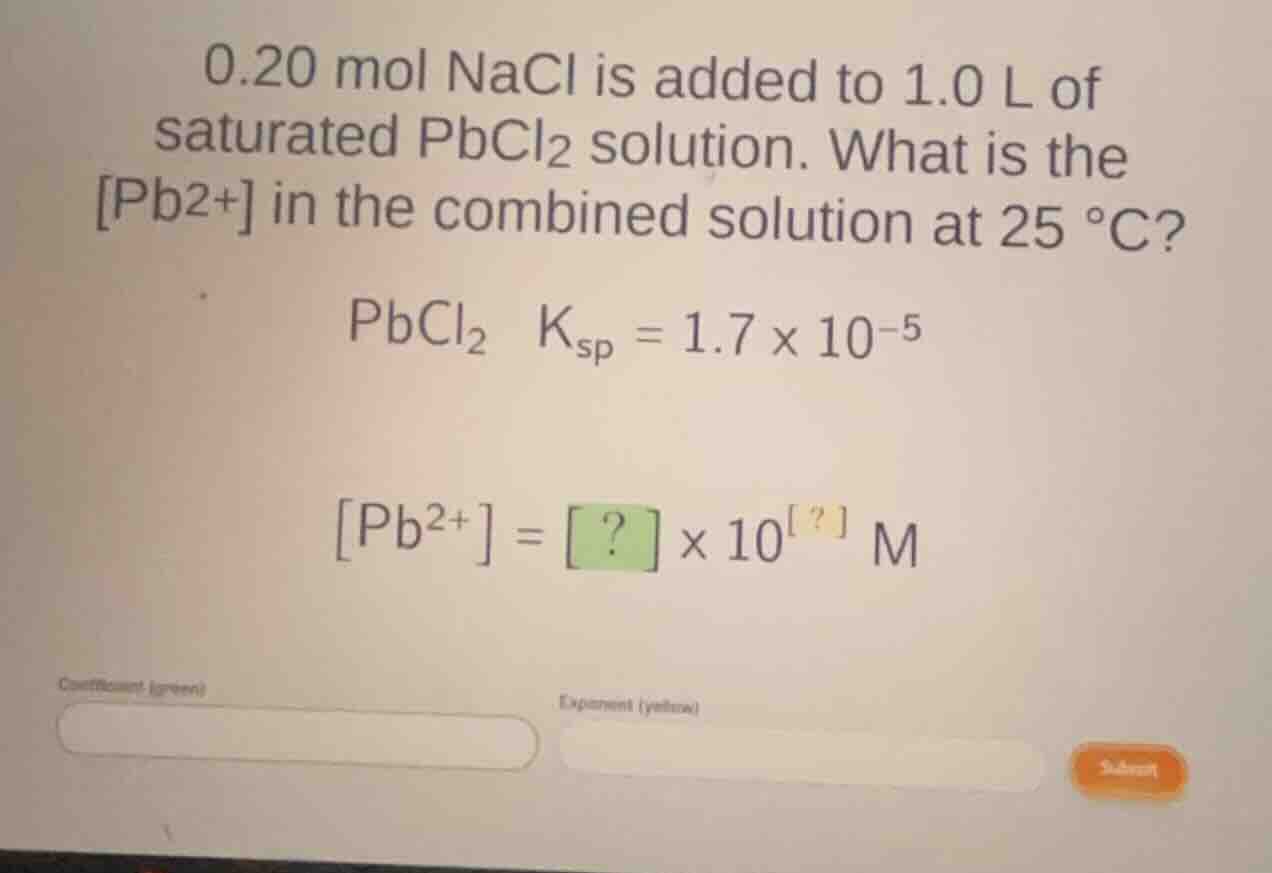
0.20 mol nacl is added to 1.0 l of saturated \\(\text{pbcl}_2\\) solution. what is the \\(\text{pb}^{2+}\\) in the combined solution at 25 °c?
\\(\text{pbcl}_2\\) \\(k_{\text{sp}} = 1.7 \times 10^{-5}\\)
\\(\text{pb}^{2+} = ? \times 10^{?} \text{ m}\\)
Identify the chemical equilibrium and given values
We are given a saturated solution of lead(II) chloride, \(\text{PbCl}_2\), to which sodium chloride, \(\text{NaCl}\), is added.
The dissolution equilibrium for \(\text{PbCl}_2\) is:
The solubility product constant expression is:
The volume of the solution is \(1.0\text{ L}\).
The amount of added \(\text{NaCl}\) is \(0.20\text{ mol}\).
Determine the concentration of chloride ions
Since \(\text{NaCl}\) is a strong electrolyte, it dissociates completely:
The concentration of \(\text{Cl}^-\) added from \(\text{NaCl}\) is:
Because of the Common Ion Effect, the solubility of \(\text{PbCl}_2\) is greatly suppressed.
The concentration of \(\text{Cl}^-\) coming from the dissolution of \(\text{PbCl}_2\) is \(2s\), where \(s = [\text{Pb}^{2+}]\).
Thus, the total equilibrium concentration of chloride is:
Apply the approximation for solubility
Since \(K_{sp} = 1.7 \times 10^{-5}\) is very small, the solubility \(s\) of \(\text{PbCl}_2\) in the presence of \(0.20\text{ M}\) \(\text{Cl}^-\) will be extremely small.
Therefore, we can make the approximation:
Calculate the lead ion concentration
Substitute the approximated concentration of \(\text{Cl}^-\) into the \(K_{sp}\) expression:
Verify the approximation validity
Let's check if \(2s\) is indeed negligible compared to \(0.20\):
Comparing \(8.5 \times 10^{-4}\) to \(0.20\):
Since this is well below \(5\%\), the approximation is highly accurate.
Thus, the concentration of \(\text{Pb}^{2+}\) is \(4.3 \times 10^{-4}\text{ M}\) (rounded to two significant figures).

Snap & solve any problem in the app
Get step-by-step solutions on Sovi AI
Photo-based solutions with guided steps
Explore more problems and detailed explanations
\(0.20\text{ mol NaCl}\) is added to \(1.0\text{ L}\) of saturated \(\text{PbCl}_2\) solution. What is the \([\text{Pb}^{2+}]\) in the combined solution at \(25\text{ }^\circ\text{C}\)?
\(\text{PbCl}_2\ \ K_{sp} = 1.7 \times 10^{-5}\)
\([\text{Pb}^{2+}] =\) <blank>\(4.3\)</blank> \(\times 10^{\text{ }}\)<blank>\(-4\)</blank> \(\text{M}\)