QUESTION IMAGE
Question
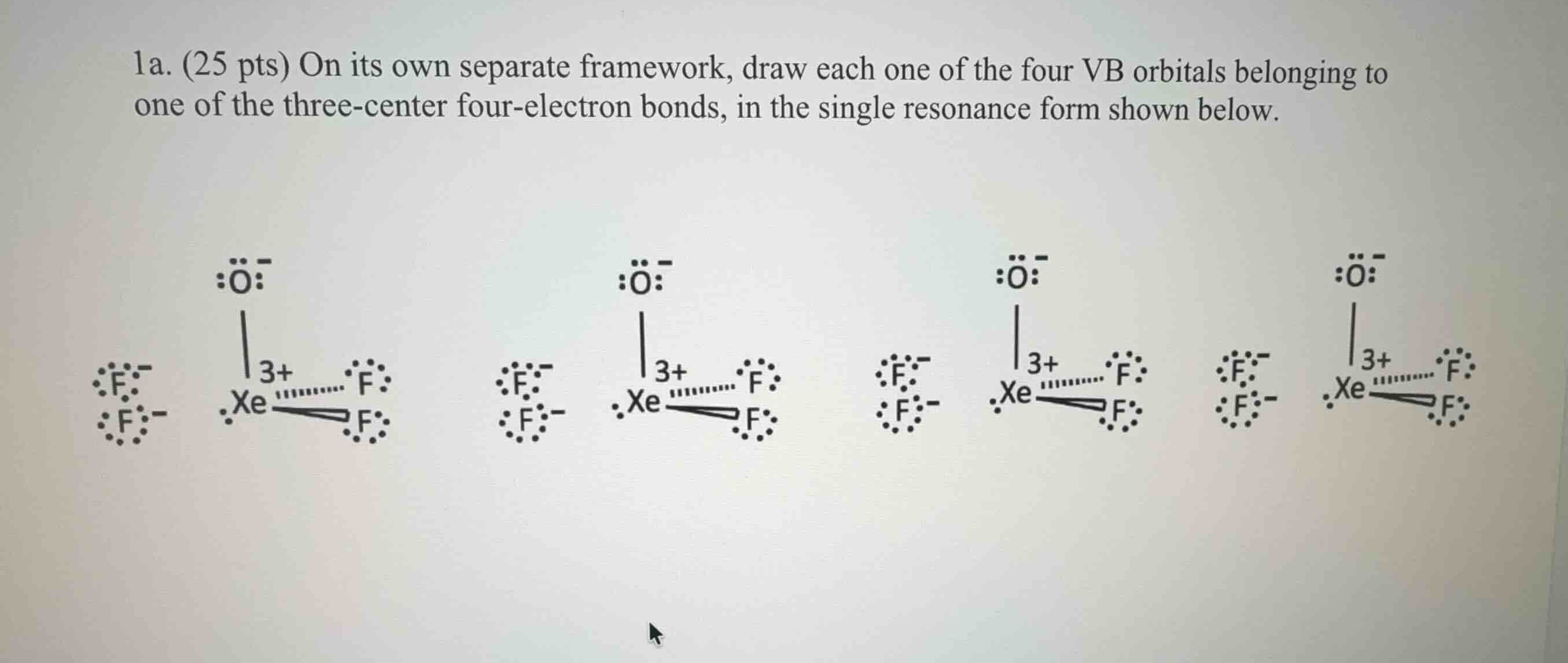
1a. (25 pts) on its own separate framework, draw each one of the four vb orbitals belonging to one of the three-center four-electron bonds, in the single resonance form shown below.
Identify the 3c-4e bond
The molecule shown is \(\text{XeOF}_4\). The central xenon atom has a \(3+\) formal charge, an apical oxygen atom with a single bond and a negative charge (\(\text{O}^-\)), and four equatorial fluorine atoms (two covalently bound, and two as isolated fluoride anions \(\text{F}^-\) in this specific resonance structure).
The three-center four-electron (3c-4e) bonding system in this resonance form is formed along the linear \(\text{F}-\text{Xe}-\text{F}\) axes. Specifically, each linear \(\text{F}-\text{Xe}-\text{F}\) unit consists of:
- A central xenon atom (\(\text{Xe}^{3+}\)).
- Two equatorial fluorine atoms on opposite sides. In this resonance structure, one is covalently bound (sharing a pair of electrons with Xe) and the other is an isolated fluoride ion (\(\text{F}^-\)) with a full octet.
Thus, there are two perpendicular linear 3c-4e systems in the equatorial plane:
- One along the \(\text{F}-\text{Xe}\cdots\text{F}^-\) axis (left-to-right).
- One along the other \(\text{F}-\text{Xe}\cdots\text{F}^-\) axis (front-to-back).
Let us focus on one of these linear \(\text{F}-\text{Xe}\cdots\text{F}^-\) 3c-4e bonds to describe its four Valence Bond (VB) orbitals.
Determine the VB orbitals
In Valence Bond theory, a three-center four-electron (3c-4e) bond is described by localized atomic orbitals on each of the three participating atoms. For a linear \(\text{F}_a-\text{Xe}-\text{F}_b\) system:
- The central \(\text{Xe}\) uses a \(p\)-orbital aligned along the bond axis (let's call it the \(p_x\) orbital).
- The two terminal fluorine atoms (\(\text{F}_a\) and \(\text{F}_b\)) each use a \(p\)-orbital directed along the bond axis (their respective \(p_x\) orbitals).
The four valence electrons in this 3c-4e system occupy two localized VB orbitals (each containing a pair of electrons):
- Covalent Bond Orbital: A localized bonding orbital between \(\text{Xe}\) and the covalently bound fluorine (\(\text{F}_a\)). This is formed by the overlap of the \(\text{Xe}\) \(p_x\) orbital and the \(\text{F}_a\) \(p_x\) orbital.
- Fluoride Lone Pair Orbital: A localized non-bonding lone pair orbital residing entirely on the isolated fluoride ion (\(\text{F}_b^-\)). This is a fully occupied \(p_x\) orbital on \(\text{F}_b^-\).
To fully represent the VB description of this resonance structure, we draw the active atomic orbitals that participate in this bonding scheme across the four frameworks:
- Orbital 1: The \(p\)-orbital on the covalently bound fluorine atom (\(\text{F}\)) pointing toward \(\text{Xe}\).
- Orbital 2: The \(p\)-orbital on the central \(\text{Xe}\) atom pointing toward the covalently bound fluorine.
- Orbital 3: The \(p\)-orbital on the central \(\text{Xe}\) atom pointing toward the isolated fluoride ion (\(\text{F}^-\)).
- Orbital 4: The \(p\)-orbital on the isolated fluoride ion (\(\text{F}^-\)) pointing toward \(\text{Xe}\).
(Note: Orbitals 2 and 3 represent the two lobes of the single \(p\)-orbital on the central \(\text{Xe}\) atom aligned along this axis).
Describe the drawings for each framework
To represen…

Snap & solve any problem in the app
Get step-by-step solutions on Sovi AI
Photo-based solutions with guided steps
Explore more problems and detailed explanations
To represent the four Valence Bond (VB) orbitals belonging to one of the three-center four-electron (3c-4e) bonds along a linear \(\text{F}-\text{Xe}\cdots\text{F}^-\) axis, draw the following atomic orbital components on each of the four frameworks from left to right:
- First Framework (Terminal Covalent Fluorine Orbital):
Draw a \(p\)-orbital on the covalently bound equatorial \(\text{F}\) atom, with its lobes aligned along the \(\text{F}-\text{Xe}\) bonding axis pointing toward the central \(\text{Xe}\) atom.
- Second Framework (Central Xenon Orbital - Lobe A):
Draw one lobe of the central \(\text{Xe}\) \(p\)-orbital pointing directly along the axis toward the covalently bound equatorial \(\text{F}\) atom.
- Third Framework (Central Xenon Orbital - Lobe B):
Draw the second, oppositely phased lobe of the central \(\text{Xe}\) \(p\)-orbital pointing along the axis toward the isolated equatorial \(\text{F}^-\) ion.
- Fourth Framework (Terminal Fluoride Ion Orbital):
Draw a fully occupied \(p\)-orbital on the isolated equatorial \(\text{F}^-\) ion, with its lobes aligned along the \(\text{Xe}\cdots\text{F}^-\) axis pointing toward the central \(\text{Xe}\) atom.