QUESTION IMAGE
Question
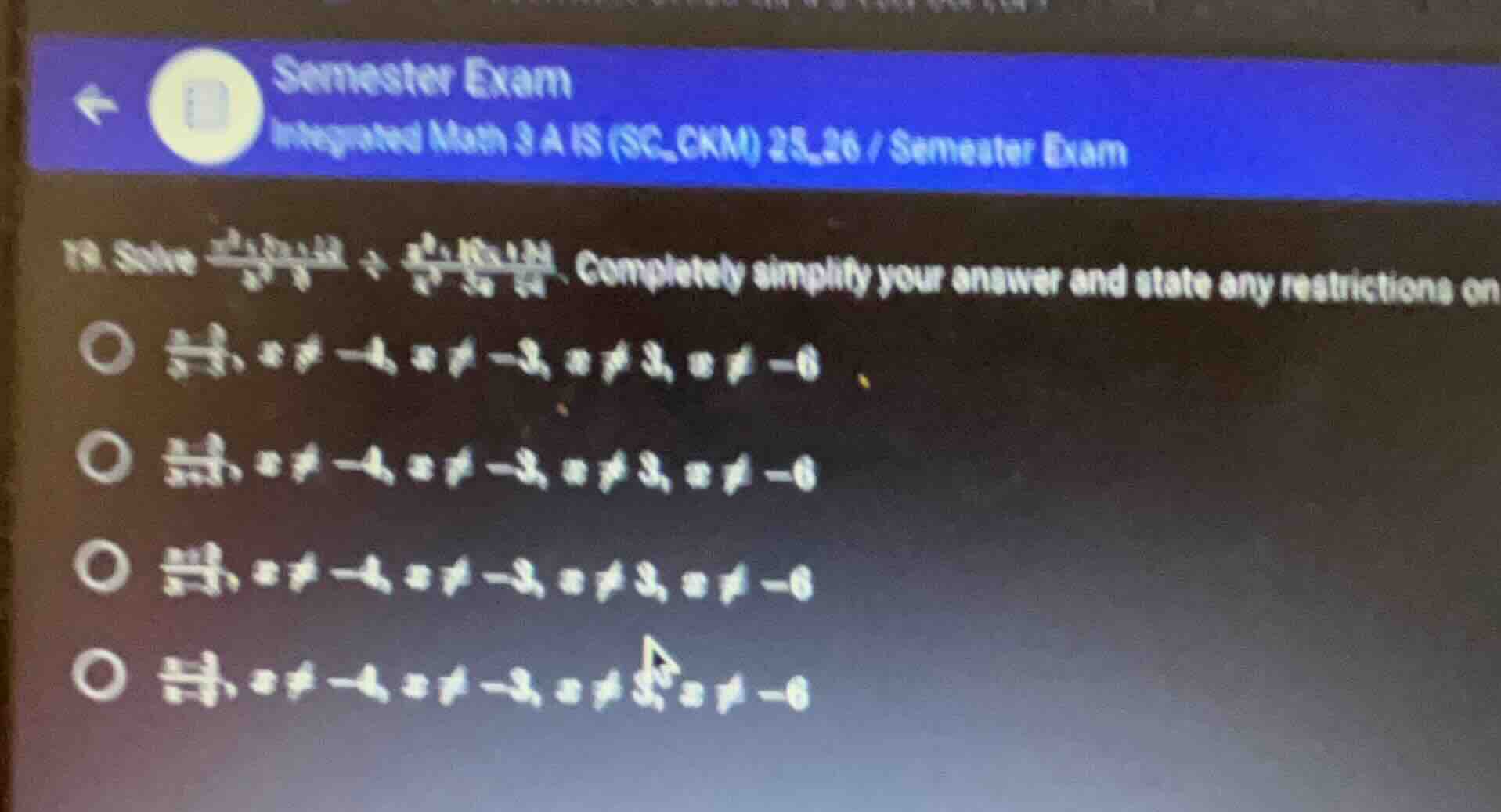
- solve \\(\frac{x^2 + 2x - 24}{x^2 - x - 12} \div \frac{x^2 + x - 30}{x^2 - 9}\\). completely simplify your answer and state any restrictions on the variable.
\\(\bigcirc\\) \\(\frac{x-3}{x-5}, x \
eq -4, x \
eq -3, x \
eq 3, x \
eq -6\\)
\\(\bigcirc\\) \\(\frac{x+3}{x-5}, x \
eq -4, x \
eq -3, x \
eq 3, x \
eq -6\\)
\\(\bigcirc\\) \\(\frac{x+3}{x+5}, x \
eq -4, x \
eq -3, x \
eq 3, x \
eq -6\\)
\\(\bigcirc\\) \\(\frac{x-3}{x+5}, x \
eq -4, x \
eq -3, x \
eq 3, x \
eq -6\\)
🆕 New Concept Discovered: Multiplying and Dividing Rational Expressions
Flipping the divisor and finding domain restrictions
Step 1: Identify the expression and factor all polynomials
The given division problem is:
First, we factor every numerator and denominator completely:
- \( x^2 + 2x - 24 = (x + 6)(x - 4) \)
- \( x^2 - 16 = (x - 4)(x + 4) \)
- \( x^2 + 9x + 18 = (x + 6)(x + 3) \)
- \( x^2 + 7x + 12 = (x + 4)(x + 3) \)
Rewriting the expression with factored forms:
Step 2: Determine the restrictions on the variable
To find the restrictions, we must identify any values of \( x \) that would cause division by zero at any point in the calculation. This includes:
- The denominators of the original fractions: \( (x - 4)(x + 4)
eq 0 \) and \( (x + 4)(x + 3)
eq 0 \)
- The numerator of the divisor (since we multiply by its reciprocal, this term moves to the denominator): \( (x + 6)(x + 3)
eq 0 \)
Setting each unique factor to zero gives the restricted values:
- \( x - 4 = 0 \implies x
eq 4 \)
- \( x + 4 = 0 \implies x
eq -4 \)
- \( x + 3 = 0 \implies x
eq -3 \)
- \( x + 6 = 0 \implies x
eq -6 \)
Thus, the restrictions are:
Step 3: Simplify the expression
To divide by a rational expression, multiply by its reciprocal:
Now, cancel the common factors in the numerator and denominator:
- Cancel \( (x - 4) \) from the first fraction.
- Cancel \( (x + 4) \) from the numerator and denominator.
- Cancel \( (x + 6) \) from the numerator and denominator.
- Cancel \( (x + 3) \) from the numerator and denominator.
The simplified expression is \( 1 \).

Snap & solve any problem in the app
Get step-by-step solutions on Sovi AI
Photo-based solutions with guided steps
Explore more problems and detailed explanations