QUESTION IMAGE
Question
3.1.19
2 parts -- of 1 point
state the domain and range for the following relation. then determine whether the relation represents a function.
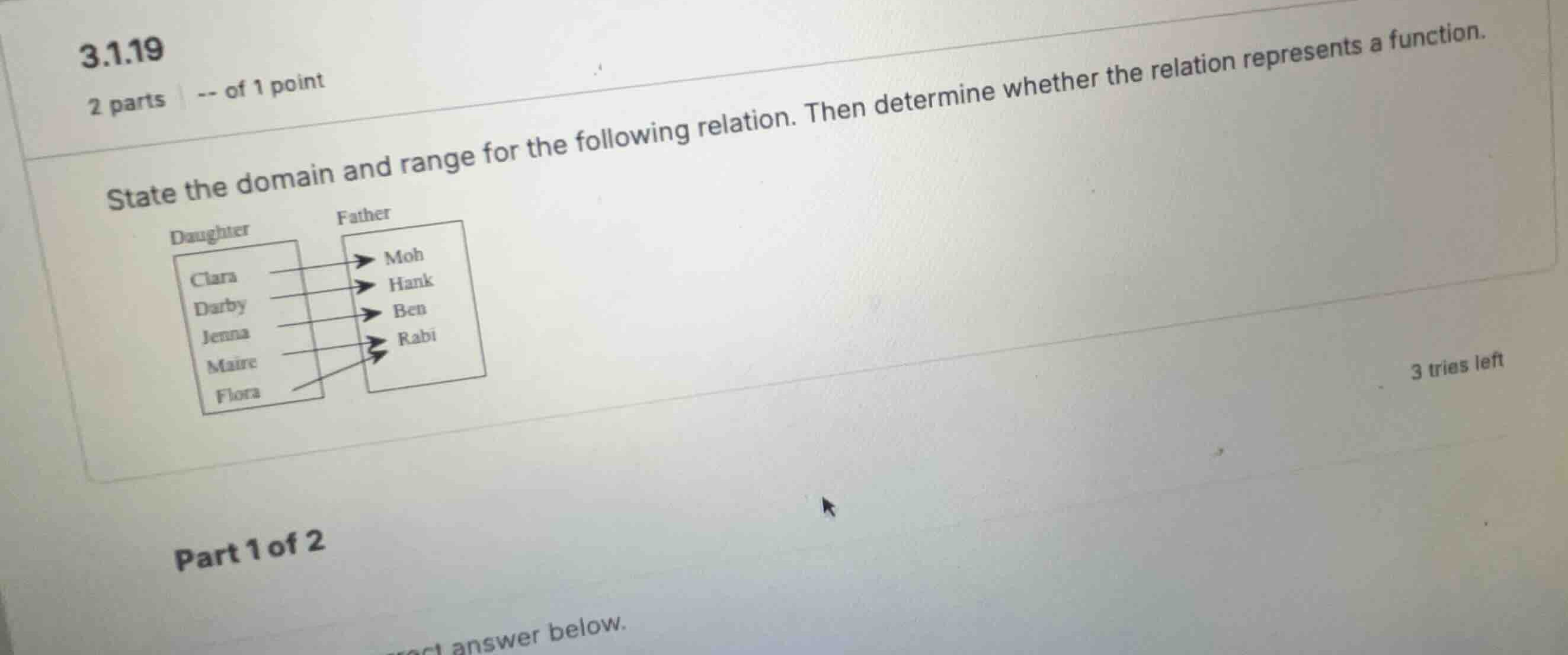
daughter | father
clara -> moh
darby -> hank
jenna -> ben
maire -> rabi
flora -> rabi
part 1 of 2
Identify the domain elements
The domain is the set of all input values (the independent variable), which corresponds to the "Daughter" set in this mapping diagram.
Identify the range elements
The range is the set of all output values (the dependent variable), which corresponds to the "Father" set pointed to by the arrows.
Determine if the relation is a function
A relation is a function if each element in the domain maps to exactly one element in the range.
Looking at the mapping:
- Clara maps to Moh (1 output)
- Darby maps to Hank (1 output)
- Jenna maps to Ben (1 output)
- Maire maps to Rabi (1 output)
- Flora maps to Rabi (1 output)
Since every daughter has exactly one father, each input maps to exactly one output. Thus, the relation represents a function.

Snap & solve any problem in the app
Get step-by-step solutions on Sovi AI
Photo-based solutions with guided steps
Explore more problems and detailed explanations
Domain: \(\{\text{Clara}, \text{Darby}, \text{Jenna}, \text{Maire}, \text{Flora}\}\)
Range: \(\{\text{Moh}, \text{Hank}, \text{Ben}, \text{Rabi}\}\)
Function Determination: Yes, the relation represents a function because each element in the domain maps to exactly one element in the range.