Sovi.AI - AI Math Tutor

Scan to solve math questions

QUESTION IMAGE

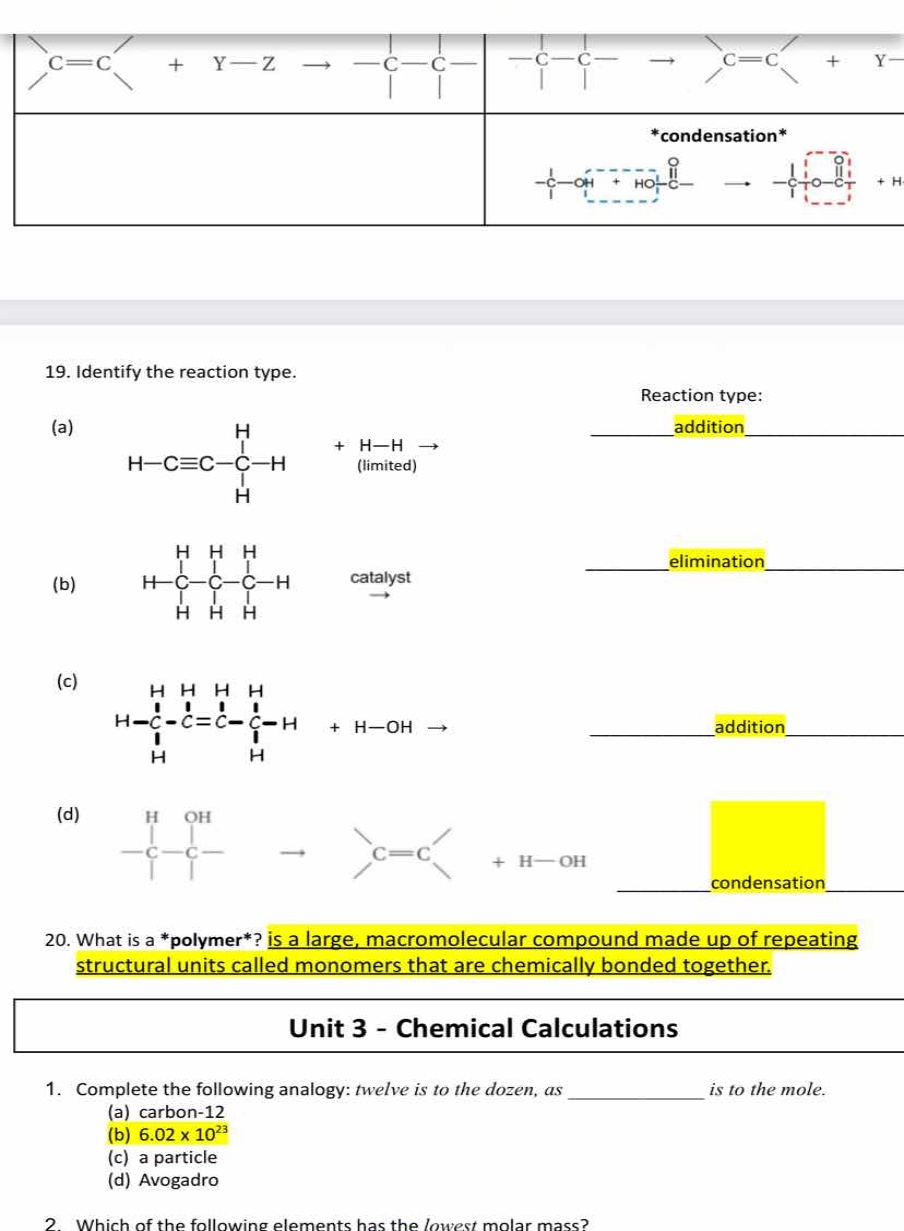
19. identify the reaction type. (a) \\(\\text{h}-\\text{c}\\equiv\\text…

Question

  1. identify the reaction type.

(a) \\(\text{h}-\text{c}\equiv\text{c}-\text{c}(\text{h})_2-\text{h} + \text{h}-\text{h} \
ightarrow\\) (limited)
reaction type: addition

(b) \\(\text{h}-\text{c}(\text{h})_2-\text{c}(\text{h})_2-\text{c}(\text{h})_2-\text{h} \xrightarrow{\text{catalyst}}\\)
reaction type: elimination

(c) \\(\text{h}-\text{c}(\text{h})_2-\text{c}(\text{h})=\text{c}(\text{h})-\text{c}(\text{h})_2-\text{h} + \text{h}-\text{oh} \
ightarrow\\)
reaction type: addition

(d) \\(\text{c}(\text{h})(\text{oh})-\text{c}(\text{h})(\text{oh}) \
ightarrow \text{c}=\text{c} + \text{h}-\text{oh}\\)
reaction type: condensation

  1. what is a polymer?

unit 3 - chemical calculations

  1. complete the following analogy: twelve is to the dozen, as ____________ is to the mole.

(a) carbon-12
(b) \\(6.02 \times 10^{23}\\)
(c) a particle
(d) avogadro

  1. which of the following elements has the lowest molar mass?

Explanation:

Response

<pre_analysis>
{
"quality": "clear",
"question_count": 3,
"skills_matched": [
"direct_cot",
"explain_then_answer",
"tutor"
],
"needs_drawing": false,
"concepts_used": [],
"new_concepts": [
"Organic Reaction Types",
"Polymer Definition",
"Avogadro's Number"
],
"current_concepts": [
"Organic Reaction Types",
"Polymer Definition",
"Avogadro's Number"
]
}
</pre_analysis>

<reasoning>

Analyze organic reaction types

We examine the chemical equations in Question 19 to identify each reaction type:

  • (a) Propyne (\(\text{H}-\text{C}\equiv\text{C}-\text{CH}_3\)) reacts with a limited amount of hydrogen gas (\(\text{H}-\text{H}\)) to form an alkene. This is an addition reaction because atoms are added across a multiple bond.
  • (b) Propane (\(\text{CH}_3-\text{CH}_2-\text{CH}_3\)) reacts in the presence of a catalyst to form an alkene and release hydrogen. This is an elimination reaction because atoms are removed to form a double bond.
  • (c) But-2-ene (\(\text{CH}_3-\text{CH}=\text{CH}-\text{CH}_3\)) reacts with water (\(\text{H}-\text{OH}\)) to form an alcohol. This is an addition reaction (specifically hydration) across the double bond.
  • (d) An alcohol with adjacent hydrogen and hydroxyl groups (\(\text{H}-\text{C}-\text{C}-\text{OH}\)) reacts to form an alkene (\(\text{C}=\text{C}\)) and water (\(\text{H}-\text{OH}\)). This is an elimination reaction (specifically dehydration). Note: The yellow highlight in the image incorrectly says "condensation", but the reaction shown is a classic elimination of water from a single molecule to form a double bond.

Define a polymer

For Question 20, we define a polymer based on its chemical structure:

  • A polymer is a large, macromolecular compound composed of many repeating structural subunits called monomers, which are covalently bonded together.

Solve the mole analogy

For Unit 3, Question 1, we analyze the analogy:

  • "Twelve" is the numerical quantity that defines a "dozen".
  • Similarly, Avogadro's number, \(6.02 \times 10^{23}\), is the numerical quantity of particles that defines a "mole".
  • Therefore, the correct option is (b).

</reasoning>

<answer>

Question 19

(a) addition
(b) elimination
(c) addition
(d) elimination

Question 20

A polymer is a large, macromolecular compound made up of repeating structural units called monomers that are chemically bonded together.

Unit 3 - Question 1

<mcq-option>(a) carbon-12</mcq-option>
<mcq-correct>(b) \(6.02 \times 10^{23}\)</mcq-correct>
<mcq-option>(c) a particle</mcq-option>
<mcq-option>(d) Avogadro</mcq-option>
</answer>

<post_analysis>
{
"subject": "Natural Science",
"question_type": "Multi-part",
"knowledge_point": [
"Natural Science",
"Chemistry",
"Organic Reaction Types"
]
}
</post_analysis>

Answer:

<pre_analysis>
{
"quality": "clear",
"question_count": 3,
"skills_matched": [
"direct_cot",
"explain_then_answer",
"tutor"
],
"needs_drawing": false,
"concepts_used": [],
"new_concepts": [
"Organic Reaction Types",
"Polymer Definition",
"Avogadro's Number"
],
"current_concepts": [
"Organic Reaction Types",
"Polymer Definition",
"Avogadro's Number"
]
}
</pre_analysis>

<reasoning>

Analyze organic reaction types

We examine the chemical equations in Question 19 to identify each reaction type:

  • (a) Propyne (\(\text{H}-\text{C}\equiv\text{C}-\text{CH}_3\)) reacts with a limited amount of hydrogen gas (\(\text{H}-\text{H}\)) to form an alkene. This is an addition reaction because atoms are added across a multiple bond.
  • (b) Propane (\(\text{CH}_3-\text{CH}_2-\text{CH}_3\)) reacts in the presence of a catalyst to form an alkene and release hydrogen. This is an elimination reaction because atoms are removed to form a double bond.
  • (c) But-2-ene (\(\text{CH}_3-\text{CH}=\text{CH}-\text{CH}_3\)) reacts with water (\(\text{H}-\text{OH}\)) to form an alcohol. This is an addition reaction (specifically hydration) across the double bond.
  • (d) An alcohol with adjacent hydrogen and hydroxyl groups (\(\text{H}-\text{C}-\text{C}-\text{OH}\)) reacts to form an alkene (\(\text{C}=\text{C}\)) and water (\(\text{H}-\text{OH}\)). This is an elimination reaction (specifically dehydration). Note: The yellow highlight in the image incorrectly says "condensation", but the reaction shown is a classic elimination of water from a single molecule to form a double bond.

Define a polymer

For Question 20, we define a polymer based on its chemical structure:

  • A polymer is a large, macromolecular compound composed of many repeating structural subunits called monomers, which are covalently bonded together.

Solve the mole analogy

For Unit 3, Question 1, we analyze the analogy:

  • "Twelve" is the numerical quantity that defines a "dozen".
  • Similarly, Avogadro's number, \(6.02 \times 10^{23}\), is the numerical quantity of particles that defines a "mole".
  • Therefore, the correct option is (b).

</reasoning>

<answer>

Question 19

(a) addition
(b) elimination
(c) addition
(d) elimination

Question 20

A polymer is a large, macromolecular compound made up of repeating structural units called monomers that are chemically bonded together.

Unit 3 - Question 1

<mcq-option>(a) carbon-12</mcq-option>
<mcq-correct>(b) \(6.02 \times 10^{23}\)</mcq-correct>
<mcq-option>(c) a particle</mcq-option>
<mcq-option>(d) Avogadro</mcq-option>
</answer>

<post_analysis>
{
"subject": "Natural Science",
"question_type": "Multi-part",
"knowledge_point": [
"Natural Science",
"Chemistry",
"Organic Reaction Types"
]
}
</post_analysis>