QUESTION IMAGE
Question
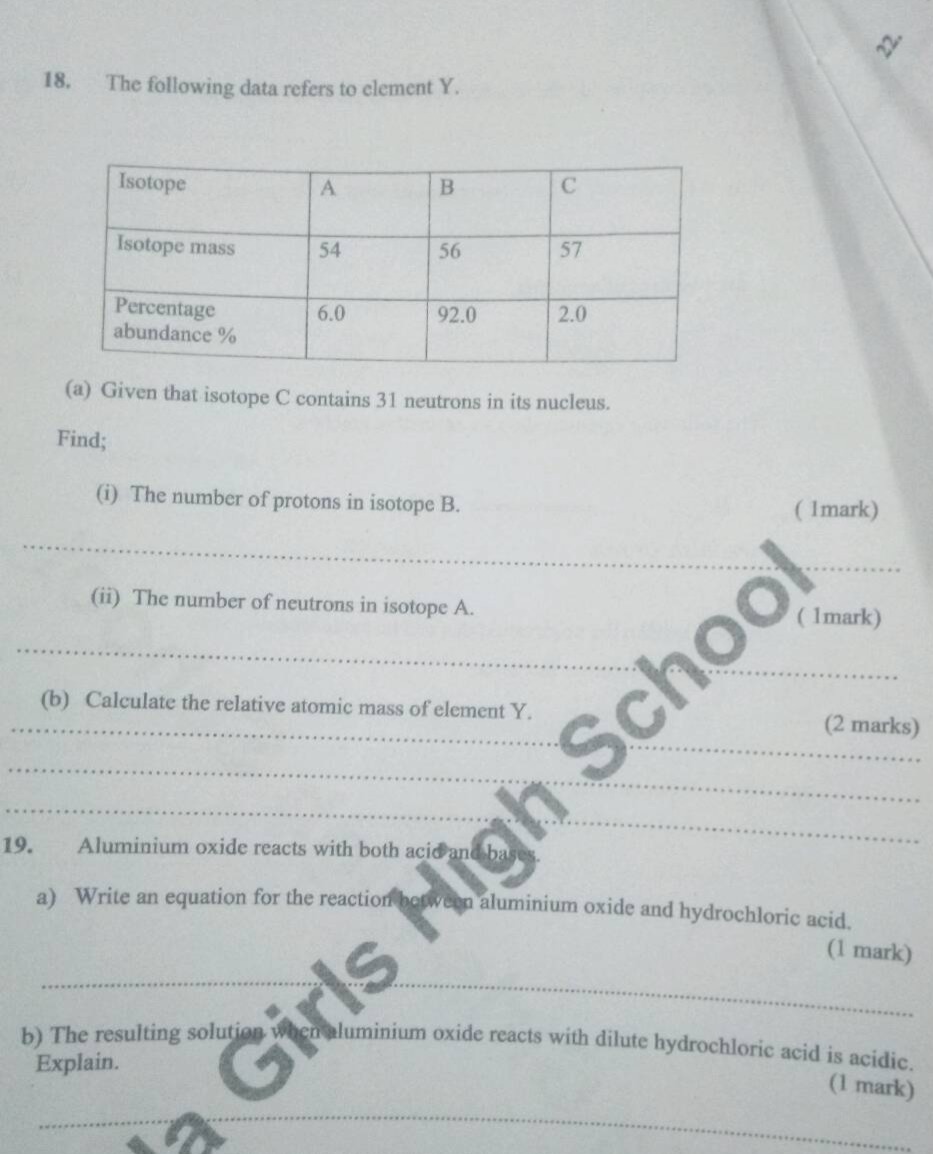
- the following data refers to element y.
\
(a) given that isotope c contains 31 neutrons in its nucleus.
find;
(i) the number of protons in isotope b. (1mark)
(ii) the number of neutrons in isotope a. (1mark)
(b) calculate the relative atomic mass of element y. (2 marks)
- aluminium oxide reacts with both acid and bases.
a) write an equation for the reaction between aluminium oxide and hydrochloric acid. (1 mark)
b) the resulting solution when aluminium oxide reacts with dilute hydrochloric acid is acidic. explain. (1 mark)
🆕 New Concept Discovered: Calculating Relative Atomic Mass & Isotope Composition
Finding protons, neutrons, and weighted average mass.
Step 1: Find the number of protons in isotope B
The mass number of isotope C is \( 57 \). The mass number is the sum of protons and neutrons:
For isotope C:
Since isotopes of the same element have the same number of protons, isotope B also has \( 26 \) protons.
Step 2: Find the number of neutrons in isotope A
Isotope A belongs to the same element Y, so it also has \( 26 \) protons. Its mass number is \( 54 \).
Step 3: Calculate the relative atomic mass of element Y
The relative atomic mass is the weighted average of the isotopic masses based on their percentage abundances:
Step 4: Write the equation for the reaction between aluminium oxide and hydrochloric acid
Aluminium oxide (\(\text{Al}_2\text{O}_3\)) reacts with hydrochloric acid (\(\text{HCl}\)) to form aluminium chloride (\(\text{AlCl}_3\)) and water (\(\text{H}_2\text{O}\)):
Step 5: Explain why the resulting solution is acidic
Aluminium chloride (\(\text{AlCl}_3\)) dissolves in water to form hydrated aluminium ions, \([\text{Al}(\text{H}_2\text{O})_6]^{3+}\). Due to the high charge density of the \(\text{Al}^{3+}\) ion, it polarizes the \(\text{O}-\text{H}\) bonds in the coordinated water molecules, releasing \(\text{H}^+\) (or \(\text{H}_3\text{O}^+\)) ions into the solution via hydrolysis:
The presence of excess \(\text{H}_3\text{O}^+\) ions makes the solution acidic.
---

Snap & solve any problem in the app
Get step-by-step solutions on Sovi AI
Photo-based solutions with guided steps
Explore more problems and detailed explanations
18. Element Y
- (a) (i) Number of protons in isotope B: \( 26 \)
- (a) (ii) Number of neutrons in isotope A: \( 28 \)
- (b) Relative atomic mass of element Y: \( 55.9 \)
19. Aluminium Oxide Reactions
- (a) Balanced chemical equation:
- (b) Explanation: The salt formed, aluminium chloride (\(\text{AlCl}_3\)), undergoes hydrolysis in water. The highly charged \(\text{Al}^{3+}\) ion polarizes water molecules, releasing \(\text{H}^+\) ions into the solution, which makes it acidic.