QUESTION IMAGE
Question
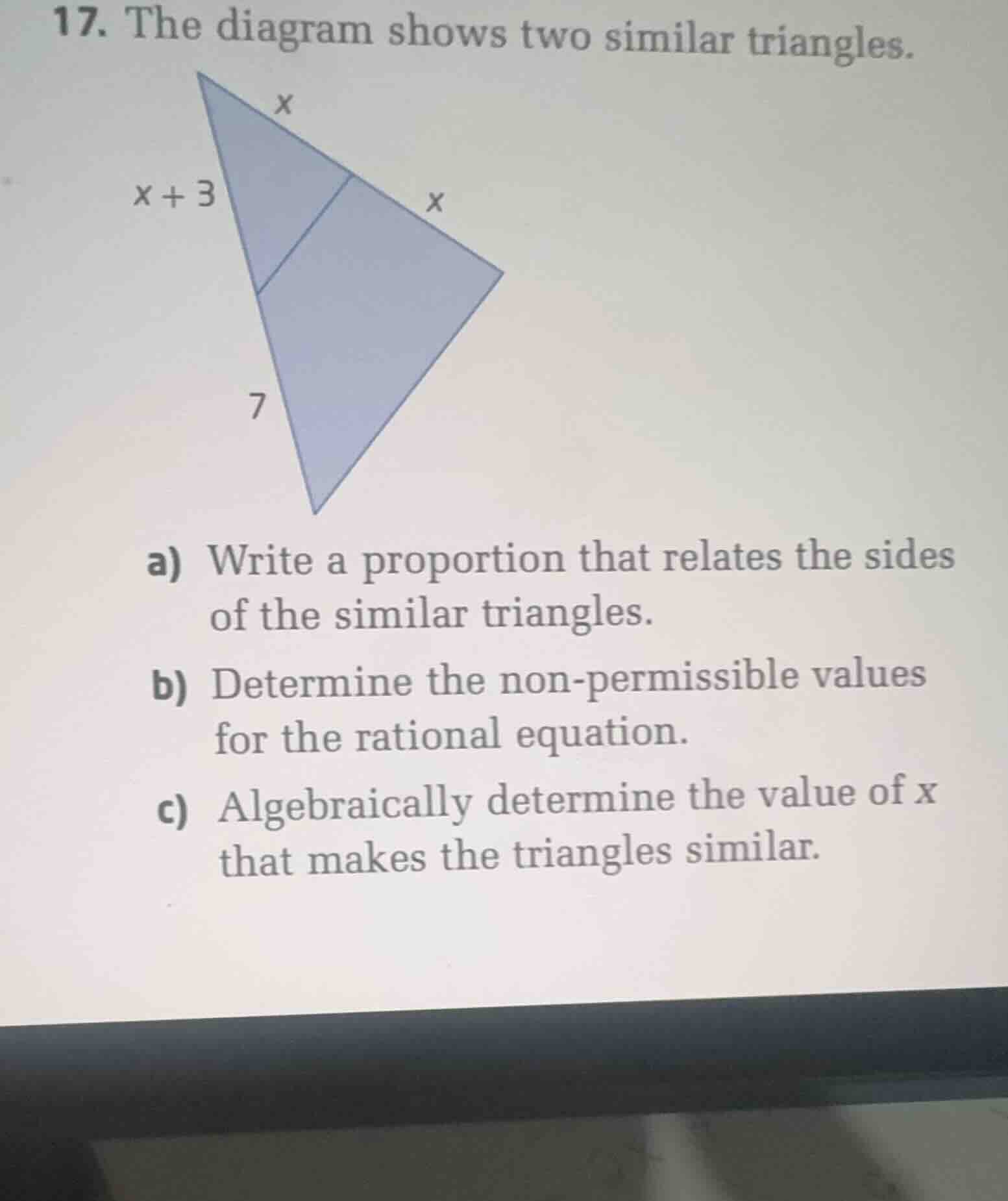
- the diagram shows two similar triangles.
a) write a proportion that relates the sides of the similar triangles.
b) determine the non-permissible values for the rational equation.
c) algebraically determine the value of x that makes the triangles similar.
Identify corresponding sides of similar triangles
The diagram shows a smaller triangle nested inside a larger triangle sharing the top vertex.
The sides of the smaller triangle from the shared vertex are \(x\) and \(x+3\).
The corresponding sides of the larger triangle from the shared vertex are:
- One side: \(x + x = 2x\)
- Other side: \((x+3) + 7 = x + 10\)
Since the triangles are similar, the ratio of corresponding sides must be equal:
Alternatively, comparing the smaller triangle's sides to the larger triangle's corresponding sides:
Determine non-permissible values
Using the Non-permissible Values knowledge point, we find the values of \(x\) that make any denominator in our rational equation equal to zero.
The denominators in the proportion are \(x+3\) and \(x+10\).
Set each denominator to zero:
Thus, the non-permissible values are \(x = -3\) and \(x = -10\).
Additionally, since \(x\) represents a physical length, we must have \(x > 0\).
Solve the rational equation for x
Cross-multiply the proportion to solve for \(x\):
Isolate the variable x
Subtract \(x^2\) from both sides:
Subtract \(6x\) from both sides:
Divide by 4:
Since \(2.25\) is positive and does not equal any non-permissible values, it is the valid solution.

Snap & solve any problem in the app
Get step-by-step solutions on Sovi AI
Photo-based solutions with guided steps
Explore more problems and detailed explanations
Question a
A proportion that relates the sides of the similar triangles is:
Question b
The non-permissible values for the rational equation are:
Question c
The value of \(x\) that makes the triangles similar is: