QUESTION IMAGE
Question
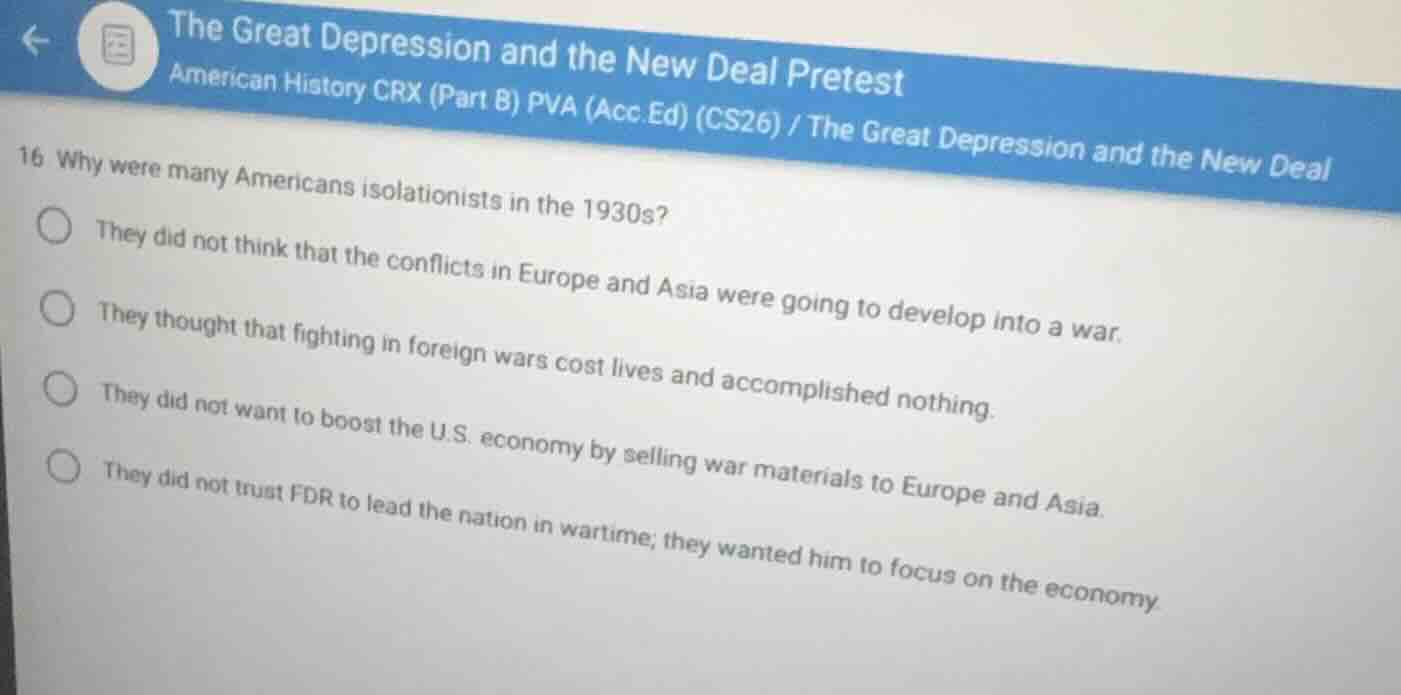
16 why were many americans isolationists in the 1930s?
they did not think that the conflicts in europe and asia were going to develop into a war.
they thought that fighting in foreign wars cost lives and accomplished nothing.
they did not want to boost the u.s. economy by selling war materials to europe and asia.
they did not trust fdr to lead the nation in wartime; they wanted him to focus on the economy.
<pre_analysis>
{
"quality": "clear",
"question_count": 1,
"skills_matched": [
"direct_cot",
"multiple_choice_formatter",
"explain_then_answer",
"tutor"
],
"needs_drawing": false,
"concepts_used": [
"Pre-WWII Foreign Policy"
],
"new_concepts": [
"American Isolationism",
"Nye Committee",
"Neutrality Acts"
],
"current_concepts": [
"Pre-WWII Foreign Policy",
"American Isolationism",
"Nye Committee",
"Neutrality Acts"
]
}
</pre_analysis>
<reasoning>
Analyze the historical context of the 1930s
During the 1930s, the United States was deeply affected by the Great Depression. Simultaneously, geopolitical tensions were rising in Europe and Asia. Having experienced the heavy casualties and economic strain of World War I, many Americans felt a strong sense of disillusionment regarding foreign interventions.
Evaluate the impact of World War I on public sentiment
Using the Pre-WWII Foreign Policy knowledge point, we recall that a dominant sentiment in the interwar period was that America's entry into World War I had been a mistake. Many believed that fighting in foreign wars cost precious American lives and ultimately accomplished very little, as it did not result in lasting global peace.
Assess the provided multiple-choice options
- Option 1: "They did not think that the conflicts in Europe and Asia were going to develop into a war." This is incorrect; many recognized the danger of war but simply wanted the U.S. to stay out of it.
- Option 2: "They thought that fighting in foreign wars cost lives and accomplished nothing." This directly aligns with the widespread disillusionment following World War I.
- Option 3: "They did not want to boost the U.S. economy by selling war materials to Europe and Asia." This is incorrect; many actually favored trade but opposed direct military involvement.
- Option 4: "They did not trust FDR to lead the nation in wartime..." This is incorrect; while there was political opposition, isolationism was a broad public sentiment rooted in the legacy of WWI rather than purely distrust of FDR.
Select the correct option
The second option accurately reflects the core motivation of 1930s isolationists, who believed that foreign conflicts were costly and futile.
</reasoning>
<answer>
<mcq-option>They did not think that the conflicts in Europe and Asia were going to develop into a war.</mcq-option>
<mcq-correct>They thought that fighting in foreign wars cost lives and accomplished nothing.</mcq-correct>
<mcq-option>They did not want to boost the U.S. economy by selling war materials to Europe and Asia.</mcq-option>
<mcq-option>They did not trust FDR to lead the nation in wartime; they wanted him to focus on the economy.</mcq-option>
</answer>
<post_analysis>
{
"subject": "Social Science",
"question_type": "Multiple Choice",
"knowledge_point": [
"Social Science",
"History",
"Pre-WWII Foreign Policy"
]
}
</post_analysis>
Snap & solve any problem in the app
Get step-by-step solutions on Sovi AI
Photo-based solutions with guided steps
Explore more problems and detailed explanations
<pre_analysis>
{
"quality": "clear",
"question_count": 1,
"skills_matched": [
"direct_cot",
"multiple_choice_formatter",
"explain_then_answer",
"tutor"
],
"needs_drawing": false,
"concepts_used": [
"Pre-WWII Foreign Policy"
],
"new_concepts": [
"American Isolationism",
"Nye Committee",
"Neutrality Acts"
],
"current_concepts": [
"Pre-WWII Foreign Policy",
"American Isolationism",
"Nye Committee",
"Neutrality Acts"
]
}
</pre_analysis>
<reasoning>
Analyze the historical context of the 1930s
During the 1930s, the United States was deeply affected by the Great Depression. Simultaneously, geopolitical tensions were rising in Europe and Asia. Having experienced the heavy casualties and economic strain of World War I, many Americans felt a strong sense of disillusionment regarding foreign interventions.
Evaluate the impact of World War I on public sentiment
Using the Pre-WWII Foreign Policy knowledge point, we recall that a dominant sentiment in the interwar period was that America's entry into World War I had been a mistake. Many believed that fighting in foreign wars cost precious American lives and ultimately accomplished very little, as it did not result in lasting global peace.
Assess the provided multiple-choice options
- Option 1: "They did not think that the conflicts in Europe and Asia were going to develop into a war." This is incorrect; many recognized the danger of war but simply wanted the U.S. to stay out of it.
- Option 2: "They thought that fighting in foreign wars cost lives and accomplished nothing." This directly aligns with the widespread disillusionment following World War I.
- Option 3: "They did not want to boost the U.S. economy by selling war materials to Europe and Asia." This is incorrect; many actually favored trade but opposed direct military involvement.
- Option 4: "They did not trust FDR to lead the nation in wartime..." This is incorrect; while there was political opposition, isolationism was a broad public sentiment rooted in the legacy of WWI rather than purely distrust of FDR.
Select the correct option
The second option accurately reflects the core motivation of 1930s isolationists, who believed that foreign conflicts were costly and futile.
</reasoning>
<answer>
<mcq-option>They did not think that the conflicts in Europe and Asia were going to develop into a war.</mcq-option>
<mcq-correct>They thought that fighting in foreign wars cost lives and accomplished nothing.</mcq-correct>
<mcq-option>They did not want to boost the U.S. economy by selling war materials to Europe and Asia.</mcq-option>
<mcq-option>They did not trust FDR to lead the nation in wartime; they wanted him to focus on the economy.</mcq-option>
</answer>
<post_analysis>
{
"subject": "Social Science",
"question_type": "Multiple Choice",
"knowledge_point": [
"Social Science",
"History",
"Pre-WWII Foreign Policy"
]
}
</post_analysis>