Sovi.AI - AI Math Tutor

Scan to solve math questions

QUESTION IMAGE

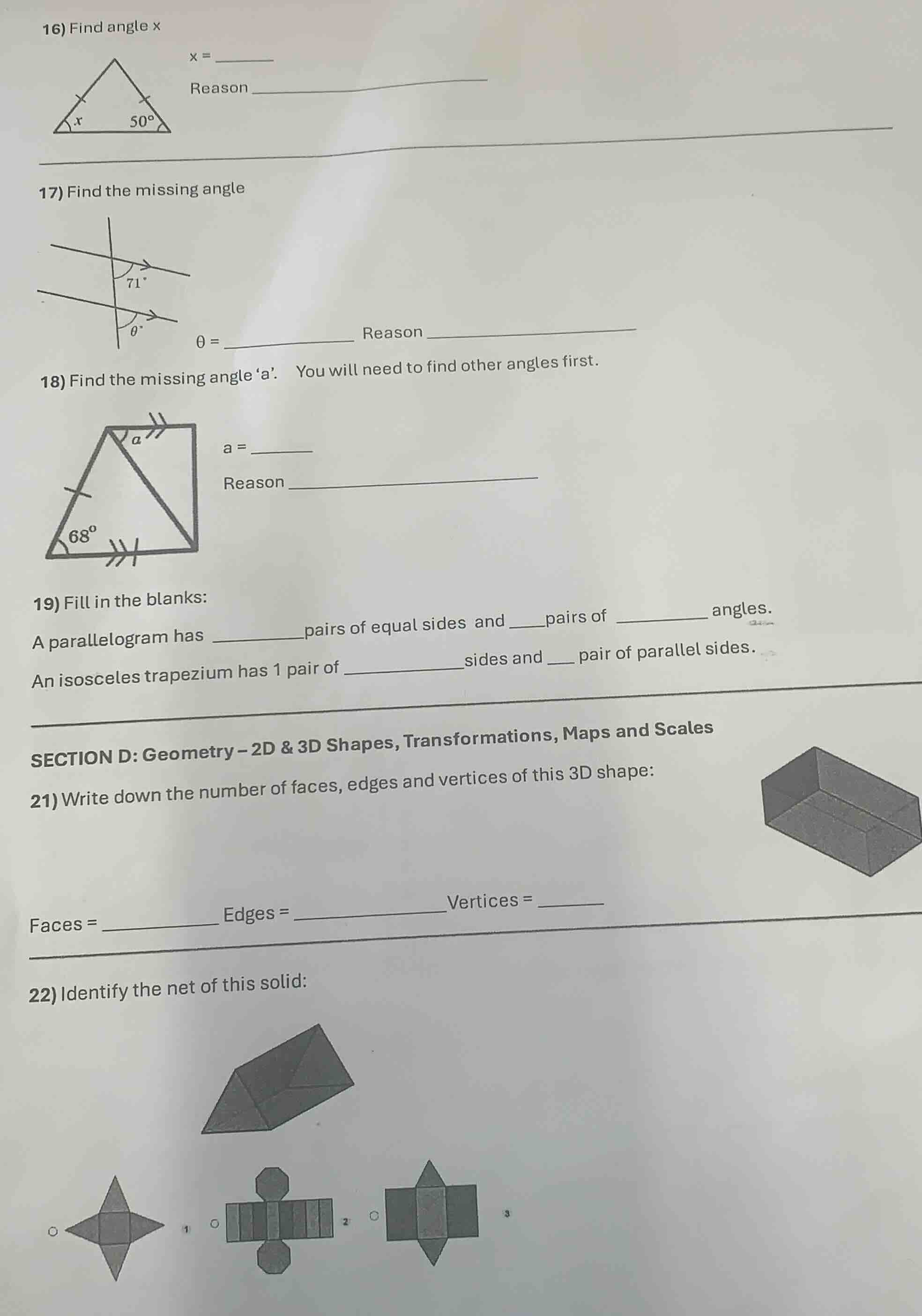
16) find angle x \\(x = \\underline{\\quad\\quad}\\) reason \\(\\underl…

Question

  1. find angle x

\\(x = \underline{\quad\quad}\\)
reason \\(\underline{\quad\quad\quad\quad\quad\quad\quad\quad\quad\quad\quad\quad\quad\quad\quad\quad\quad\quad\quad\quad\quad\quad\quad\quad\quad\quad\quad\quad}\\)

  1. find the missing angle

\\(\theta = \underline{\quad\quad}\\)
reason \\(\underline{\quad\quad\quad\quad\quad\quad\quad\quad\quad\quad\quad\quad\quad\quad\quad\quad\quad\quad\quad\quad\quad\quad\quad\quad\quad\quad\quad\quad}\\)

  1. find the missing angle a. you will need to find other angles first.

\\(a = \underline{\quad\quad}\\)
reason \\(\underline{\quad\quad\quad\quad\quad\quad\quad\quad\quad\quad\quad\quad\quad\quad\quad\quad\quad\quad\quad\quad\quad\quad\quad\quad\quad\quad\quad\quad}\\)

  1. fill in the blanks:

a parallelogram has \\(\underline{\quad\quad}\\) pairs of equal sides and \\(\underline{\quad\quad}\\) pairs of \\(\underline{\quad\quad}\\) angles.
an isosceles trapezium has 1 pair of \\(\underline{\quad\quad}\\) sides and \\(\underline{\quad\quad}\\) pair of parallel sides.

section d: geometry - 2d & 3d shapes, transformations, maps and scales

  1. write down the number of faces, edges and vertices of this 3d shape:

faces = \\(\underline{\quad\quad}\\) edges = \\(\underline{\quad\quad}\\) vertices = \\(\underline{\quad\quad}\\)

  1. identify the net of this solid:

Explanation:

Response

<pre_analysis>
{
"quality": "clear",
"question_count": 6,
"skills_matched": [
"step_cot",
"table_formatter",
"explain_then_answer",
"tutor"
],
"needs_drawing": false,
"concepts_used": [],
"new_concepts": [
"Isosceles Triangle Properties",
"Alternate Interior Angles",
"3D Shape Properties"
],
"current_concepts": [
"Isosceles Triangle Properties",
"Alternate Interior Angles",
"Angle Properties in Polygons",
"Properties of Quadrilaterals",
"3D Shape Properties",
"Geometric Nets"
]
}
</pre_analysis>

<reasoning>

Solve Question 16

The triangle shown is an isosceles triangle because two of its sides are marked with equal tick marks.
In an isosceles triangle, the angles opposite the equal sides are equal.
Therefore, the base angles are equal:
\[x = 50^\circ\]
The reason is that base angles of an isosceles triangle are equal.

Solve Question 17

The diagram shows two parallel lines cut by a transversal line.
The angle \(71^\circ\) and the angle \(\theta\) are alternate interior angles.
Since the lines are parallel, alternate interior angles are equal:
\[\theta = 71^\circ\]
The reason is that alternate interior angles are equal.

Solve Question 18

The shape contains a triangle and parallel lines.
The triangle on the left has two sides marked as equal, making it an isosceles triangle.
The base angle opposite one of the equal sides is \(68^\circ\).
Thus, the other base angle at the top is also \(68^\circ\).
The top side of the quadrilateral is parallel to the bottom side, indicated by the arrows.
The angle \(a\) and the base angle \(68^\circ\) at the bottom left are alternate interior angles.
Therefore:
\[a = 68^\circ\]
The reason is that alternate interior angles are equal.

Solve Question 19

A parallelogram has 2 pairs of equal sides and 2 pairs of equal angles (or opposite angles).
An isosceles trapezium has 1 pair of equal non-parallel sides and 1 pair of parallel sides.

Solve Question 21

The 3D shape shown is a cuboid (rectangular prism).
A cuboid has:

  • Faces = 6
  • Edges = 12
  • Vertices = 8

Solve Question 22

The 3D solid shown is a triangular prism.
A triangular prism has 2 triangular bases and 3 rectangular faces.
Looking at the options:

  • Option 1 is a net for a square-based pyramid (1 square, 4 triangles).
  • Option 2 is a net for a cylinder or a T-shape layout of a cross.
  • Option 3 is a net for a triangular prism (3 rectangles in a row with 2 triangles attached to the sides).

Therefore, the correct net is Option 3.
</reasoning>

<answer>

No.Answer
17\(\theta = 71^\circ\) <br> Reason: Alternate interior angles are equal.
18\(a = 68^\circ\) <br> Reason: Alternate interior angles are equal.
19A parallelogram has 2 pairs of equal sides and 2 pairs of equal angles. <br> An isosceles trapezium has 1 pair of equal sides and 1 pair of parallel sides.
21Faces = 6, Edges = 12, Vertices = 8
22Option 3

</answer>

<post_analysis>
{
"subject": "Mathematics",
"question_type": "Multi-part",
"knowledge_point": [
"Mathematics",
"Geometry",
"Angle Properties in Polygons"
]
}
</post_analysis>

Answer:

<pre_analysis>
{
"quality": "clear",
"question_count": 6,
"skills_matched": [
"step_cot",
"table_formatter",
"explain_then_answer",
"tutor"
],
"needs_drawing": false,
"concepts_used": [],
"new_concepts": [
"Isosceles Triangle Properties",
"Alternate Interior Angles",
"3D Shape Properties"
],
"current_concepts": [
"Isosceles Triangle Properties",
"Alternate Interior Angles",
"Angle Properties in Polygons",
"Properties of Quadrilaterals",
"3D Shape Properties",
"Geometric Nets"
]
}
</pre_analysis>

<reasoning>

Solve Question 16

The triangle shown is an isosceles triangle because two of its sides are marked with equal tick marks.
In an isosceles triangle, the angles opposite the equal sides are equal.
Therefore, the base angles are equal:
\[x = 50^\circ\]
The reason is that base angles of an isosceles triangle are equal.

Solve Question 17

The diagram shows two parallel lines cut by a transversal line.
The angle \(71^\circ\) and the angle \(\theta\) are alternate interior angles.
Since the lines are parallel, alternate interior angles are equal:
\[\theta = 71^\circ\]
The reason is that alternate interior angles are equal.

Solve Question 18

The shape contains a triangle and parallel lines.
The triangle on the left has two sides marked as equal, making it an isosceles triangle.
The base angle opposite one of the equal sides is \(68^\circ\).
Thus, the other base angle at the top is also \(68^\circ\).
The top side of the quadrilateral is parallel to the bottom side, indicated by the arrows.
The angle \(a\) and the base angle \(68^\circ\) at the bottom left are alternate interior angles.
Therefore:
\[a = 68^\circ\]
The reason is that alternate interior angles are equal.

Solve Question 19

A parallelogram has 2 pairs of equal sides and 2 pairs of equal angles (or opposite angles).
An isosceles trapezium has 1 pair of equal non-parallel sides and 1 pair of parallel sides.

Solve Question 21

The 3D shape shown is a cuboid (rectangular prism).
A cuboid has:

  • Faces = 6
  • Edges = 12
  • Vertices = 8

Solve Question 22

The 3D solid shown is a triangular prism.
A triangular prism has 2 triangular bases and 3 rectangular faces.
Looking at the options:

  • Option 1 is a net for a square-based pyramid (1 square, 4 triangles).
  • Option 2 is a net for a cylinder or a T-shape layout of a cross.
  • Option 3 is a net for a triangular prism (3 rectangles in a row with 2 triangles attached to the sides).

Therefore, the correct net is Option 3.
</reasoning>

<answer>

No.Answer
17\(\theta = 71^\circ\) <br> Reason: Alternate interior angles are equal.
18\(a = 68^\circ\) <br> Reason: Alternate interior angles are equal.
19A parallelogram has 2 pairs of equal sides and 2 pairs of equal angles. <br> An isosceles trapezium has 1 pair of equal sides and 1 pair of parallel sides.
21Faces = 6, Edges = 12, Vertices = 8
22Option 3

</answer>

<post_analysis>
{
"subject": "Mathematics",
"question_type": "Multi-part",
"knowledge_point": [
"Mathematics",
"Geometry",
"Angle Properties in Polygons"
]
}
</post_analysis>