Sovi.AI - AI Math Tutor

Scan to solve math questions

QUESTION IMAGE

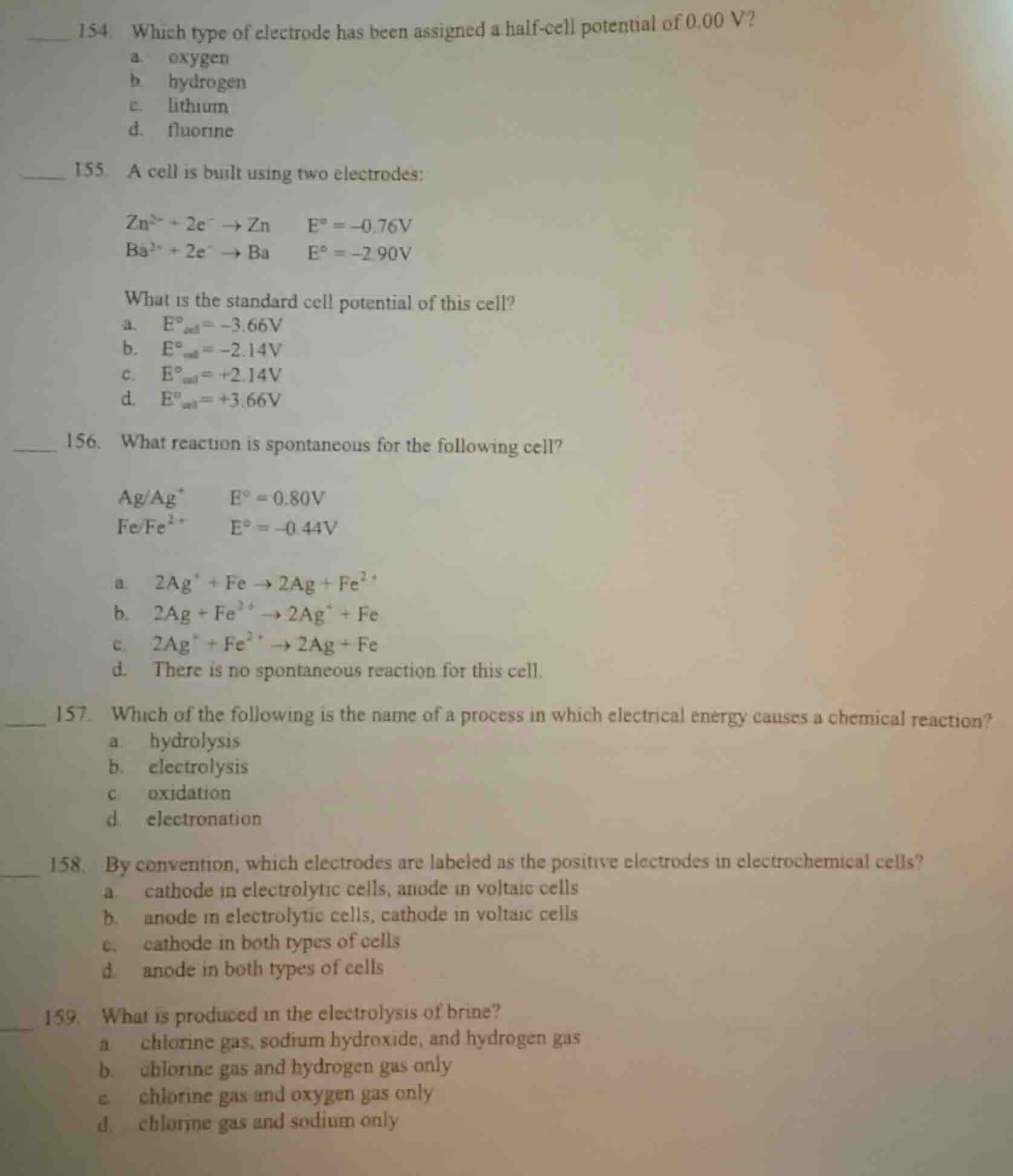
154. which type of electrode has been assigned a half-cell potential of…

Question

  1. which type of electrode has been assigned a half-cell potential of 0.00 v?

a. oxygen
b. hydrogen
c. lithium
d. fluorine

  1. a cell is built using two electrodes:

\\(\text{zn}^{2+} + 2e^- \
ightarrow \text{zn}\\) \\(e^\circ = -0.76\text{v}\\)
\\(\text{ba}^{2+} + 2e^- \
ightarrow \text{ba}\\) \\(e^\circ = -2.90\text{v}\\)

what is the standard cell potential of this cell?
a. \\(e^\circ_{\text{cell}} = -3.66\text{v}\\)
b. \\(e^\circ_{\text{cell}} = -2.14\text{v}\\)
c. \\(e^\circ_{\text{cell}} = +2.14\text{v}\\)
d. \\(e^\circ_{\text{cell}} = +3.66\text{v}\\)

  1. what reaction is spontaneous for the following cell?

\\(\text{ag}/\text{ag}^+\\) \\(e^\circ = 0.80\text{v}\\)
\\(\text{fe}/\text{fe}^{2+}\\) \\(e^\circ = -0.44\text{v}\\)

a. \\(2\text{ag}^+ + \text{fe} \
ightarrow 2\text{ag} + \text{fe}^{2+}\\)
b. \\(2\text{ag} + \text{fe}^{2+} \
ightarrow 2\text{ag}^+ + \text{fe}\\)
c. \\(2\text{ag}^+ + \text{fe}^{2+} \
ightarrow 2\text{ag} + \text{fe}\\)
d. there is no spontaneous reaction for this cell.

  1. which of the following is the name of a process in which electrical energy causes a chemical reaction?

a. hydrolysis
b. electrolysis
c. oxidation
d. electronation

  1. by convention, which electrodes are labeled as the positive electrodes in electrochemical cells?

a. cathode in electrolytic cells, anode in voltaic cells
b. anode in electrolytic cells, cathode in voltaic cells
c. cathode in both types of cells
d. anode in both types of cells

  1. what is produced in the electrolysis of brine?

a. chlorine gas, sodium hydroxide, and hydrogen gas
b. chlorine gas and hydrogen gas only
c. chlorine gas and oxygen gas only
d. chlorine gas and sodium only

Explanation:

Response

<pre_analysis>
{
"quality": "clear",
"question_count": 6,
"skills_matched": [
"step_cot",
"explain_then_answer",
"tutor",
"mastery_adaptive_brevity"
],
"needs_drawing": false,
"concepts_used": [
"Standard Hydrogen Electrode",
"Standard Cell Potential Calculation",
"Electrolysis"
],
"new_concepts": [
"Spontaneous Redox Reactions",
"Electrode Signs",
"Electrolysis of Brine"
],
"current_concepts": [
"Standard Hydrogen Electrode",
"Standard Cell Potential Calculation",
"Spontaneous Redox Reactions",
"Electrolysis",
"Electrode Signs",
"Electrolysis of Brine"
]
}
</pre_analysis>

<reasoning>

Identify the reference electrode

Using the Standard Hydrogen Electrode knowledge point
\[
E^\circ_{\text{SHE}} = 0.00\text{ V}
\]

Calculate standard cell potential

Using the Standard Cell Potential Calculation knowledge point
\[

$$\begin{aligned} E^\circ_{\text{cell}} &= E^\circ_{\text{cathode}} - E^\circ_{\text{anode}} \\ E^\circ_{\text{cell}} &= -0.76\text{ V} - (-2.90\text{ V}) = +2.14\text{ V} \end{aligned}$$

\]

Determine the spontaneous reaction

To find the spontaneous reaction, the half-reaction with the more positive standard reduction potential acts as the reduction at the cathode:
\[

$$\begin{aligned} \text{Reduction (Cathode): } & \text{Ag}^+ + e^- ightarrow \text{Ag} \quad (E^\circ = +0.80\text{ V}) \\ \text{Oxidation (Anode): } & \text{Fe} ightarrow \text{Fe}^{2+} + 2e^- \quad (E^\circ = -0.44\text{ V}) \end{aligned}$$

\]
Multiplying the reduction half-reaction by 2 to balance electrons and adding them gives:
\[
2\text{Ag}^+ + \text{Fe}
ightarrow 2\text{Ag} + \text{Fe}^{2+}
\]

Define electrical to chemical energy conversion

Using the Electrolysis knowledge point
\[
\text{Electrical Energy}
ightarrow \text{Chemical Reaction} \implies \text{Electrolysis}
\]

Determine positive electrode conventions

In a voltaic (galvanic) cell, spontaneous chemical reactions generate electricity, and the cathode is the positive electrode. In an electrolytic cell, an external power source drives a non-spontaneous reaction, making the anode the positive electrode. Thus, the positive electrodes are the anode in electrolytic cells and the cathode in voltaic cells.

Identify products of brine electrolysis

Using the Electrolysis knowledge point
\[
2\text{NaCl}(aq) + 2\text{H}_2\text{O}(l) \xrightarrow{\text{electrolysis}} \text{Cl}_2(g) + \text{H}_2(g) + 2\text{NaOH}(aq)
\]
</reasoning>

<answer>

Question 154

<mcq-option>a. oxygen</mcq-option>
<mcq-correct>b. hydrogen</mcq-correct>
<mcq-option>c. lithium</mcq-option>
<mcq-option>d. fluorine</mcq-option>

Question 155

<mcq-option>a. \(E^\circ_{\text{cell}} = -3.66\text{V}\)</mcq-option>
<mcq-option>b. \(E^\circ_{\text{cell}} = -2.14\text{V}\)</mcq-option>
<mcq-correct>c. \(E^\circ_{\text{cell}} = +2.14\text{V}\)</mcq-correct>
<mcq-option>d. \(E^\circ_{\text{cell}} = +3.66\text{V}\)</mcq-option>

Question 156

<mcq-correct>a. \(2\text{Ag}^+ + \text{Fe}
ightarrow 2\text{Ag} + \text{Fe}^{2+}\)</mcq-correct>
<mcq-option>b. \(2\text{Ag} + \text{Fe}^{3+}
ightarrow 2\text{Ag}^+ + \text{Fe}\)</mcq-option>
<mcq-option>c. \(2\text{Ag}^+ + \text{Fe}^{2+}
ightarrow 2\text{Ag} + \text{Fe}\)</mcq-option>
<mcq-option>d. There is no spontaneous reaction for this cell.</mcq-option>

Question 157

<mcq-option>a. hydrolysis</mcq-option>
<mcq-correct>b. electrolysis</mcq-correct>
<mcq-option>c. oxidation</mcq-option>
<mcq-option>d. electronation</mcq-option>

Question 158

<mcq-option>a. cathode in electrolytic cells,…

Answer:

<pre_analysis>
{
"quality": "clear",
"question_count": 6,
"skills_matched": [
"step_cot",
"explain_then_answer",
"tutor",
"mastery_adaptive_brevity"
],
"needs_drawing": false,
"concepts_used": [
"Standard Hydrogen Electrode",
"Standard Cell Potential Calculation",
"Electrolysis"
],
"new_concepts": [
"Spontaneous Redox Reactions",
"Electrode Signs",
"Electrolysis of Brine"
],
"current_concepts": [
"Standard Hydrogen Electrode",
"Standard Cell Potential Calculation",
"Spontaneous Redox Reactions",
"Electrolysis",
"Electrode Signs",
"Electrolysis of Brine"
]
}
</pre_analysis>

<reasoning>

Identify the reference electrode

Using the Standard Hydrogen Electrode knowledge point
\[
E^\circ_{\text{SHE}} = 0.00\text{ V}
\]

Calculate standard cell potential

Using the Standard Cell Potential Calculation knowledge point
\[

$$\begin{aligned} E^\circ_{\text{cell}} &= E^\circ_{\text{cathode}} - E^\circ_{\text{anode}} \\ E^\circ_{\text{cell}} &= -0.76\text{ V} - (-2.90\text{ V}) = +2.14\text{ V} \end{aligned}$$

\]

Determine the spontaneous reaction

To find the spontaneous reaction, the half-reaction with the more positive standard reduction potential acts as the reduction at the cathode:
\[

$$\begin{aligned} \text{Reduction (Cathode): } & \text{Ag}^+ + e^- ightarrow \text{Ag} \quad (E^\circ = +0.80\text{ V}) \\ \text{Oxidation (Anode): } & \text{Fe} ightarrow \text{Fe}^{2+} + 2e^- \quad (E^\circ = -0.44\text{ V}) \end{aligned}$$

\]
Multiplying the reduction half-reaction by 2 to balance electrons and adding them gives:
\[
2\text{Ag}^+ + \text{Fe}
ightarrow 2\text{Ag} + \text{Fe}^{2+}
\]

Define electrical to chemical energy conversion

Using the Electrolysis knowledge point
\[
\text{Electrical Energy}
ightarrow \text{Chemical Reaction} \implies \text{Electrolysis}
\]

Determine positive electrode conventions

In a voltaic (galvanic) cell, spontaneous chemical reactions generate electricity, and the cathode is the positive electrode. In an electrolytic cell, an external power source drives a non-spontaneous reaction, making the anode the positive electrode. Thus, the positive electrodes are the anode in electrolytic cells and the cathode in voltaic cells.

Identify products of brine electrolysis

Using the Electrolysis knowledge point
\[
2\text{NaCl}(aq) + 2\text{H}_2\text{O}(l) \xrightarrow{\text{electrolysis}} \text{Cl}_2(g) + \text{H}_2(g) + 2\text{NaOH}(aq)
\]
</reasoning>

<answer>

Question 154

<mcq-option>a. oxygen</mcq-option>
<mcq-correct>b. hydrogen</mcq-correct>
<mcq-option>c. lithium</mcq-option>
<mcq-option>d. fluorine</mcq-option>

Question 155

<mcq-option>a. \(E^\circ_{\text{cell}} = -3.66\text{V}\)</mcq-option>
<mcq-option>b. \(E^\circ_{\text{cell}} = -2.14\text{V}\)</mcq-option>
<mcq-correct>c. \(E^\circ_{\text{cell}} = +2.14\text{V}\)</mcq-correct>
<mcq-option>d. \(E^\circ_{\text{cell}} = +3.66\text{V}\)</mcq-option>

Question 156

<mcq-correct>a. \(2\text{Ag}^+ + \text{Fe}
ightarrow 2\text{Ag} + \text{Fe}^{2+}\)</mcq-correct>
<mcq-option>b. \(2\text{Ag} + \text{Fe}^{3+}
ightarrow 2\text{Ag}^+ + \text{Fe}\)</mcq-option>
<mcq-option>c. \(2\text{Ag}^+ + \text{Fe}^{2+}
ightarrow 2\text{Ag} + \text{Fe}\)</mcq-option>
<mcq-option>d. There is no spontaneous reaction for this cell.</mcq-option>

Question 157

<mcq-option>a. hydrolysis</mcq-option>
<mcq-correct>b. electrolysis</mcq-correct>
<mcq-option>c. oxidation</mcq-option>
<mcq-option>d. electronation</mcq-option>

Question 158

<mcq-option>a. cathode in electrolytic cells, anode in voltaic cells</mcq-option>
<mcq-correct>b. anode in electrolytic cells, cathode in voltaic cells</mcq-correct>
<mcq-option>c. cathode in both types of cells</mcq-option>
<mcq-option>d. anode in both types of cells</mcq-option>

Question 159

<mcq-correct>a. chlorine gas, sodium hydroxide, and hydrogen gas</mcq-correct>
<mcq-option>b. chlorine gas and hydrogen gas only</mcq-option>
<mcq-option>c. chlorine gas and oxygen gas only</mcq-option>
<mcq-option>d. chlorine gas and sodium only</mcq-option>
</answer>

<post_analysis>
{
"subject": "Natural Science",
"question_type": "Multiple Choice",
"knowledge_point": [
"Natural Science",
"Chemistry",
"Electrochemistry"
]
}
</post_analysis>