QUESTION IMAGE
Question
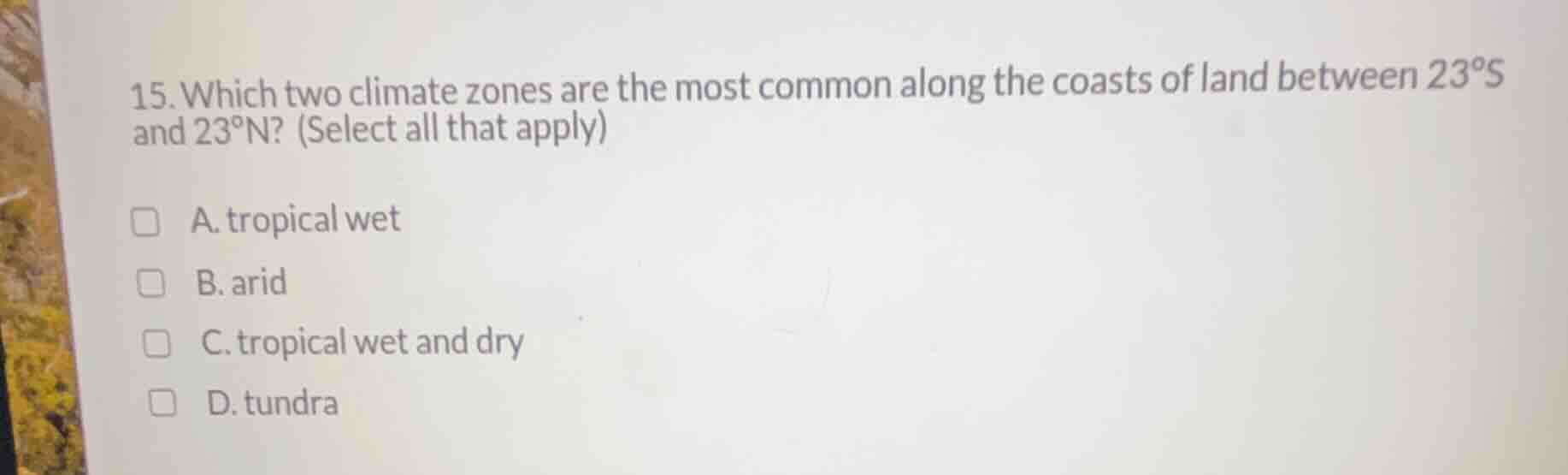
- which two climate zones are the most common along the coasts of land between 23°s and 23°n? (select all that apply)
a. tropical wet
b. arid
c. tropical wet and dry
d. tundra
<pre_analysis>
{
"quality": "clear",
"question_count": 1,
"skills_matched": [
"direct_cot",
"multiple_choice_formatter",
"explain_then_answer",
"quick"
],
"needs_drawing": false,
"concepts_used": [],
"new_concepts": [
"Global Climate Zones",
"Tropical Climates"
],
"current_concepts": [
"Oceania Climate Zones",
"Global Climate Zones",
"Tropical Climates"
]
}
</pre_analysis>
<reasoning>
Identify the latitudinal range
The region between \(23^\circ\text{S}\) (Tropic of Capricorn) and \(23^\circ\text{N}\) (Tropic of Cancer) represents the Earth's tropical zone.
Analyze the coastal climate characteristics
Within this tropical latitudinal band, coastal landmasses are heavily influenced by warm ocean currents, trade winds, and high solar radiation. These factors lead to high precipitation and warm temperatures year-round along the coasts.
Evaluate the options
- A. tropical wet: Highly common along equatorial and tropical coasts due to constant warm, moist maritime air masses.
- B. arid: Typically found inland or on western coasts adjacent to cold currents, but not the most common coastal type globally in this band.
- C. tropical wet and dry: Highly common in the outer tropics where seasonal shifts of the Intertropical Convergence Zone (ITCZ) create distinct wet and dry seasons along coasts.
- D. tundra: Found only in high-latitude polar regions, completely absent from this tropical band.
</reasoning>
<answer>
<mcq-correct>A. tropical wet</mcq-correct>
<mcq-option>B. arid</mcq-option>
<mcq-correct>C. tropical wet and dry</mcq-correct>
<mcq-option>D. tundra</mcq-option>
</answer>
<post_analysis>
{
"subject": "Social Science",
"question_type": "Multiple Choice",
"knowledge_point": [
"Social Science",
"Geography",
"Global Climate Zones"
]
}
</post_analysis>
Snap & solve any problem in the app
Get step-by-step solutions on Sovi AI
Photo-based solutions with guided steps
Explore more problems and detailed explanations
<pre_analysis>
{
"quality": "clear",
"question_count": 1,
"skills_matched": [
"direct_cot",
"multiple_choice_formatter",
"explain_then_answer",
"quick"
],
"needs_drawing": false,
"concepts_used": [],
"new_concepts": [
"Global Climate Zones",
"Tropical Climates"
],
"current_concepts": [
"Oceania Climate Zones",
"Global Climate Zones",
"Tropical Climates"
]
}
</pre_analysis>
<reasoning>
Identify the latitudinal range
The region between \(23^\circ\text{S}\) (Tropic of Capricorn) and \(23^\circ\text{N}\) (Tropic of Cancer) represents the Earth's tropical zone.
Analyze the coastal climate characteristics
Within this tropical latitudinal band, coastal landmasses are heavily influenced by warm ocean currents, trade winds, and high solar radiation. These factors lead to high precipitation and warm temperatures year-round along the coasts.
Evaluate the options
- A. tropical wet: Highly common along equatorial and tropical coasts due to constant warm, moist maritime air masses.
- B. arid: Typically found inland or on western coasts adjacent to cold currents, but not the most common coastal type globally in this band.
- C. tropical wet and dry: Highly common in the outer tropics where seasonal shifts of the Intertropical Convergence Zone (ITCZ) create distinct wet and dry seasons along coasts.
- D. tundra: Found only in high-latitude polar regions, completely absent from this tropical band.
</reasoning>
<answer>
<mcq-correct>A. tropical wet</mcq-correct>
<mcq-option>B. arid</mcq-option>
<mcq-correct>C. tropical wet and dry</mcq-correct>
<mcq-option>D. tundra</mcq-option>
</answer>
<post_analysis>
{
"subject": "Social Science",
"question_type": "Multiple Choice",
"knowledge_point": [
"Social Science",
"Geography",
"Global Climate Zones"
]
}
</post_analysis>