QUESTION IMAGE
Question
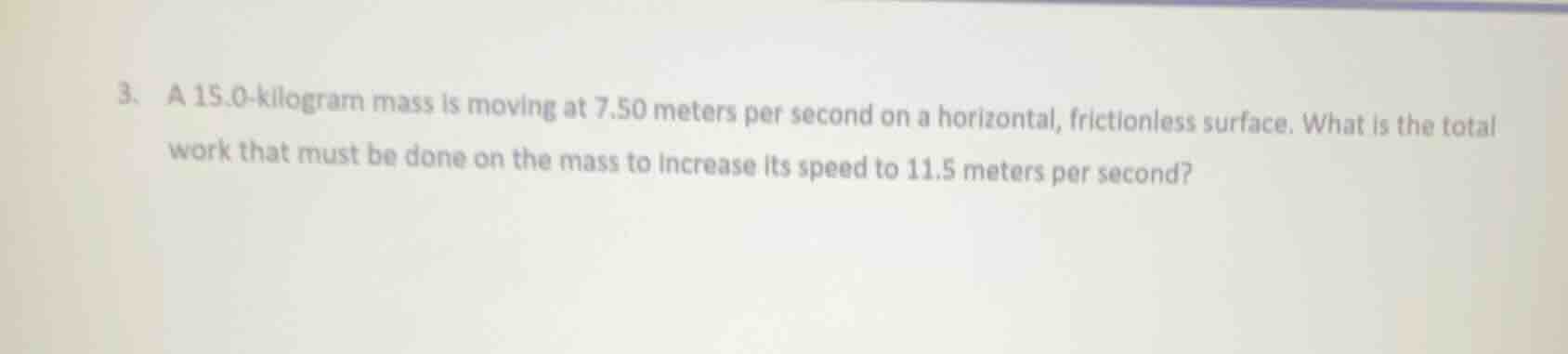
- a 15.0 - kilogram mass is moving at 7.50 meters per second on a horizontal, frictionless surface. what is the total work that must be done on the mass to increase its speed to 11.5 meters per second?
Step1: Recall the Work - Energy Theorem
The work - energy theorem states that the net work done on an object is equal to the change in its kinetic energy. The formula for kinetic energy is $KE=\frac{1}{2}mv^{2}$, where $m$ is the mass of the object and $v$ is its velocity. The work done $W$ is given by $W=\Delta KE = KE_{f}-KE_{i}$, where $KE_{f}$ is the final kinetic energy and $KE_{i}$ is the initial kinetic energy.
Step2: Identify the given values
We are given that the mass of the object $m = 15.0\space kg$, the initial velocity $v_{i}=7.50\space m/s$, and the final velocity $v_{f}=11.5\space m/s$.
Step3: Calculate the initial kinetic energy
Using the formula for kinetic energy $KE_{i}=\frac{1}{2}mv_{i}^{2}$, substitute $m = 15.0\space kg$ and $v_{i}=7.50\space m/s$:
Step4: Calculate the final kinetic energy
Using the formula for kinetic energy $KE_{f}=\frac{1}{2}mv_{f}^{2}$, substitute $m = 15.0\space kg$ and $v_{f}=11.5\space m/s$:
Step5: Calculate the work done
Using the work - energy theorem $W=\Delta KE=KE_{f}-KE_{i}$, substitute the values of $KE_{f}$ and $KE_{i}$:

Snap & solve any problem in the app
Get step-by-step solutions on Sovi AI
Photo-based solutions with guided steps
Explore more problems and detailed explanations
The total work done on the mass is $\boldsymbol{570\space J}$ (or more precisely, if we calculate with more decimal places:
So the work done is $570\space J$)