QUESTION IMAGE
Question
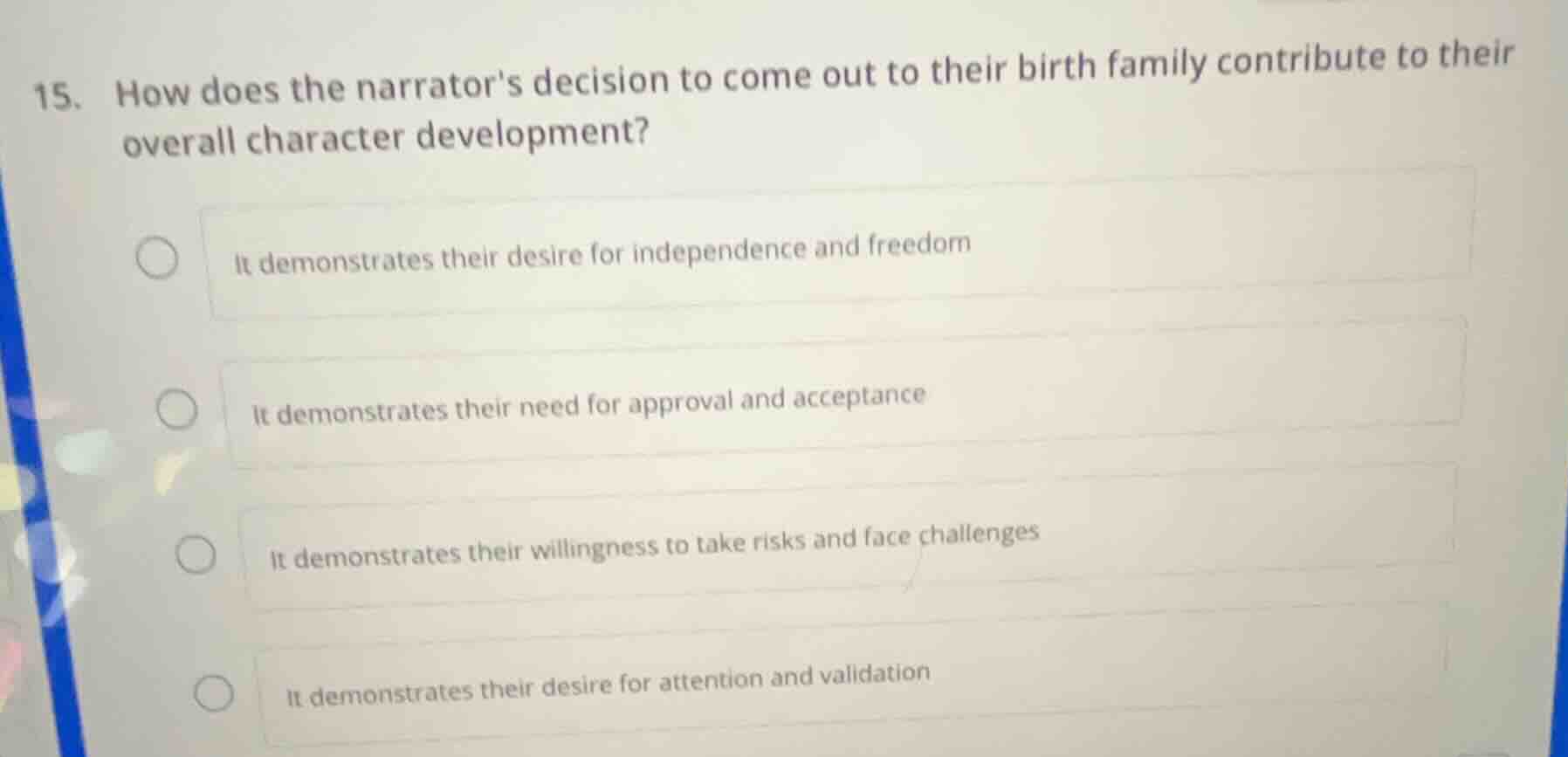
- how does the narrators decision to come out to their birth family contribute to their overall character development?
it demonstrates their desire for independence and freedom
it demonstrates their need for approval and acceptance
it demonstrates their willingness to take risks and face challenges
it demonstrates their desire for attention and validation
<pre_analysis>
{
"quality": "clear",
"question_count": 1,
"skills_matched": [
"direct_cot",
"multiple_choice_formatter",
"explain_then_answer",
"tutor",
"mastery_adaptive_brevity"
],
"needs_drawing": false,
"concepts_used": [
"Character Development",
"Coming Out Narrative"
],
"new_concepts": [],
"current_concepts": [
"Character Development",
"Coming Out Narrative",
"Textual Analysis"
]
}
</pre_analysis>
<reasoning>
Analyze the character's decision
Using the Coming Out Narrative knowledge point, coming out to a birth family involves vulnerability, navigating complex relationships, and confronting potential rejection. This choice highlights a significant personal threshold where the character chooses authenticity over safety.
Connect to character growth
Using the Character Development knowledge point, making a high-stakes choice to reveal one's true identity to birth family members demonstrates a profound readiness to confront difficult emotional landscapes. This action directly illustrates the character's courage, resilience, and active agency in navigating personal obstacles.
Evaluate the options
- Option 1 focuses on independence, which is secondary to the emotional confrontation of coming out.
- Option 2 suggests a need for approval, whereas coming out often risks disapproval, showing a move past merely seeking approval.
- Option 3 directly aligns with the courage required to face potential rejection and emotional difficulty.
- Option 4 mischaracterizes the decision as attention-seeking rather than a search for authentic self-expression.
</reasoning>
<answer>
<mcq-option>(A) It demonstrates their desire for independence and freedom</mcq-option>
<mcq-option>(B) It demonstrates their need for approval and acceptance</mcq-option>
<mcq-correct>(C) It demonstrates their willingness to take risks and face challenges</mcq-correct>
<mcq-option>(D) It demonstrates their desire for attention and validation</mcq-option>
</answer>
<post_analysis>
{
"subject": "Others",
"question_type": "Multiple Choice",
"knowledge_point": [
"Others",
"Literature",
"Character Analysis"
]
}
</post_analysis>
Snap & solve any problem in the app
Get step-by-step solutions on Sovi AI
Photo-based solutions with guided steps
Explore more problems and detailed explanations
<pre_analysis>
{
"quality": "clear",
"question_count": 1,
"skills_matched": [
"direct_cot",
"multiple_choice_formatter",
"explain_then_answer",
"tutor",
"mastery_adaptive_brevity"
],
"needs_drawing": false,
"concepts_used": [
"Character Development",
"Coming Out Narrative"
],
"new_concepts": [],
"current_concepts": [
"Character Development",
"Coming Out Narrative",
"Textual Analysis"
]
}
</pre_analysis>
<reasoning>
Analyze the character's decision
Using the Coming Out Narrative knowledge point, coming out to a birth family involves vulnerability, navigating complex relationships, and confronting potential rejection. This choice highlights a significant personal threshold where the character chooses authenticity over safety.
Connect to character growth
Using the Character Development knowledge point, making a high-stakes choice to reveal one's true identity to birth family members demonstrates a profound readiness to confront difficult emotional landscapes. This action directly illustrates the character's courage, resilience, and active agency in navigating personal obstacles.
Evaluate the options
- Option 1 focuses on independence, which is secondary to the emotional confrontation of coming out.
- Option 2 suggests a need for approval, whereas coming out often risks disapproval, showing a move past merely seeking approval.
- Option 3 directly aligns with the courage required to face potential rejection and emotional difficulty.
- Option 4 mischaracterizes the decision as attention-seeking rather than a search for authentic self-expression.
</reasoning>
<answer>
<mcq-option>(A) It demonstrates their desire for independence and freedom</mcq-option>
<mcq-option>(B) It demonstrates their need for approval and acceptance</mcq-option>
<mcq-correct>(C) It demonstrates their willingness to take risks and face challenges</mcq-correct>
<mcq-option>(D) It demonstrates their desire for attention and validation</mcq-option>
</answer>
<post_analysis>
{
"subject": "Others",
"question_type": "Multiple Choice",
"knowledge_point": [
"Others",
"Literature",
"Character Analysis"
]
}
</post_analysis>