QUESTION IMAGE
Question
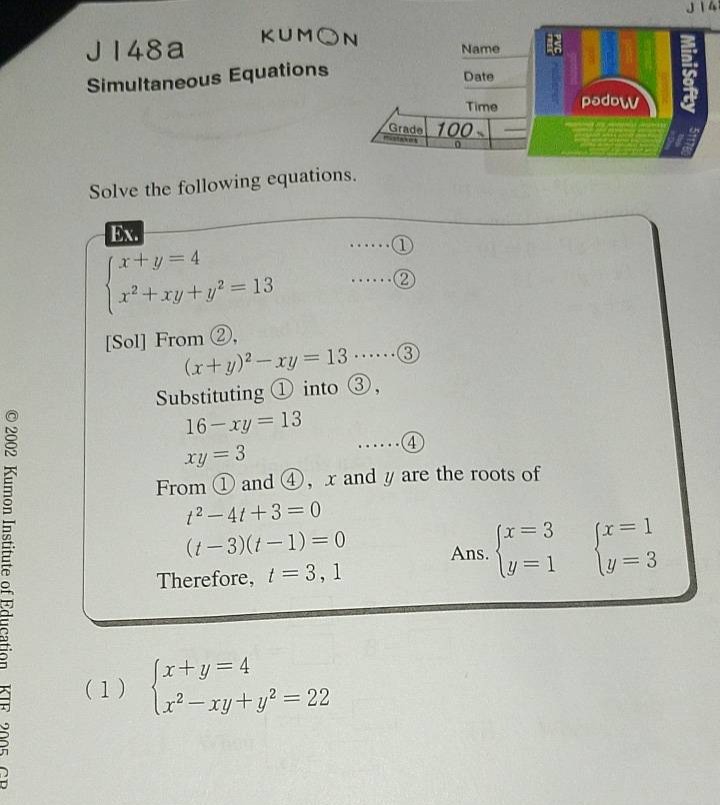
j 148a kumon
simultaneous equations
solve the following equations.
ex.
\\(\
$$\begin{cases} x + y = 4 & \\dots\\dots (1) \\\\ x^2 + xy + y^2 = 13 & \\dots\\dots (2) \\end{cases}$$
\\)
sol from (2),
\\((x + y)^2 - xy = 13 \dots\dots (3)\\)
substituting (1) into (3),
\\(16 - xy = 13\\)
\\(xy = 3 \dots\dots (4)\\)
from (1) and (4), \\(x\\) and \\(y\\) are the roots of
\\(t^2 - 4t + 3 = 0\\)
\\((t - 3)(t - 1) = 0\\)
therefore, \\(t = 3, 1\\)
ans. \\(\
$$\begin{cases} x = 3 \\\\ y = 1 \\end{cases}$$
\\), \\(\
$$\begin{cases} x = 1 \\\\ y = 3 \\end{cases}$$
\\)
(1) \\(\
$$\begin{cases} x + y = 4 \\\\ x^2 - xy + y^2 = 22 \\end{cases}$$
\\)
Step1: Rewrite the second equation
$$
(x+y)^2 - 3xy = 22
$$
Step2: Substitute the first equation
$$
4^2 - 3xy = 22
$$
Step3: Solve for the product
$$
xy = -2
$$
Step4: Form the quadratic equation
$$
t^2 - 4t - 2 = 0
$$
Step5: Solve for the roots
$$
t = 2 \pm \sqrt{6}
$$
Step6: State the final solutions
$$
LATEXBLOCK0
, \quad
LATEXBLOCK1
$$

Snap & solve any problem in the app
Get step-by-step solutions on Sovi AI
Photo-based solutions with guided steps
Explore more problems and detailed explanations
$$
LATEXBLOCK0
, \quad
LATEXBLOCK1
$$