QUESTION IMAGE
Question
j 136b
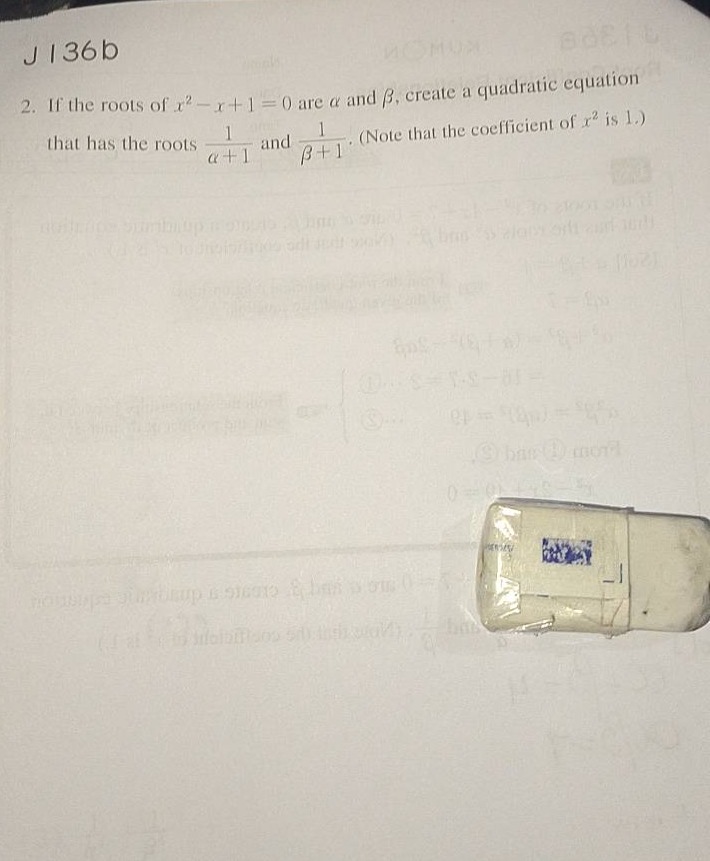
- if the roots of (x^2 - x + 1 = 0) are (alpha) and (\beta), create a quadratic equation that has the roots (\frac{1}{alpha + 1}) and (\frac{1}{\beta + 1}). (note that the coefficient of (x^2) is 1.)
Step1: Find sum and product of original roots
$$\alpha + \beta = 1, \quad \alpha\beta = 1$$
Step2: Calculate sum of new roots
$$\frac{1}{\alpha+1} + \frac{1}{\beta+1} = \frac{\alpha+\beta+2}{\alpha\beta+\alpha+\beta+1} = \frac{1+2}{1+1+1} = 1$$
Step3: Calculate product of new roots
$$\frac{1}{\alpha+1} \cdot \frac{1}{\beta+1} = \frac{1}{\alpha\beta+\alpha+\beta+1} = \frac{1}{1+1+1} = \frac{1}{3}$$
Step4: Formulate the new quadratic equation
$$x^2 - x + \frac{1}{3} = 0 \implies 3x^2 - 3x + 1 = 0$$

Snap & solve any problem in the app
Get step-by-step solutions on Sovi AI
Photo-based solutions with guided steps
Explore more problems and detailed explanations
\(3x^2 - 3x + 1 = 0\)