Sovi.AI - AI Math Tutor

Scan to solve math questions

QUESTION IMAGE

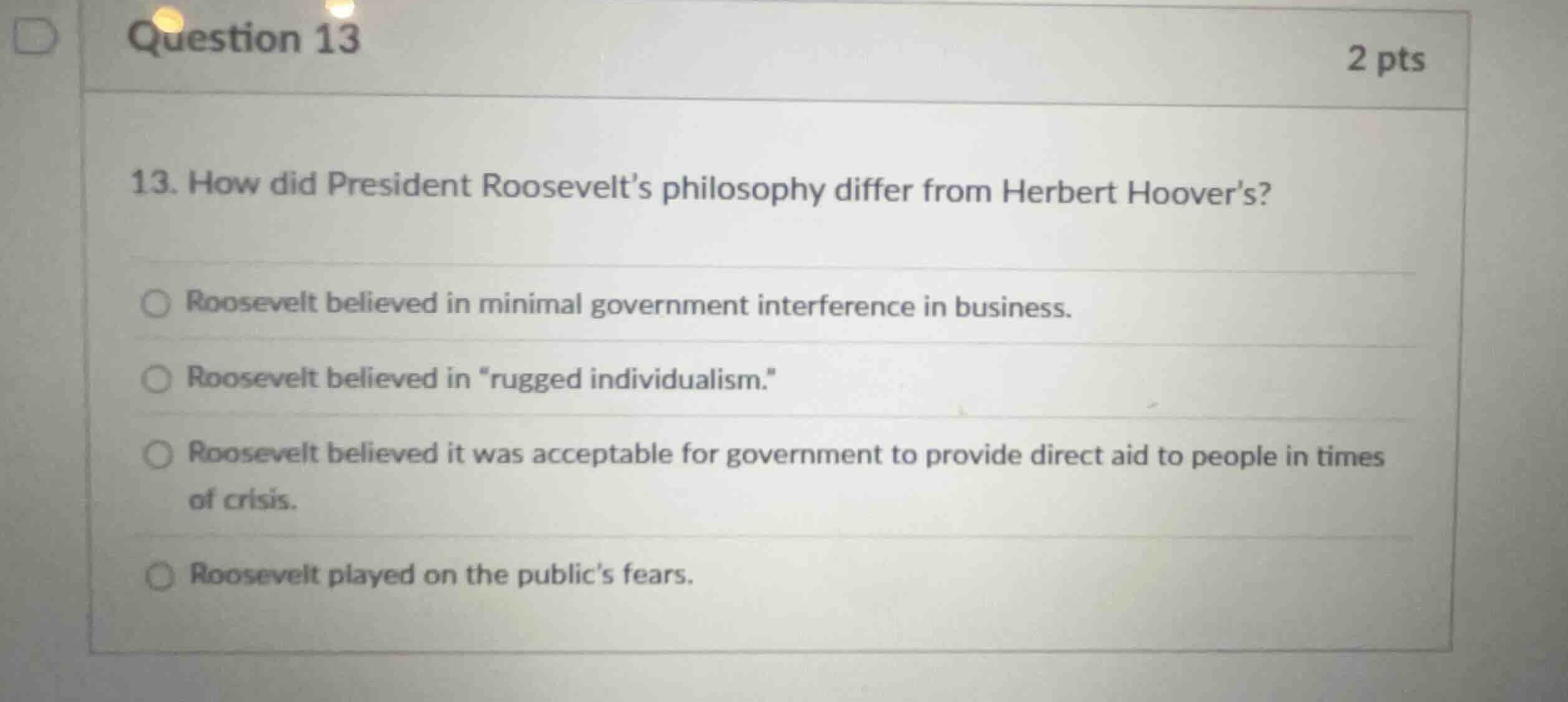
13. how did president roosevelts philosophy differ from herbert hoovers…

Question

  1. how did president roosevelts philosophy differ from herbert hoovers?

roosevelt believed in minimal government interference in business.
roosevelt believed in
ugged individualism.\
roosevelt believed it was acceptable for government to provide direct aid to people in times of crisis.
roosevelt played on the publics fears.

Explanation:

Response

<pre_analysis>
{
"quality": "clear",
"question_count": 1,
"skills_matched": [
"direct_cot",
"multiple_choice_formatter",
"explain_then_answer",
"tutor"
],
"needs_drawing": false,
"concepts_used": [
"Great Depression"
],
"new_concepts": [
"New Deal Philosophy",
"Rugged Individualism"
],
"current_concepts": [
"Great Depression",
"New Deal Philosophy",
"Rugged Individualism"
]
}
</pre_analysis>

<reasoning>

Analyze Hoover's economic philosophy

Herbert Hoover believed in "rugged individualism" and voluntary cooperation. He argued that direct federal relief would weaken individual initiative and self-reliance during the Great Depression.

Analyze Roosevelt's economic philosophy

Franklin D. Roosevelt advocated for active government intervention. He believed the federal government had a direct responsibility to provide relief, recovery, and reform to citizens during economic crises.

Compare the philosophies

The key difference lies in direct federal aid. Hoover opposed direct federal welfare payments, whereas Roosevelt embraced direct relief programs to assist struggling Americans.

Evaluate the given options

  • Option 1 describes Hoover's laissez-faire leaning, not Roosevelt's.
  • Option 2 describes Hoover's core philosophy of "rugged individualism."
  • Option 3 correctly identifies Roosevelt's belief in direct government aid during crises.
  • Option 4 is historically inaccurate and does not represent a philosophical difference.

</reasoning>

<answer>
<mcq-option>Roosevelt believed in minimal government interference in business.</mcq-option>
<mcq-option>Roosevelt believed in "rugged individualism."</mcq-option>
<mcq-correct>Roosevelt believed it was acceptable for government to provide direct aid to people in times of crisis.</mcq-correct>
<mcq-option>Roosevelt played on the public's fears.</mcq-option>
</answer>

<post_analysis>
{
"subject": "Social Science",
"question_type": "Multiple Choice",
"knowledge_point": [
"Social Science",
"History",
"Great Depression and New Deal"
]
}
</post_analysis>

Answer:

<pre_analysis>
{
"quality": "clear",
"question_count": 1,
"skills_matched": [
"direct_cot",
"multiple_choice_formatter",
"explain_then_answer",
"tutor"
],
"needs_drawing": false,
"concepts_used": [
"Great Depression"
],
"new_concepts": [
"New Deal Philosophy",
"Rugged Individualism"
],
"current_concepts": [
"Great Depression",
"New Deal Philosophy",
"Rugged Individualism"
]
}
</pre_analysis>

<reasoning>

Analyze Hoover's economic philosophy

Herbert Hoover believed in "rugged individualism" and voluntary cooperation. He argued that direct federal relief would weaken individual initiative and self-reliance during the Great Depression.

Analyze Roosevelt's economic philosophy

Franklin D. Roosevelt advocated for active government intervention. He believed the federal government had a direct responsibility to provide relief, recovery, and reform to citizens during economic crises.

Compare the philosophies

The key difference lies in direct federal aid. Hoover opposed direct federal welfare payments, whereas Roosevelt embraced direct relief programs to assist struggling Americans.

Evaluate the given options

  • Option 1 describes Hoover's laissez-faire leaning, not Roosevelt's.
  • Option 2 describes Hoover's core philosophy of "rugged individualism."
  • Option 3 correctly identifies Roosevelt's belief in direct government aid during crises.
  • Option 4 is historically inaccurate and does not represent a philosophical difference.

</reasoning>

<answer>
<mcq-option>Roosevelt believed in minimal government interference in business.</mcq-option>
<mcq-option>Roosevelt believed in "rugged individualism."</mcq-option>
<mcq-correct>Roosevelt believed it was acceptable for government to provide direct aid to people in times of crisis.</mcq-correct>
<mcq-option>Roosevelt played on the public's fears.</mcq-option>
</answer>

<post_analysis>
{
"subject": "Social Science",
"question_type": "Multiple Choice",
"knowledge_point": [
"Social Science",
"History",
"Great Depression and New Deal"
]
}
</post_analysis>