QUESTION IMAGE
Question
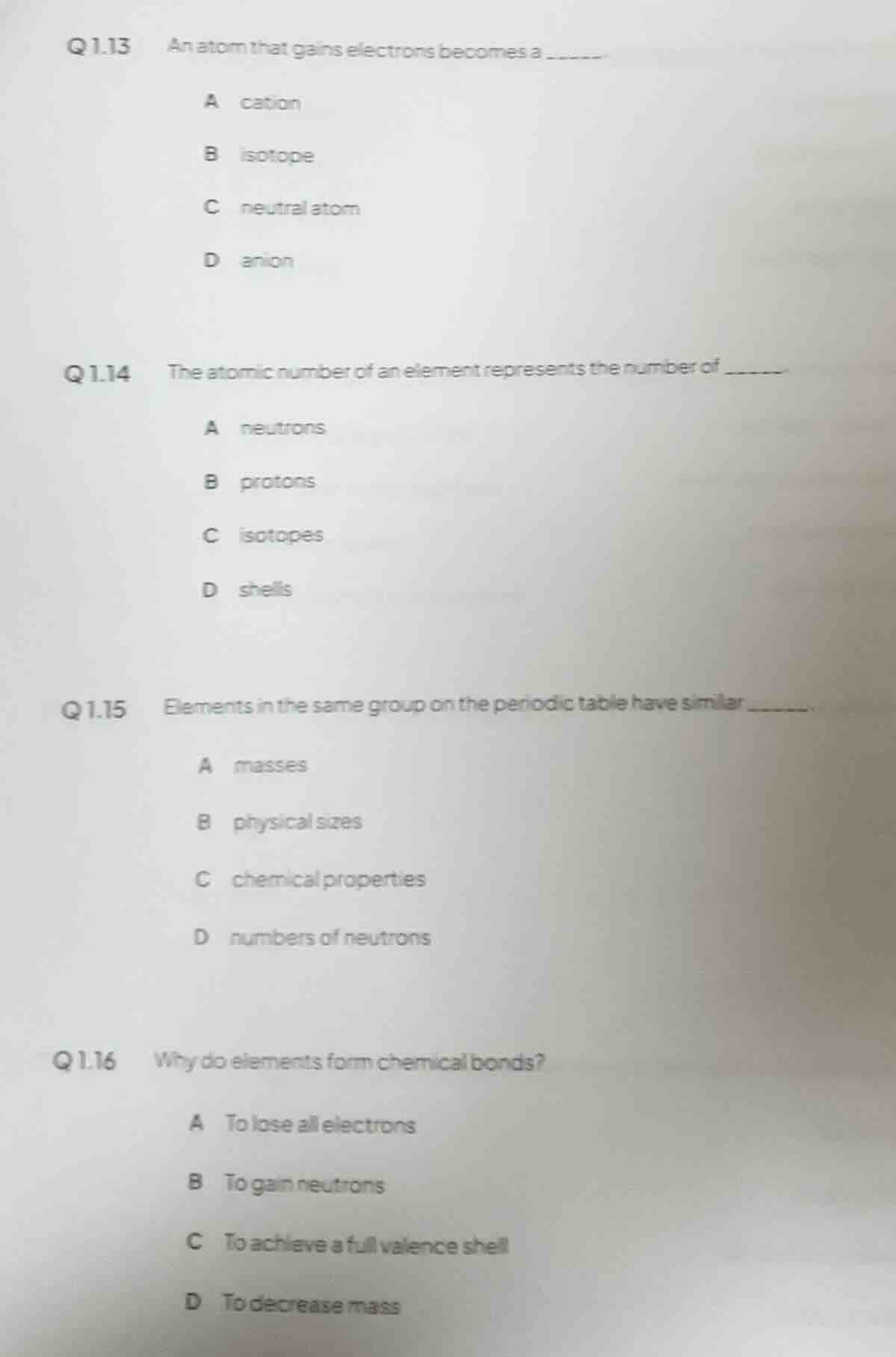
q 1.13 an atom that gains electrons becomes a ______
a cation
b isotope
c neutral atom
d anion
q 1.14 the atomic number of an element represents the number of ______
a neutrons
b protons
c isotopes
d shells
q 1.15 elements in the same group on the periodic table have similar ______
a masses
b physical sizes
c chemical properties
d numbers of neutrons
q 1.16 why do elements form chemical bonds?
a to lose all electrons
b to gain neutrons
c to achieve a full valence shell
d to decrease mass
Analyze Q 1.13: Ion formation
An atom that gains electrons acquires a negative charge because electrons are negatively charged subatomic particles. A negatively charged ion is called an anion.
Analyze Q 1.14: Atomic number definition
The atomic number of an element is defined as the number of protons in the nucleus of an atom of that element.
Analyze Q 1.15: Periodic table groups
Elements in the same vertical column (group) of the periodic table have the same number of valence electrons, which gives them similar chemical properties.
Analyze Q 1.16: Purpose of chemical bonding
Atoms form chemical bonds to achieve a stable electron configuration, which typically means having a full outer (valence) shell of electrons.

Snap & solve any problem in the app
Get step-by-step solutions on Sovi AI
Photo-based solutions with guided steps
Explore more problems and detailed explanations
Question 1.13
- A cation
- B isotope
- C neutral atom
- D anion (Correct answer)
Question 1.14
- A neutrons
- B protons (Correct answer)
- C isotopes
- D shells
Question 1.15
- A masses
- B physical sizes
- C chemical properties (Correct answer)
- D numbers of neutrons
Question 1.16
- A To lose all electrons
- B To gain neutrons
- C To achieve a full valence shell (Correct answer)
- D To decrease mass