QUESTION IMAGE
Question
12 using exact values (e.g. \\(10 + 4\pi\\)), find the area of the shapes given in question 6.
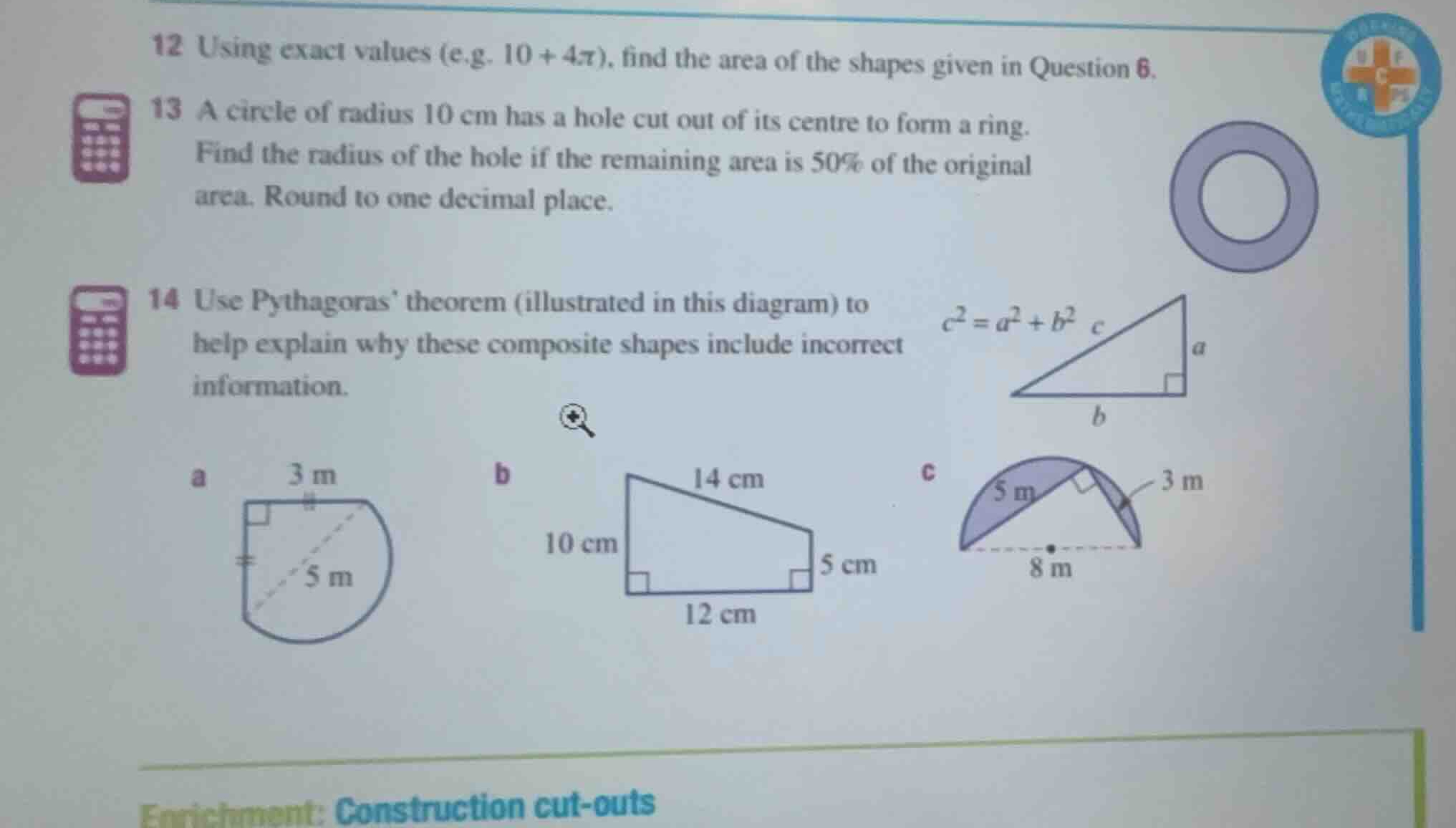
13 a circle of radius \\(10\text{ cm}\\) has a hole cut out of its centre to form a ring. find the radius of the hole if the remaining area is \\(50\\%\\) of the original area. round to one decimal place.
14 use pythagoras theorem (illustrated in this diagram) to help explain why these composite shapes include incorrect information.
a
b
c
Question 12
Identify missing reference.
Question 12 refers to "Question 6" which is not visible in the provided image. Therefore, Question 12 cannot be solved.
Question 13
Calculate the inner radius.
Using the Composite Shapes knowledge point:
The original area of the circle with radius \(R = 10\text{ cm}\) is:
The remaining area of the ring is \(50\%\) of the original area:
The area of the ring is the difference between the outer circle and the inner hole of radius \(r\):
Set them equal to solve for \(r\):
Rounding to one decimal place gives \(7.1\text{ cm}\).
Question 14a
Analyze shape a.
The shape consists of a right-angled corner with two equal sides of length \(3\text{ m}\) (indicated by the tick marks) and a semicircle.
The dashed line represents the hypotenuse of the right-angled triangle formed by the two sides of length \(3\text{ m}\).
Using Pythagoras' theorem:
However, the diagram labels this dashed line as \(5\text{ m}\). Since \(\sqrt{18}
eq 5\), the given information is incorrect.
Question 14b
Analyze shape b.
The shape is a right-angled trapezoid. We can split it into a rectangle of dimensions \(12\text{ cm} \times 5\text{ cm}\) and a right-angled triangle.
The base of the triangle is \(12\text{ cm}\).
The height of the triangle is the difference between the two parallel vertical sides:
Using Pythagoras' theorem to find the hypotenuse \(c\):
However, the diagram labels the slanted side as \(14\text{ cm}\). Since \(13
eq 14\), the given information is incorrect.
Question 14c
Analyze shape c.
The shape contains a right-angled triangle inside a semicircle. The hypotenuse of this right-angled triangle is the diameter of the semicircle, labeled as \(8\text{ m}\).
The other two sides of the right-angled triangle are labeled as \(5\text{ m}\) and \(3\text{ m}\).
Using Pythagoras' theorem:
However, the diagram labels the hypotenuse as \(8\text{ m}\). Since \(\sqrt{34}
eq 8\), the given information is incorrect.

Snap & solve any problem in the app
Get step-by-step solutions on Sovi AI
Photo-based solutions with guided steps
Explore more problems and detailed explanations
Question 12
This question cannot be answered because it refers to Question 6, which is not visible in the image.
Question 13
The radius of the hole is \(7.1\text{ cm}\).
Question 14
- a: By Pythagoras' theorem, the hypotenuse of the right-angled triangle with legs of \(3\text{ m}\) should be \(\sqrt{3^2 + 3^2} = \sqrt{18} \approx 4.24\text{ m}\), but it is incorrectly labeled as \(5\text{ m}\).
- b: By splitting the trapezoid into a rectangle and a right-angled triangle, the legs of the triangle are \(12\text{ cm}\) and \(5\text{ cm}\). The hypotenuse should be \(\sqrt{12^2 + 5^2} = \sqrt{169} = 13\text{ cm}\), but it is incorrectly labeled as \(14\text{ cm}\).
- c: By Pythagoras' theorem, the hypotenuse of the right-angled triangle with legs of \(5\text{ m}\) and \(3\text{ m}\) should be \(\sqrt{5^2 + 3^2} = \sqrt{34} \approx 5.83\text{ m}\), but it is incorrectly labeled as \(8\text{ m}\).