QUESTION IMAGE
Question
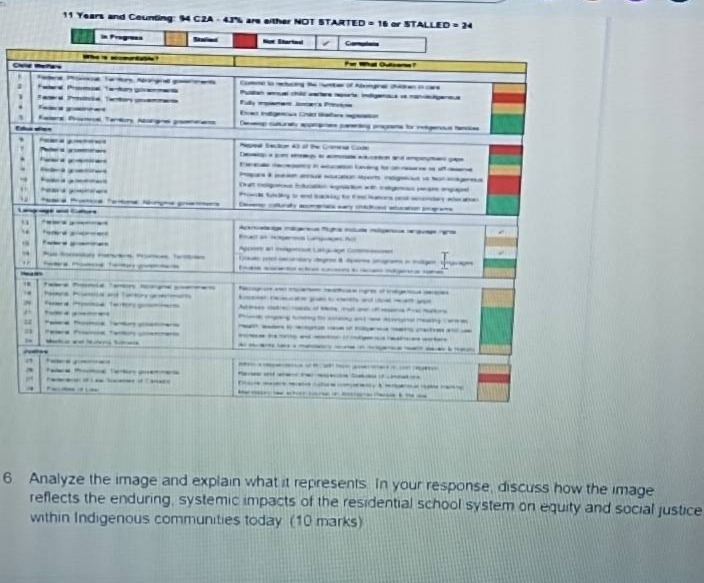
11 years and counting: 94 cta - 43% are either not started = 16 or stalled = 24
6 analyze the image and explain what it represents. in your response, discuss how the image reflects the enduring, systemic impacts of the residential school system on equity and social justice within indigenous communities today. (10 marks)
🆕 New Concept Discovered: Policy Progress and Systemic Equity Analysis
Analyzing institutional accountability and policy implementation gaps to understand ongoing systemic inequalities.
Step 1: Analyze the Image and Identify What It Represents
The image displays a progress tracker monitoring the implementation of the Truth and Reconciliation Commission of Canada (TRC) Calls to Action (specifically focusing on the first 28 Calls to Action, which cover the "Legacy" categories).
- Title and Header: The header reads "11 Years and Counting: 94 CTA - 43% are either NOT STARTED = 16 or STALLED = 24". This indicates that more than a decade after the initial reports, a significant portion of these critical directives remain unfulfilled.
- Categories Covered: The table lists specific legacy areas: Child Welfare (Calls 1–5), Education (Calls 6–12), Language and Culture (Calls 13–17), Health (Calls 18–24), and Justice (Calls 25–28).
- Status Indicators: Color-coded bars on the right indicate the status of each call:
- Green: In Progress
- Yellow/Orange: Stalled
- Red: Not Started
- Checkmark (\checkmark): Complete
- Key Observation: Very few items are marked with a checkmark (complete), while many critical areas—particularly in Education, Child Welfare, and Justice—remain stalled (yellow) or not started (red).
Step 2: Connect the Image to the Enduring, Systemic Impacts of Residential Schools
The residential school system was a deliberate, state-sponsored policy aimed at cultural assimilation, which systematically disrupted Indigenous families, languages, cultures, and governance structures. The categories in the tracker directly correspond to the areas where the deepest intergenerational trauma and systemic disadvantages persist today:
- Child Welfare (Calls 1–5): Residential schools forcibly removed children from their homes. Today, this is mirrored in the child welfare system, where Indigenous children are massively overrepresented in foster care—a phenomenon often described as a continuation of the residential school legacy.
- Education (Calls 6–12): The residential school system provided substandard education focused on assimilation rather than academic achievement. Today, systemic funding gaps persist between on-reserve and off-reserve schools, leading to lower graduation rates and reduced economic opportunities.
- Language and Culture (Calls 13–17): Residential schools strictly prohibited the use of Indigenous languages, leading to severe language loss. The stalled progress in protecting and revitalizing these languages threatens the preservation of cultural identity across generations.
- Health (Calls 18–24): Severe physical, emotional, and sexual abuse in residential schools, combined with poor nutrition and healthcare, created deep-seated intergenerational trauma. This manifests today in disproportionately high rates of chronic illness, mental health struggles, and lower life expectancy among Indigenous populations, compounded by systemic racism within the modern healthcare system.
- Justice (Calls 25–28): The imposition of colonial legal systems and the destruction of traditional Indigenous legal orders have led to severe overrepresentation of Indigenous people in the Canadian correctional system, alongside a lack of cultural competency training within legal professions.
Step 3: Discuss the Implications for Equity and Social Justice Today
The lack of progress shown in the tracker highlights a profound gap in social justice and equity:
- **Institu…

Snap & solve any problem in the app
Get step-by-step solutions on Sovi AI
Photo-based solutions with guided steps
Explore more problems and detailed explanations
1. What the Image Represents
The image represents a progress tracker monitoring the implementation of the Truth and Reconciliation Commission of Canada (TRC) Calls to Action (specifically legacy Calls 1 to 28). It highlights that after 11 years, 43% of these critical directives remain either stalled or not started, with very few fully completed. The table categorizes these actions into five key legacy areas: Child Welfare, Education, Language and Culture, Health, and Justice.
---
2. Connection to the Enduring, Systemic Impacts of Residential Schools
The categories in the tracker represent the exact areas where the residential school system inflicted deep, intergenerational harm:
- Child Welfare: The forced removal of children during the residential school era has transitioned into the modern child welfare system, where Indigenous children remain disproportionately overrepresented in foster care.
- Education: Substandard education and cultural erasure in residential schools created systemic educational barriers. Today, funding inequities between on-reserve and off-reserve schools continue to limit opportunities for Indigenous youth.
- Language and Culture: The deliberate suppression of Indigenous languages in residential schools has led to a critical endangerment of these languages today, making revitalization efforts urgent yet underfunded.
- Health: Intergenerational trauma from systemic abuse in schools manifests today in severe health disparities, mental health crises, and unequal access to culturally safe healthcare.
- Justice: The destruction of traditional Indigenous legal systems and ongoing systemic bias have resulted in the severe overrepresentation of Indigenous people in the correctional system.
---
3. Impact on Equity and Social Justice Today
- Failure of Accountability: The high volume of "Stalled" (yellow) and "Not Started" (red) indicators demonstrates a gap between political rhetoric and actual structural change.
- Perpetuation of Systemic Inequality: Without fully implementing these Calls to Action, the colonial legacy of the residential school system is actively maintained, preventing Indigenous communities from achieving equitable health, economic, and educational outcomes.
- Social Justice Barrier: True social justice requires dismantling systemic barriers and restoring self-determination. The slow progress shown in this tracker indicates that Canadian institutions have yet to make the fundamental structural shifts required for genuine reconciliation and equity.