QUESTION IMAGE
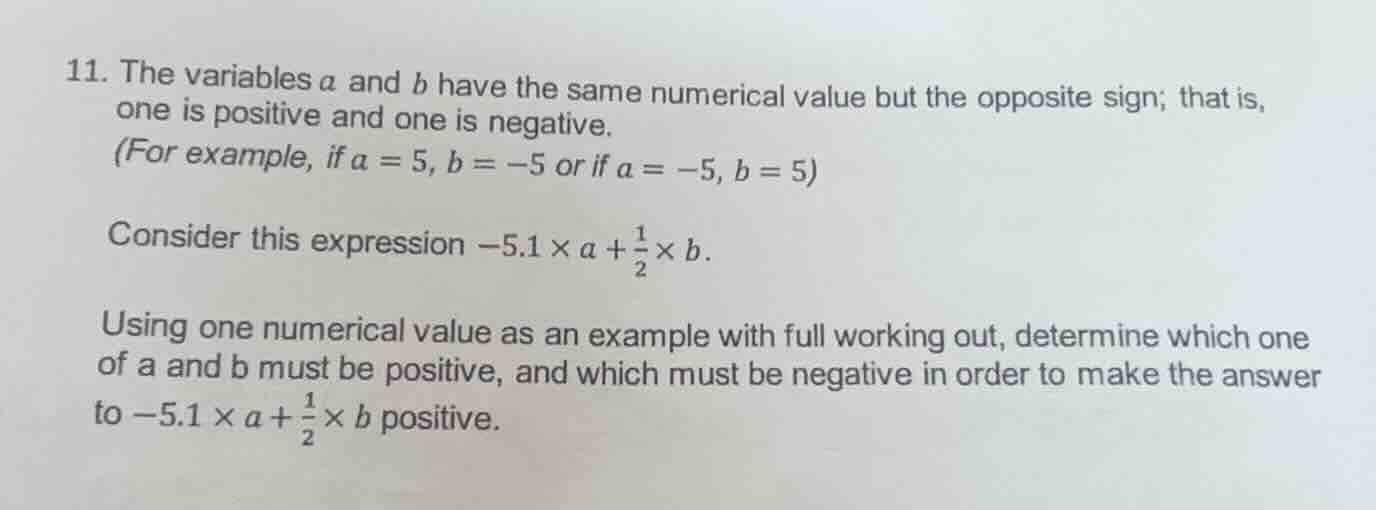
Question
- the variables \\(a\\) and \\(b\\) have the same numerical value but the opposite sign; that is, one is positive and one is negative.
(for example, if \\(a = 5\\), \\(b = -5\\) or if \\(a = -5\\), \\(b = 5\\))
consider this expression \\(-5.1 \times a + \frac{1}{2} \times b\\).
using one numerical value as an example with full working out, determine which one of \\(a\\) and \\(b\\) must be positive, and which must be negative in order to make the answer to \\(-5.1 \times a + \frac{1}{2} \times b\\) positive.
Define variables using opposite values
Let the numerical value of the variables be \(5\).
Since \(a\) and \(b\) have opposite signs:
Case 1: \(a = -5\) and \(b = 5\)
Case 2: \(a = 5\) and \(b = -5\)
Evaluate Case 1
Substitute \(a = -5\) and \(b = 5\) into the expression:
The result \(28\) is positive.
Evaluate Case 2
Substitute \(a = 5\) and \(b = -5\) into the expression:
The result \(-28\) is negative.
Determine the required signs
Case 1 yields a positive result.
In Case 1, \(a\) is negative and \(b\) is positive.
Therefore, \(a\) must be negative and \(b\) must be positive.

Snap & solve any problem in the app
Get step-by-step solutions on Sovi AI
Photo-based solutions with guided steps
Explore more problems and detailed explanations
To make the expression \(-5.1 \times a + \frac{1}{2} \times b\) positive, \(a\) must be negative and \(b\) must be positive.
Example Working Out:
Let the numerical value be \(5\).
If \(a = -5\) and \(b = 5\):
Since \(28 > 0\), this combination makes the expression positive.