QUESTION IMAGE
Question
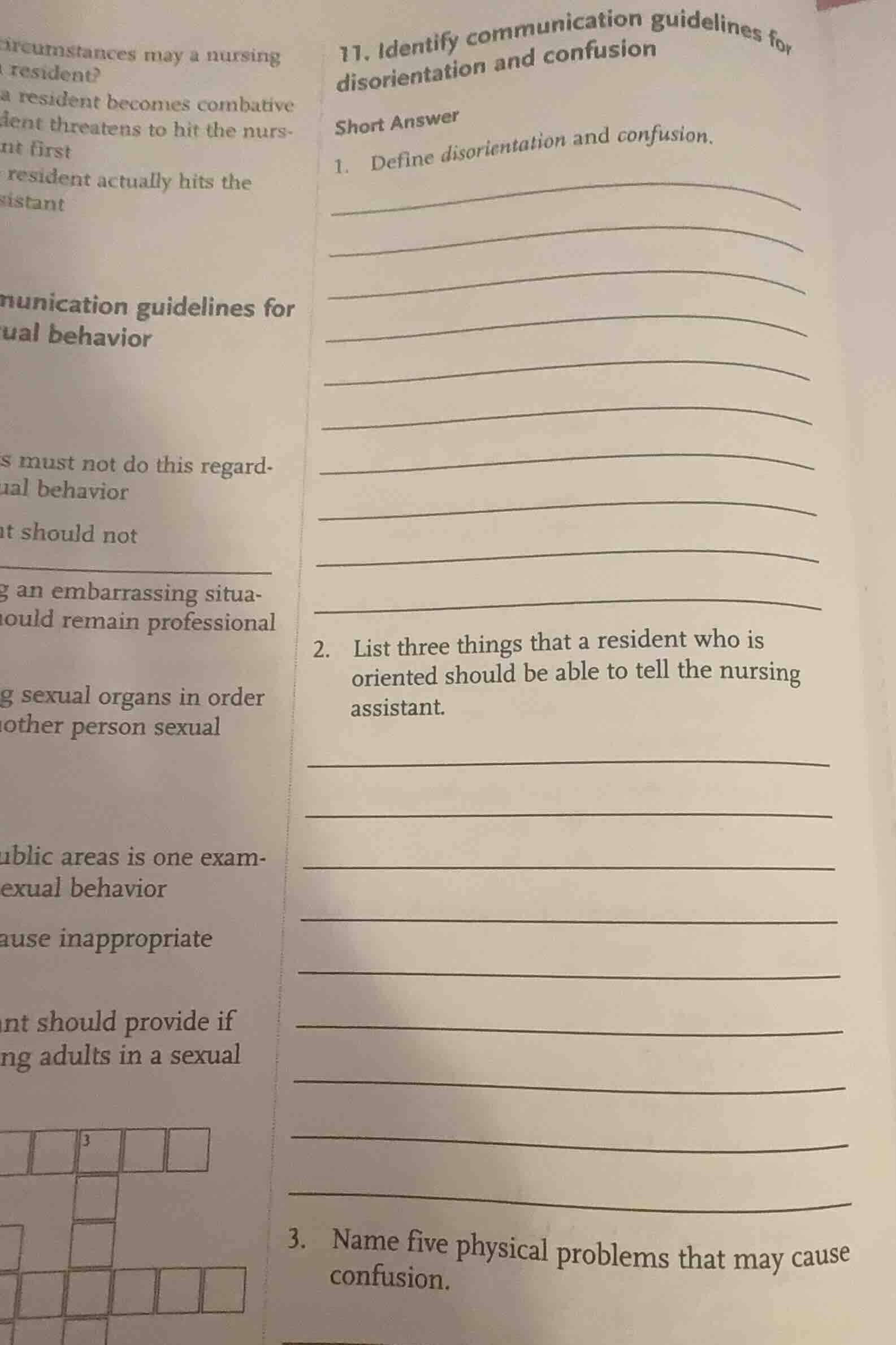
- identify communication guidelines for disorientation and confusion
short answer
- define disorientation and confusion.
- list three things that a resident who is oriented should be able to tell the nursing assistant.
- name five physical problems that may cause confusion.
Define disorientation and confusion
- Disorientation: The inability to identify or be aware of person, place, time, or situation.
- Confusion: The inability to think clearly, logically, and quickly, leading to difficulty focusing attention and making decisions.
Identify orientation indicators
- Person: Who they are (their name).
- Place: Where they are (the facility name, city, or state).
- Time: The current time, day, month, or year.
List physical causes of confusion
- Urinary tract infections (UTIs) or other systemic infections.
- Dehydration or nutritional deficiencies.
- Low blood sugar (hypoglycemia) or metabolic imbalances.
- Lack of oxygen (hypoxia) or respiratory issues.
- Medication side effects, interactions, or toxicity.

Snap & solve any problem in the app
Get step-by-step solutions on Sovi AI
Photo-based solutions with guided steps
Explore more problems and detailed explanations
Question 1
Define disorientation and confusion.
- Disorientation: <blank>The state of being unable to identify or be aware of person, place, time, or situation.</blank>
- Confusion: <blank>The inability to think clearly, logically, and quickly, resulting in difficulty focusing attention, remembering, and making decisions.</blank>
Question 2
List three things that a resident who is oriented should be able to tell the nursing assistant.
- <blank>Who they are (their name/identity)</blank>
- <blank>Where they are (the current location/facility)</blank>
- <blank>The current time (the day, month, year, or season)</blank>
Question 3
Name five physical problems that may cause confusion.
- <blank>Urinary tract infections (UTIs) or other infections</blank>
- <blank>Dehydration or fluid imbalance</blank>
- <blank>Low blood sugar (hypoglycemia)</blank>
- <blank>Lack of oxygen (hypoxia)</blank>
- <blank>Medication side effects or drug interactions</blank>