QUESTION IMAGE
Question
11.
12.
14.
15.
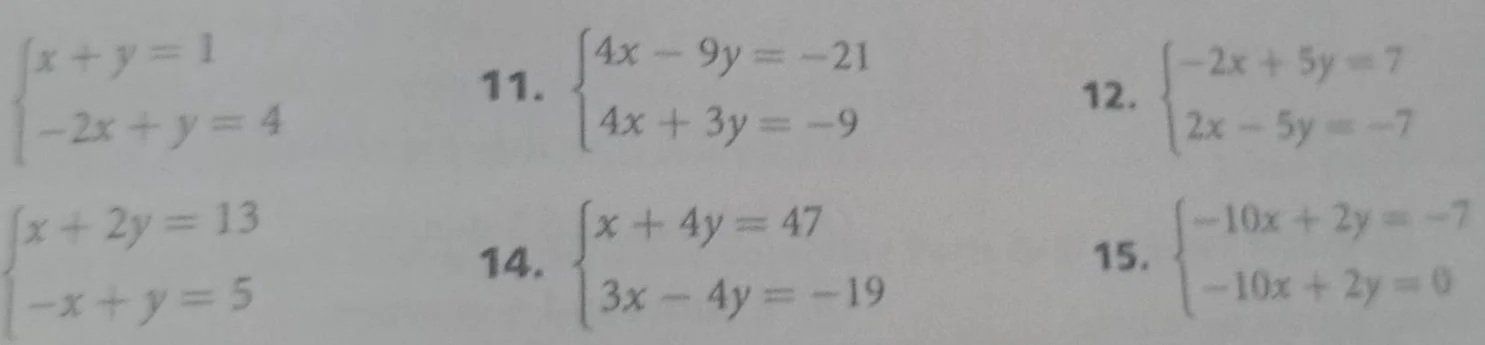
To solve these systems of linear equations, we can use methods like substitution or elimination. Let's solve each one:
System 1:
Step 1: Subtract the first equation from the second to eliminate $y$.
$$(-2x + y) - (x + y) = 4 - 1$$
$$-2x + y - x - y = 3$$
$$-3x = 3$$
Step 2: Solve for $x$.
$$x = \frac{3}{-3} = -1$$
Step 3: Substitute $x = -1$ into the first equation to find $y$.
$$-1 + y = 1$$
$$y = 1 + 1 = 2$$
Solution: $x = -1$, $y = 2$
System 11:
Step 1: Subtract the first equation from the second to eliminate $x$.
$$(4x + 3y) - (4x - 9y) = -9 - (-21)$$
$$4x + 3y - 4x + 9y = 12$$
$$12y = 12$$
Step 2: Solve for $y$.
$$y = \frac{12}{12} = 1$$
Step 3: Substitute $y = 1$ into the second equation to find $x$.
$$4x + 3(1) = -9$$
$$4x + 3 = -9$$
$$4x = -12$$
$$x = \frac{-12}{4} = -3$$
Solution: $x = -3$, $y = 1$
System 12:
Step 1: Add the two equations to eliminate $x$ and $y$.
$$(-2x + 5y) + (2x - 5y) = 7 + (-7)$$
$$0 = 0$$
This is an identity, meaning the two equations are equivalent (they represent the same line).
Solution: Infinitely many solutions (the lines are coincident).
System (next row, first):
Step 1: Add the two equations to eliminate $x$.
$$(x + 2y) + (-x + y) = 13 + 5$$
$$3y = 18$$
Step 2: Solve for $y$.
$$y = \frac{18}{3} = 6$$
Step 3: Substitute $y = 6$ into the second equation to find $x$.
$$-x + 6 = 5$$
$$-x = -1$$
$$x = 1$$
Solution: $x = 1$, $y = 6$
System 14:
Step 1: Add the two equations to eliminate $y$.
$$(x + 4y) + (3x - 4y) = 47 + (-19)$$
$$4x = 28$$
Step 2: Solve for $x$.
$$x = \frac{28}{4} = 7$$
Step 3: Substitute $x = 7$ into the first equation to find $y$.
$$7 + 4y = 47$$
$$4y = 40$$
$$y = \frac{40}{4} = 10$$
Solution: $x = 7$, $y = 10$
System 15:
Step 1: Subtract the first equation from the second.
$$(-10x + 2y) - (-10x + 2y) = 0 - (-7)$$
$$0 = 7$$
This is a contradiction, meaning the lines are parallel and never intersect.
Solution: No solution.
Final Answers:
- $\boldsymbol{x = -1}$, $\boldsymbol{y = 2}$
- $\boldsymbol{x = -3}$, $\boldsymbol{y = 1}$
- Infinitely many solutions
Next row (first): $\boldsymbol{x = 1}$, $\boldsymbol{y = 6}$
- $\boldsymbol{x = 7}$, $\boldsymbol{y = 10}$
- No solution

Snap & solve any problem in the app
Get step-by-step solutions on Sovi AI
Photo-based solutions with guided steps
Explore more problems and detailed explanations
To solve these systems of linear equations, we can use methods like substitution or elimination. Let's solve each one:
System 1:
Step 1: Subtract the first equation from the second to eliminate $y$.
$$(-2x + y) - (x + y) = 4 - 1$$
$$-2x + y - x - y = 3$$
$$-3x = 3$$
Step 2: Solve for $x$.
$$x = \frac{3}{-3} = -1$$
Step 3: Substitute $x = -1$ into the first equation to find $y$.
$$-1 + y = 1$$
$$y = 1 + 1 = 2$$
Solution: $x = -1$, $y = 2$
System 11:
Step 1: Subtract the first equation from the second to eliminate $x$.
$$(4x + 3y) - (4x - 9y) = -9 - (-21)$$
$$4x + 3y - 4x + 9y = 12$$
$$12y = 12$$
Step 2: Solve for $y$.
$$y = \frac{12}{12} = 1$$
Step 3: Substitute $y = 1$ into the second equation to find $x$.
$$4x + 3(1) = -9$$
$$4x + 3 = -9$$
$$4x = -12$$
$$x = \frac{-12}{4} = -3$$
Solution: $x = -3$, $y = 1$
System 12:
Step 1: Add the two equations to eliminate $x$ and $y$.
$$(-2x + 5y) + (2x - 5y) = 7 + (-7)$$
$$0 = 0$$
This is an identity, meaning the two equations are equivalent (they represent the same line).
Solution: Infinitely many solutions (the lines are coincident).
System (next row, first):
Step 1: Add the two equations to eliminate $x$.
$$(x + 2y) + (-x + y) = 13 + 5$$
$$3y = 18$$
Step 2: Solve for $y$.
$$y = \frac{18}{3} = 6$$
Step 3: Substitute $y = 6$ into the second equation to find $x$.
$$-x + 6 = 5$$
$$-x = -1$$
$$x = 1$$
Solution: $x = 1$, $y = 6$
System 14:
Step 1: Add the two equations to eliminate $y$.
$$(x + 4y) + (3x - 4y) = 47 + (-19)$$
$$4x = 28$$
Step 2: Solve for $x$.
$$x = \frac{28}{4} = 7$$
Step 3: Substitute $x = 7$ into the first equation to find $y$.
$$7 + 4y = 47$$
$$4y = 40$$
$$y = \frac{40}{4} = 10$$
Solution: $x = 7$, $y = 10$
System 15:
Step 1: Subtract the first equation from the second.
$$(-10x + 2y) - (-10x + 2y) = 0 - (-7)$$
$$0 = 7$$
This is a contradiction, meaning the lines are parallel and never intersect.
Solution: No solution.
Final Answers:
- $\boldsymbol{x = -1}$, $\boldsymbol{y = 2}$
- $\boldsymbol{x = -3}$, $\boldsymbol{y = 1}$
- Infinitely many solutions
Next row (first): $\boldsymbol{x = 1}$, $\boldsymbol{y = 6}$
- $\boldsymbol{x = 7}$, $\boldsymbol{y = 10}$
- No solution