QUESTION IMAGE
Question
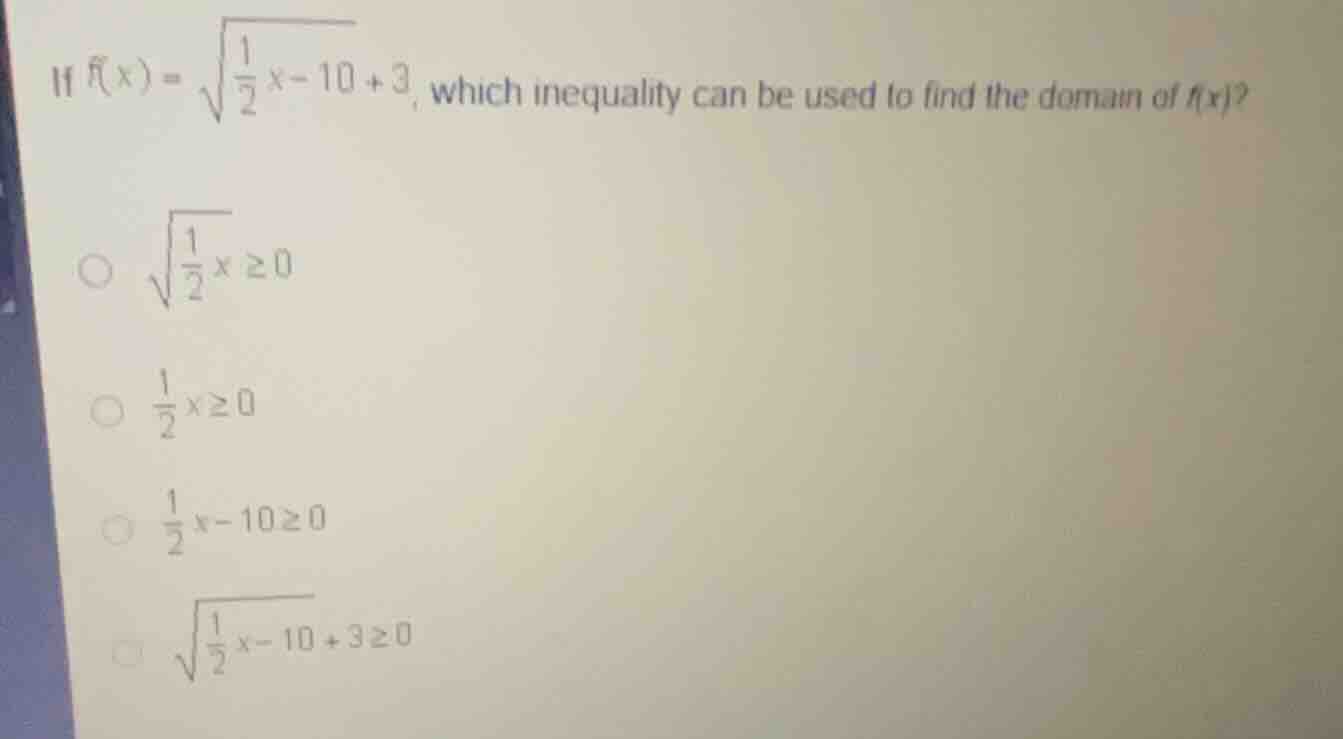
if \\(f(x) = \sqrt{\frac{1}{2}x - 10} + 3\\), which inequality can be used to find the domain of \\(f(x)\\)?
- \\(\sqrt{\frac{1}{2}x} \ge 0\\)
- \\(\frac{1}{2}x \ge 0\\)
- \\(\frac{1}{2}x - 10 \ge 0\\)
- \\(\sqrt{\frac{1}{2}x - 10} + 3 \ge 0\\)
Identify the condition for the domain of a square root function
For a real-valued square root function \(g(x) = \sqrt{u(x)}\), the radicand must be non-negative:
$$
u(x) \ge 0
$$
Apply the condition to the given function
Given \(f(x) = \sqrt{\frac{1}{2}x - 10} + 3\), the radicand is:
$$
\frac{1}{2}x - 10
$$
Setting this expression to be non-negative yields:
$$
\frac{1}{2}x - 10 \ge 0
$$

Snap & solve any problem in the app
Get step-by-step solutions on Sovi AI
Photo-based solutions with guided steps
Explore more problems and detailed explanations
- (A) \(\sqrt{\frac{1}{2}x} \ge 0\)
- (B) \(\frac{1}{2}x \ge 0\)
- (C) \(\frac{1}{2}x - 10 \ge 0\) (Correct answer)
- (D) \(\sqrt{\frac{1}{2}x - 10} + 3 \ge 0\)