QUESTION IMAGE
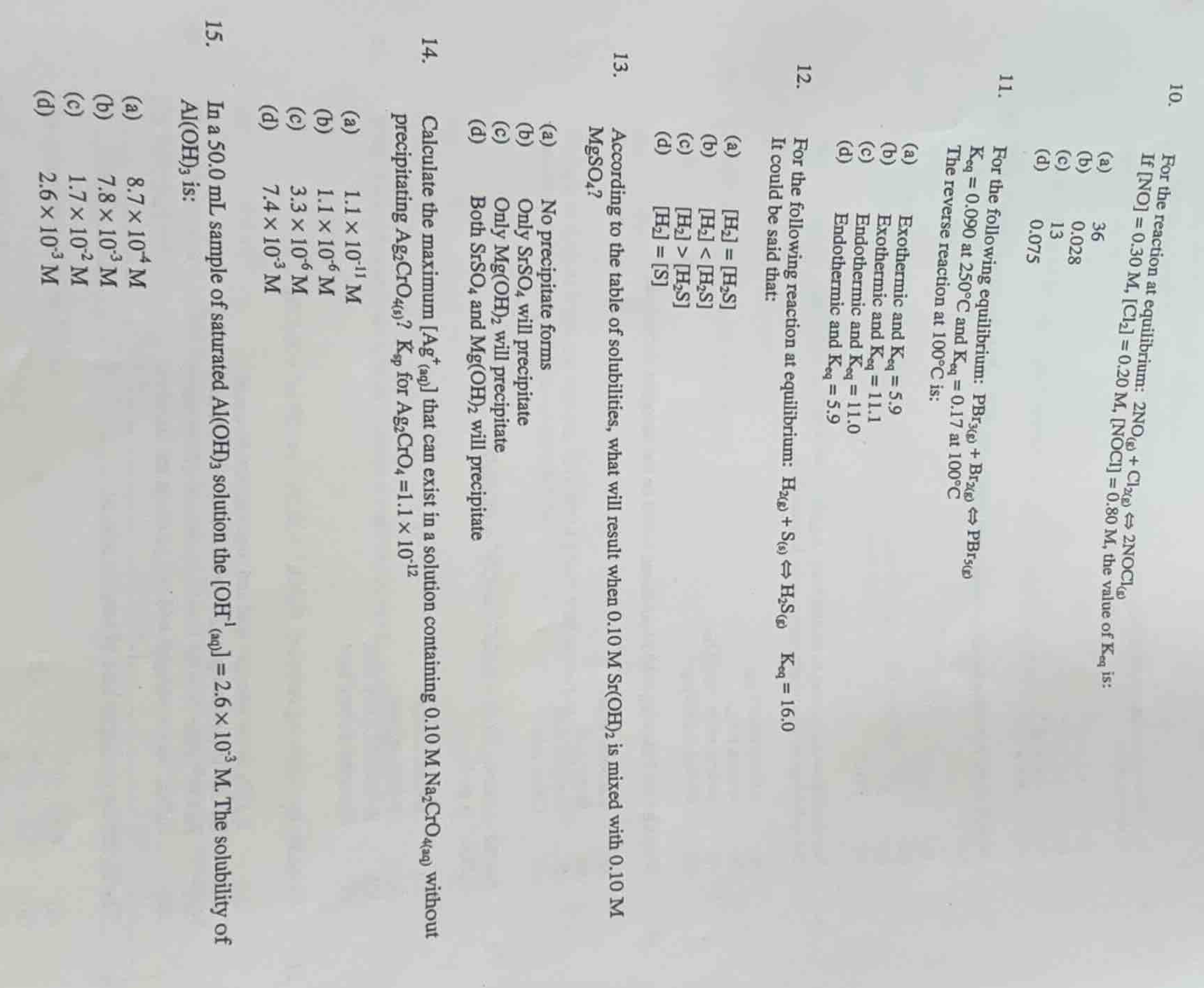
Question
- for the reaction at equilibrium: \\(2\text{no}_{\text{(g)}} + \text{cl}_{2\text{(g)}} \
ightleftharpoons 2\text{nocl}_{\text{(g)}}\\)
if \\(\text{no} = 0.30\text{ m}\\), \\(\text{cl}_2 = 0.20\text{ m}\\), \\(\text{nocl} = 0.80\text{ m}\\), the value of \\(k_{\text{eq}}\\) is:
(a) 36
(b) 0.028
(c) 13
(d) 0.075
- for the following equilibrium: \\(\text{pbr}_{3\text{(g)}} + \text{br}_{2\text{(g)}} \
ightleftharpoons \text{pbr}_{5\text{(g)}}\\)
\\(k_{\text{eq}} = 0.090\\) at \\(250^\circ\text{c}\\) and \\(k_{\text{eq}} = 0.17\\) at \\(100^\circ\text{c}\\)
the reverse reaction at \\(100^\circ\text{c}\\) is:
(a) exothermic and \\(k_{\text{eq}} = 5.9\\)
(b) exothermic and \\(k_{\text{eq}} = 11.1\\)
(c) endothermic and \\(k_{\text{eq}} = 11.0\\)
(d) endothermic and \\(k_{\text{eq}} = 5.9\\)
- for the following reaction at equilibrium: \\(\text{h}_{2\text{(g)}} + \text{s}_{\text{(s)}} \
ightleftharpoons \text{h}_2\text{s}_{\text{(g)}}\\) \\(k_{\text{eq}} = 16.0\\)
it could be said that:
(a) \\(\text{h}_2 = \text{h}_2\text{s}\\)
(b) \\(\text{h}_2 < \text{h}_2\text{s}\\)
(c) \\(\text{h}_2 > \text{h}_2\text{s}\\)
(d) \\(\text{h}_2 = \text{s}\\)
- according to the table of solubilities, what will result when \\(0.10\text{ m } \text{sr(oh)}_2\\) is mixed with \\(0.10\text{ m } \text{mgso}_4\\)?
(a) no precipitate forms
(b) only \\(\text{srso}_4\\) will precipitate
(c) only \\(\text{mg(oh)}_2\\) will precipitate
(d) both \\(\text{srso}_4\\) and \\(\text{mg(oh)}_2\\) will precipitate
- calculate the maximum \\(\text{ag}^+_{\text{(aq)}}\\) that can exist in a solution containing \\(0.10\text{ m } \text{na}_2\text{cro}_{4\text{(aq)}}\\) without precipitating \\(\text{ag}_2\text{cro}_{4\text{(s)}}\\)? \\(k_{\text{sp}}\text{ for } \text{ag}_2\text{cro}_4 = 1.1 \times 10^{-12}\\)
(a) \\(1.1 \times 10^{-11}\text{ m}\\)
(b) \\(1.1 \times 10^{-6}\text{ m}\\)
(c) \\(3.3 \times 10^{-6}\text{ m}\\)
(d) \\(7.4 \times 10^{-3}\text{ m}\\)
- in a \\(50.0\text{ ml}\\) sample of saturated \\(\text{al(oh)}_3\\) solution the \\(\text{oh}^-_{\text{(aq)}} = 2.6 \times 10^{-3}\text{ m}\\). the solubility of \\(\text{al(oh)}_3\\) is:
(a) \\(8.7 \times 10^{-4}\text{ m}\\)
(b) \\(7.8 \times 10^{-3}\text{ m}\\)
(c) \\(1.7 \times 10^{-2}\text{ m}\\)
(d) \\(2.6 \times 10^{-3}\text{ m}\\)
Calculate the equilibrium constant for Question 10
Using the Equilibrium Constant Calculations knowledge point
Determine the reverse reaction constant for Question 11
Using the Equilibrium Constant Calculations knowledge point
Using the Le Chateliers Principle knowledge point, since \(K_{eq}\) decreases from \(0.17\) at \(100^\circ\text{C}\) to \(0.090\) at \(250^\circ\text{C}\) as temperature increases, the forward reaction is exothermic. Thus, the reverse reaction is endothermic.
Analyze heterogeneous equilibrium for Question 12
Using the Le Chateliers Principle knowledge point
Predict precipitation for Question 13
Using the Precipitation Reactions knowledge point
Mixing \(0.10\text{ M }\text{Sr(OH)}_2\) and \(0.10\text{ M }\text{MgSO}_4\) yields \(\text{SrSO}_4\) and \(\text{Mg(OH)}_2\). According to standard solubility rules, \(\text{SrSO}_4\) is insoluble (precipitates) and \(\text{Mg(OH)}_2\) is insoluble (precipitates). Thus, both \(\text{SrSO}_4\) and \(\text{Mg(OH)}_2\) will precipitate.
Calculate maximum silver ion concentration for Question 14
To prevent precipitation of \(\text{Ag}_2\text{CrO}_4\):
Calculate molar solubility of aluminum hydroxide for Question 15
The dissolution of \(\text{Al(OH)}_3\) is:
The molar solubility \(S\) of \(\text{Al(OH)}_3\) is equal to the concentration of \(\text{Al}^{3+}\) at equilibrium:

Snap & solve any problem in the app
Get step-by-step solutions on Sovi AI
Photo-based solutions with guided steps
Explore more problems and detailed explanations
| No. | Answer |
|---|---|
| 11 | (d) Endothermic and \(K_{eq} = 5.9\) |
| 12 | (b) \([\text{H}_2] < [\text{H}_2\text{S}]\) |
| 13 | (d) Both \(\text{SrSO}_4\) and \(\text{Mg(OH)}_2\) will precipitate |
| 14 | (c) \(3.3 \times 10^{-6}\text{ M}\) |
| 15 | (a) \(8.7 \times 10^{-4}\text{ M}\) |