QUESTION IMAGE
Question
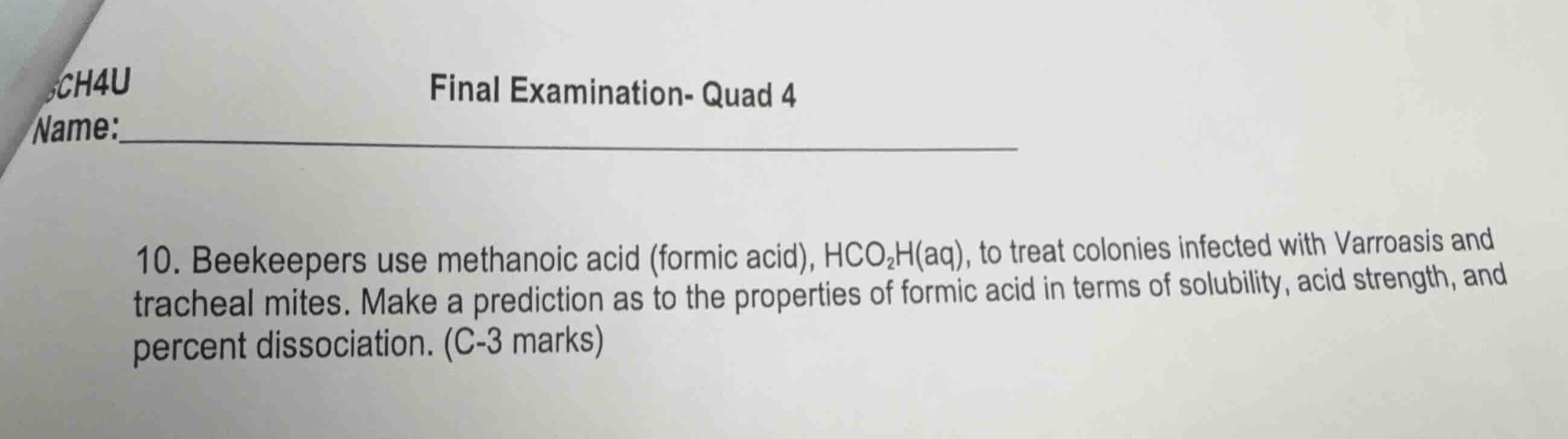
- beekeepers use methanoic acid (formic acid), \\(\text{hco}_2\text{h(aq)}\\), to treat colonies infected with varroasis and tracheal mites. make a prediction as to the properties of formic acid in terms of solubility, acid strength, and percent dissociation. (c-3 marks)
Analyze solubility of formic acid
Using the Molecular Polarity and Intermolecular Forces knowledge points, we analyze how formic acid interacts with water. Formic acid (\(\text{HCO}_2\text{H}\)) is a highly polar molecule containing a carboxyl group (\(-\text{COOH}\)). This group allows it to form strong hydrogen bonds with polar water molecules. Because it has a very short hydrocarbon chain (only one carbon), the hydrophobic effect is negligible, making formic acid infinitely soluble (miscible) in water.
Analyze acid strength
Formic acid is a carboxylic acid. Carboxylic acids do not ionize completely in aqueous solutions. Therefore, formic acid is classified as a weak acid.
Analyze percent dissociation
Since formic acid is a weak acid, it only partially ionizes in water. Its percent dissociation in a typical dilute aqueous solution is very low, typically much less than \(5\%\).
Synthesize the final prediction
We combine the three predicted properties into a concise summary: highly soluble in water, weak acid strength, and low percent dissociation.

Snap & solve any problem in the app
Get step-by-step solutions on Sovi AI
Photo-based solutions with guided steps
Explore more problems and detailed explanations
Based on the chemical structure of methanoic acid (formic acid, \(\text{HCO}_2\text{H}\)), the predicted properties are:
- Solubility: Highly soluble (miscible) in water due to its high polarity and ability to form hydrogen bonds with water molecules.
- Acid Strength: Weak acid, as it is a carboxylic acid that does not fully ionize in solution.
- Percent Dissociation: Low percent dissociation (typically \(< 5\%\)) in water because it is a weak electrolyte.