Sovi.AI - AI Math Tutor

Scan to solve math questions

QUESTION IMAGE

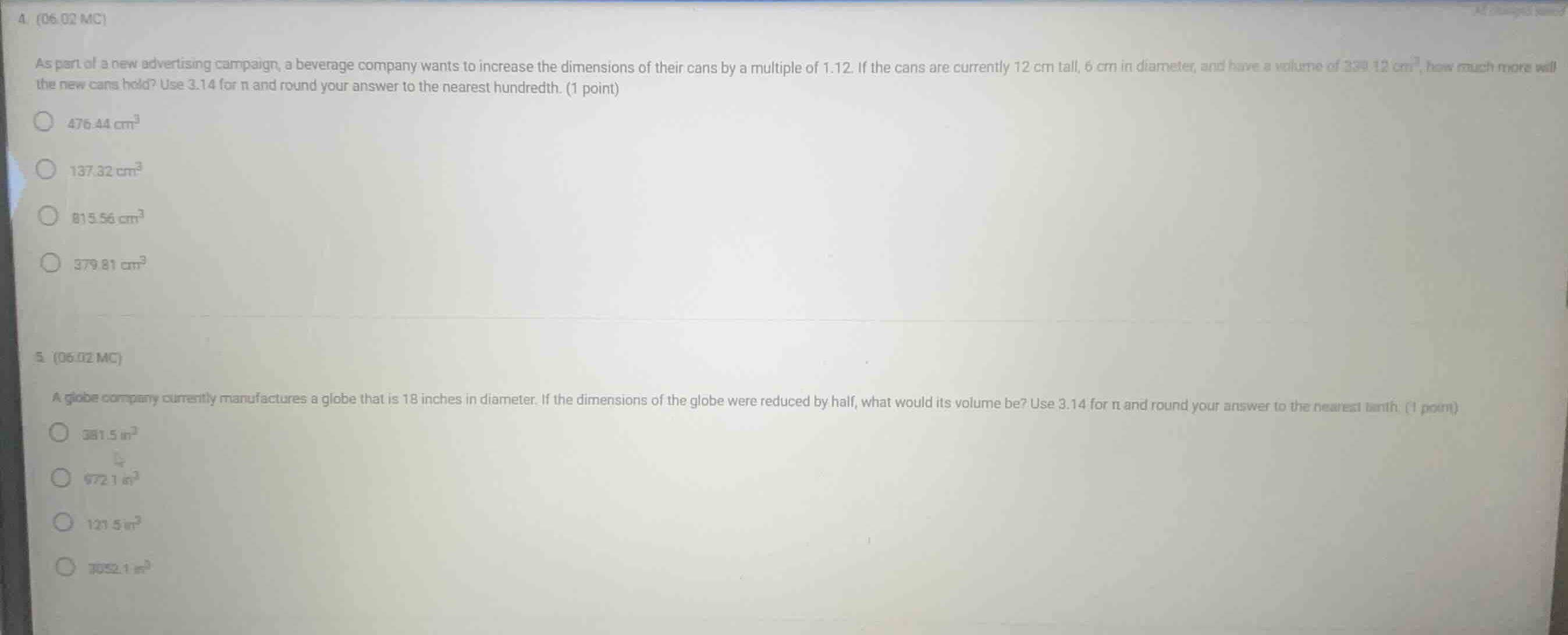
4. (06.02 mc) as part of a new advertising campaign, a beverage company…

Question

  1. (06.02 mc)

as part of a new advertising campaign, a beverage company wants to increase the dimensions of their cans by a multiple of 1.12. if the cans are currently 12 cm tall, 6 cm in diameter, and have a volume of \\(339.12\text{ cm}^3\\), how much more will the new cans hold? use 3.14 for \\(\pi\\) and round your answer to the nearest hundredth. (1 point)

\\(476.44\text{ cm}^3\\)
\\(137.32\text{ cm}^3\\)
\\(815.56\text{ cm}^3\\)
\\(379.81\text{ cm}^3\\)

  1. (06.02 mc)

a globe company currently manufactures a globe that is 18 inches in diameter. if the dimensions of the globe were reduced by half, what would its volume be? use 3.14 for \\(\pi\\) and round your answer to the nearest tenth. (1 point)

\\(381.5\text{ in}^3\\)
\\(972.1\text{ in}^3\\)
\\(121.5\text{ in}^3\\)
\\(3052.1\text{ in}^3\\)

Explanation:

Response

<pre_analysis>
{
"quality": "clear",
"question_count": 2,
"skills_matched": [
"step_cot",
"multiple_choice_formatter",
"explain_then_answer",
"tutor"
],
"needs_drawing": false,
"concepts_used": [],
"new_concepts": [
"Volume Scaling",
"Volume of Cylinders",
"Volume of Spheres"
],
"current_concepts": [
"Volume Scaling",
"Volume of Cylinders",
"Volume of Spheres"
]
}
</pre_analysis>

<reasoning>

Calculate the volume of the scaled cylinder

The original cylinder has a volume of \(V_{\text{orig}} = 339.12\text{ cm}^3\).
When all linear dimensions of a three-dimensional object are scaled by a factor of \(k\), its volume is scaled by a factor of \(k^3\).
Here, the scale factor is \(k = 1.12\).
The new volume \(V_{\text{new}}\) is:
\[
V_{\text{new}} = V_{\text{orig}} \times k^3 = 339.12 \times (1.12)^3
\]
\[
(1.12)^3 = 1.404928
\]
\[
V_{\text{new}} = 339.12 \times 1.404928 \approx 476.439\text{ cm}^3
\]

Find the difference in cylinder volumes

The question asks how much more the new cans will hold:
\[
\Delta V = V_{\text{new}} - V_{\text{orig}} \approx 476.439 - 339.12 = 137.319\text{ cm}^3
\]
Rounding to the nearest hundredth gives \(137.32\text{ cm}^3\).

Calculate the volume of the scaled sphere

The original globe is a sphere with a diameter of \(18\text{ inches}\), so its radius is \(r = 9\text{ inches}\).
The dimensions are reduced by half, so the new radius is:
\[
r_{\text{new}} = \frac{9}{2} = 4.5\text{ inches}
\]
The formula for the volume of a sphere is:
\[
V = \frac{4}{3}\pi r^3
\]
Using \(3.14\) for \(\pi\):
\[
V_{\text{new}} = \frac{4}{3} \times 3.14 \times (4.5)^3
\]
\[
(4.5)^3 = 91.125
\]
\[
V_{\text{new}} = \frac{4}{3} \times 3.14 \times 91.125 = 4 \times 3.14 \times 30.375 = 381.51\text{ in}^3
\]
Rounding to the nearest tenth gives \(381.5\text{ in}^3\).
</reasoning>

<answer>

Question 4

<mcq-option>(A) \(476.44\text{ cm}^3\)</mcq-option>
<mcq-correct>(B) \(137.32\text{ cm}^3\)</mcq-correct>
<mcq-option>(C) \(815.56\text{ cm}^3\)</mcq-option>
<mcq-option>(D) \(379.81\text{ cm}^3\)</mcq-option>

Question 5

<mcq-correct>(A) \(381.5\text{ in}^3\)</mcq-correct>
<mcq-option>(B) \(972.1\text{ in}^3\)</mcq-option>
<mcq-option>(C) \(121.5\text{ in}^3\)</mcq-option>
<mcq-option>(D) \(3052.1\text{ in}^3\)</mcq-option>
</answer>

<post_analysis>
{
"subject": "Mathematics",
"question_type": "Multiple Choice",
"knowledge_point": [
"Mathematics",
"Geometry",
"Volume Scaling"
]
}
</post_analysis>

Answer:

<pre_analysis>
{
"quality": "clear",
"question_count": 2,
"skills_matched": [
"step_cot",
"multiple_choice_formatter",
"explain_then_answer",
"tutor"
],
"needs_drawing": false,
"concepts_used": [],
"new_concepts": [
"Volume Scaling",
"Volume of Cylinders",
"Volume of Spheres"
],
"current_concepts": [
"Volume Scaling",
"Volume of Cylinders",
"Volume of Spheres"
]
}
</pre_analysis>

<reasoning>

Calculate the volume of the scaled cylinder

The original cylinder has a volume of \(V_{\text{orig}} = 339.12\text{ cm}^3\).
When all linear dimensions of a three-dimensional object are scaled by a factor of \(k\), its volume is scaled by a factor of \(k^3\).
Here, the scale factor is \(k = 1.12\).
The new volume \(V_{\text{new}}\) is:
\[
V_{\text{new}} = V_{\text{orig}} \times k^3 = 339.12 \times (1.12)^3
\]
\[
(1.12)^3 = 1.404928
\]
\[
V_{\text{new}} = 339.12 \times 1.404928 \approx 476.439\text{ cm}^3
\]

Find the difference in cylinder volumes

The question asks how much more the new cans will hold:
\[
\Delta V = V_{\text{new}} - V_{\text{orig}} \approx 476.439 - 339.12 = 137.319\text{ cm}^3
\]
Rounding to the nearest hundredth gives \(137.32\text{ cm}^3\).

Calculate the volume of the scaled sphere

The original globe is a sphere with a diameter of \(18\text{ inches}\), so its radius is \(r = 9\text{ inches}\).
The dimensions are reduced by half, so the new radius is:
\[
r_{\text{new}} = \frac{9}{2} = 4.5\text{ inches}
\]
The formula for the volume of a sphere is:
\[
V = \frac{4}{3}\pi r^3
\]
Using \(3.14\) for \(\pi\):
\[
V_{\text{new}} = \frac{4}{3} \times 3.14 \times (4.5)^3
\]
\[
(4.5)^3 = 91.125
\]
\[
V_{\text{new}} = \frac{4}{3} \times 3.14 \times 91.125 = 4 \times 3.14 \times 30.375 = 381.51\text{ in}^3
\]
Rounding to the nearest tenth gives \(381.5\text{ in}^3\).
</reasoning>

<answer>

Question 4

<mcq-option>(A) \(476.44\text{ cm}^3\)</mcq-option>
<mcq-correct>(B) \(137.32\text{ cm}^3\)</mcq-correct>
<mcq-option>(C) \(815.56\text{ cm}^3\)</mcq-option>
<mcq-option>(D) \(379.81\text{ cm}^3\)</mcq-option>

Question 5

<mcq-correct>(A) \(381.5\text{ in}^3\)</mcq-correct>
<mcq-option>(B) \(972.1\text{ in}^3\)</mcq-option>
<mcq-option>(C) \(121.5\text{ in}^3\)</mcq-option>
<mcq-option>(D) \(3052.1\text{ in}^3\)</mcq-option>
</answer>

<post_analysis>
{
"subject": "Mathematics",
"question_type": "Multiple Choice",
"knowledge_point": [
"Mathematics",
"Geometry",
"Volume Scaling"
]
}
</post_analysis>