Sovi.AI - AI Math Tutor

Scan to solve math questions

QUESTION IMAGE

you have successfully resuscitated an adult cardiac arrest patient. the…

Question

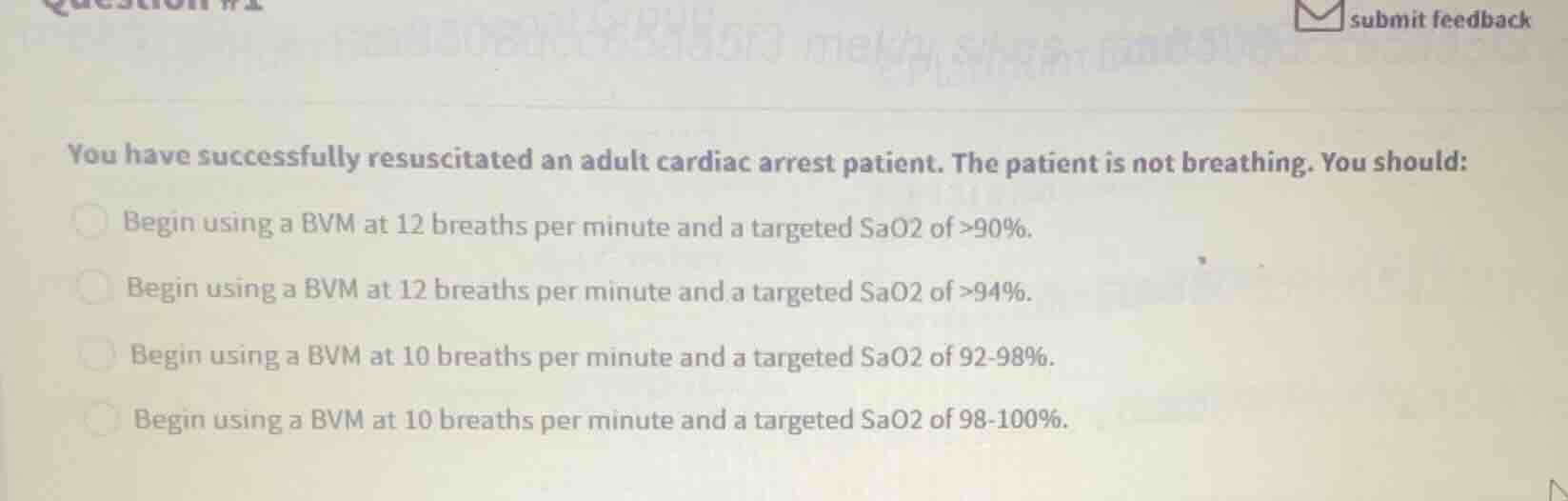
you have successfully resuscitated an adult cardiac arrest patient. the patient is not breathing. you should:
begin using a bvm at 12 breaths per minute and a targeted sao2 of >90%.
begin using a bvm at 12 breaths per minute and a targeted sao2 of >94%.
begin using a bvm at 10 breaths per minute and a targeted sao2 of 92-98%.
begin using a bvm at 10 breaths per minute and a targeted sao2 of 98-100%.

Explanation:

Response

<pre_analysis>
{
"quality": "clear",
"question_count": 1,
"skills_matched": [
"direct_cot",
"multiple_choice_formatter",
"explain_then_answer",
"tutor",
"mastery_adaptive_brevity"
],
"needs_drawing": false,
"concepts_used": [
"Airway Management Protocols",
"Inadequate Breathing Management"
],
"new_concepts": [
"Post-Cardiac Arrest Care",
"ROSC Ventilation Guidelines"
],
"current_concepts": [
"Airway Management Protocols",
"Inadequate Breathing Management",
"Post-Cardiac Arrest Care",
"ROSC Ventilation Guidelines"
]
}
</pre_analysis>

<reasoning>

Identify the clinical scenario

The patient is an adult who has been successfully resuscitated from cardiac arrest (Return of Spontaneous Circulation, or ROSC) but remains apneic (not breathing). This requires immediate ventilatory support.

Determine the appropriate ventilation rate

Using the Airway Management Protocols knowledge point:
According to the American Heart Association (AHA) guidelines for post-cardiac arrest care, once ROSC is achieved in an adult patient who is not breathing, rescue breathing should be provided at a rate of 10 breaths per minute (1 breath every 6 seconds).

Determine the target oxygen saturation

Using the Inadequate Breathing Management knowledge point:
To avoid oxygen toxicity and systemic hyperoxia while preventing hypoxia, the AHA guidelines recommend titrating oxygen delivery to maintain a targeted oxygen saturation (\(\text{SaO}_2\) or \(\text{SpO}_2\)) of 92–98%.

Evaluate the options

  • Option 1: 12 breaths per minute and \(\text{SaO}_2 > 90\%\) (Incorrect rate and target)
  • Option 2: 12 breaths per minute and \(\text{SaO}_2 > 94\%\) (Incorrect rate and target)
  • Option 3: 10 breaths per minute and \(\text{SaO}_2\) of 92–98% (Correct rate and target)
  • Option 4: 10 breaths per minute and \(\text{SaO}_2\) of 98–100% (Incorrect target; hyperoxia risk)

</reasoning>

<answer>
<mcq-option>(A) Begin using a BVM at 12 breaths per minute and a targeted SaO2 of &gt;90%.</mcq-option>
<mcq-option>(B) Begin using a BVM at 12 breaths per minute and a targeted SaO2 of &gt;94%.</mcq-option>
<mcq-correct>(C) Begin using a BVM at 10 breaths per minute and a targeted SaO2 of 92-98%.</mcq-correct>
<mcq-option>(D) Begin using a BVM at 10 breaths per minute and a targeted SaO2 of 98-100%.</mcq-option>
</answer>

<post_analysis>
{
"subject": "Natural Science",
"question_type": "Multiple Choice",
"knowledge_point": [
"Natural Science",
"Medicine",
"Emergency Medical Services"
]
}
</post_analysis>

Answer:

<pre_analysis>
{
"quality": "clear",
"question_count": 1,
"skills_matched": [
"direct_cot",
"multiple_choice_formatter",
"explain_then_answer",
"tutor",
"mastery_adaptive_brevity"
],
"needs_drawing": false,
"concepts_used": [
"Airway Management Protocols",
"Inadequate Breathing Management"
],
"new_concepts": [
"Post-Cardiac Arrest Care",
"ROSC Ventilation Guidelines"
],
"current_concepts": [
"Airway Management Protocols",
"Inadequate Breathing Management",
"Post-Cardiac Arrest Care",
"ROSC Ventilation Guidelines"
]
}
</pre_analysis>

<reasoning>

Identify the clinical scenario

The patient is an adult who has been successfully resuscitated from cardiac arrest (Return of Spontaneous Circulation, or ROSC) but remains apneic (not breathing). This requires immediate ventilatory support.

Determine the appropriate ventilation rate

Using the Airway Management Protocols knowledge point:
According to the American Heart Association (AHA) guidelines for post-cardiac arrest care, once ROSC is achieved in an adult patient who is not breathing, rescue breathing should be provided at a rate of 10 breaths per minute (1 breath every 6 seconds).

Determine the target oxygen saturation

Using the Inadequate Breathing Management knowledge point:
To avoid oxygen toxicity and systemic hyperoxia while preventing hypoxia, the AHA guidelines recommend titrating oxygen delivery to maintain a targeted oxygen saturation (\(\text{SaO}_2\) or \(\text{SpO}_2\)) of 92–98%.

Evaluate the options

  • Option 1: 12 breaths per minute and \(\text{SaO}_2 > 90\%\) (Incorrect rate and target)
  • Option 2: 12 breaths per minute and \(\text{SaO}_2 > 94\%\) (Incorrect rate and target)
  • Option 3: 10 breaths per minute and \(\text{SaO}_2\) of 92–98% (Correct rate and target)
  • Option 4: 10 breaths per minute and \(\text{SaO}_2\) of 98–100% (Incorrect target; hyperoxia risk)

</reasoning>

<answer>
<mcq-option>(A) Begin using a BVM at 12 breaths per minute and a targeted SaO2 of &gt;90%.</mcq-option>
<mcq-option>(B) Begin using a BVM at 12 breaths per minute and a targeted SaO2 of &gt;94%.</mcq-option>
<mcq-correct>(C) Begin using a BVM at 10 breaths per minute and a targeted SaO2 of 92-98%.</mcq-correct>
<mcq-option>(D) Begin using a BVM at 10 breaths per minute and a targeted SaO2 of 98-100%.</mcq-option>
</answer>

<post_analysis>
{
"subject": "Natural Science",
"question_type": "Multiple Choice",
"knowledge_point": [
"Natural Science",
"Medicine",
"Emergency Medical Services"
]
}
</post_analysis>