QUESTION IMAGE
Question
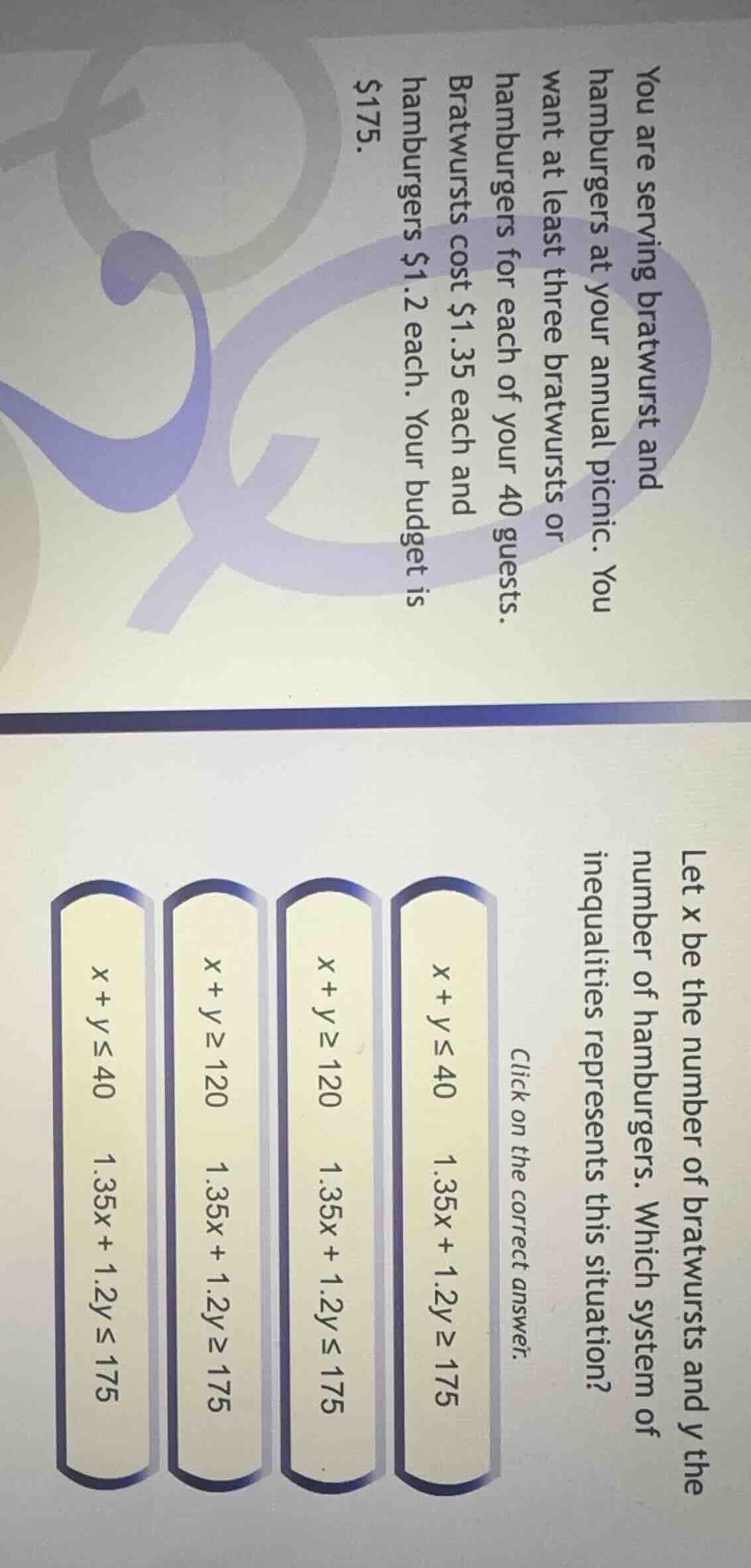
you are serving bratwurst and hamburgers at your annual picnic. you want at least three bratwursts or hamburgers for each of your 40 guests. bratwursts cost $1.35 each and hamburgers $1.2 each. your budget is $175. let x be the number of bratwursts and y the number of hamburgers. which system of inequalities represents this situation? click on the correct answer. x + y ≤ 40 1.35x + 1.2y ≥ 175 x + y ≥ 120 1.35x + 1.2y ≥ 175 x + y ≥ 120 1.35x + 1.2y ≤ 175 x + y ≤ 40 1.35x + 1.2y ≤ 175
- Analyze the quantity constraint: There are 40 guests, and we need to serve at least one item (bratwurst or hamburger) to each guest. So the total number of bratwursts (\(x\)) and hamburgers (\(y\)) should be at least \(40\) (since each guest gets one, and there are 40 guests). Wait, no—wait, the problem says "you want at least three bratwursts or hamburgers for each of your 40 guests"? Wait, no, re-reading: "You want at least three bratwursts or hamburgers for each of your 40 guests." Wait, no, maybe I misread. Wait, original text: "You want at least three bratwursts or hamburgers for each of your 40 guests." Wait, no, let's check again. Wait, the first part: "You are serving bratwurst and hamburgers at your annual picnic. You want at least three bratwursts or hamburgers for each of your 40 guests." Oh! So per guest, at least 3 items? Wait, no, "at least three bratwursts or hamburgers for each of your 40 guests"—maybe it's a typo, or maybe "at least one" but no, let's check the options. The options have \(x + y \geq 120\) or \(x + y \leq 40\). Wait, 40 guests, each with at least 3 items: \(40 \times 3 = 120\), so total items \(x + y \geq 120\). Then the budget: bratwursts cost \$1.35 each, hamburgers \$1.2 each, total cost \(1.35x + 1.2y \leq 175\) (since budget is \$175, can't exceed). So the system should be \(x + y \geq 120\) (from 40 guests × 3 items each) and \(1.35x + 1.2y \leq 175\) (budget constraint). Looking at the options, the third option (assuming the four options are:
- \(x + y \leq 40\); \(1.35x + 1.2y \geq 175\)
- \(x + y \geq 120\); \(1.35x + 1.2y \geq 175\)
- \(x + y \geq 120\); \(1.35x + 1.2y \leq 175\)
- \(x + y \leq 40\); \(1.35x + 1.2y \geq 175\)
So the correct system is \(x + y \geq 120\) (total items ≥ 120, 40×3) and \(1.35x + 1.2y \leq 175\) (budget ≤ 175). So the third option (the one with \(x + y \geq 120\) and \(1.35x + 1.2y \leq 175\)) is correct.

Snap & solve any problem in the app
Get step-by-step solutions on Sovi AI
Photo-based solutions with guided steps
Explore more problems and detailed explanations
The correct system of inequalities is:
\(x + y \geq 120\)
\(1.35x + 1.2y \leq 175\)
(Assuming the third option in the given choices corresponds to this system, e.g., if the options are labeled as:
A. \(x + y \leq 40\); \(1.35x + 1.2y \geq 175\)
B. \(x + y \geq 120\); \(1.35x + 1.2y \geq 175\)
C. \(x + y \geq 120\); \(1.35x + 1.2y \leq 175\)
D. \(x + y \leq 40\); \(1.35x + 1.2y \geq 175\)
Then the answer is C. \(x + y \geq 120\); \(1.35x + 1.2y \leq 175\))