QUESTION IMAGE
Question
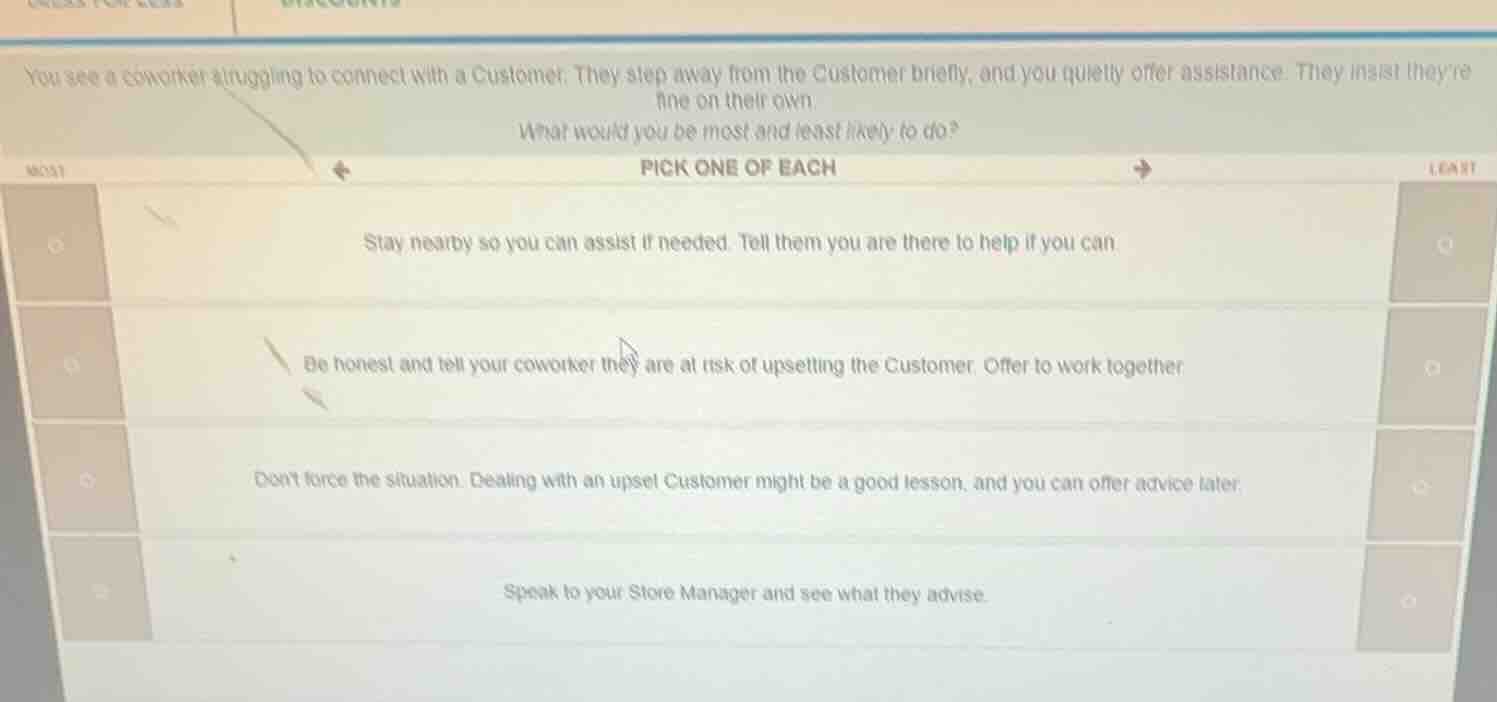
you see a coworker struggling to connect with a customer. they step away from the customer briefly, and you quietly offer assistance. they insist theyre fine on their own.
what would you be most and least likely to do?
pick one of each
stay nearby so you can assist if needed. tell them you are there to help if you can.
be honest and tell your coworker they are at risk of upsetting the customer. offer to work together.
dont force the situation. dealing with an upset customer might be a good lesson, and you can offer advice later.
speak to your store manager and see what they advise.
Analyze the scenario and options
The scenario describes a coworker struggling to connect with a customer. When you offer help privately, they decline, insisting they are fine. We need to evaluate the four potential actions to determine which is the Most effective and which is the Least effective in a professional retail environment.
The options are:
- Stay nearby so you can assist if needed. Tell them you are there to help if you can.
- Be honest and tell your coworker they are at risk of upsetting the Customer. Offer to work together.
- Don't force the situation. Dealing with an upset Customer might be a good lesson, and you can offer advice later.
- Speak to your Store Manager and see what they advise.
Evaluate the "Most" likely action
Using the Situational Judgment Test framework, the ideal action balances supporting a teammate with ensuring excellent customer service.
- Option 1 respects the coworker's boundary (since they said they are fine) while remaining supportive and ready to step in if the situation escalates. This demonstrates strong teamwork and proactive customer care without being intrusive.
- Option 2 might sound confrontational or critical, potentially escalating tension with the coworker.
- Option 3 is passive and allows a customer to potentially have a bad experience as a "lesson" for the coworker, which harms the business.
- Option 4 unnecessarily escalates a minor peer-to-peer interaction to management before trying to resolve or monitor it yourself.
Therefore, Option 1 is the Most likely/best action.
Evaluate the "Least" likely action
Using Conflict Resolution principles, we must identify the action that is most detrimental to the customer experience and team cohesion.
- Option 3 suggests letting the coworker fail at the expense of the customer ("Dealing with an upset Customer might be a good lesson"). In any customer-centric role, actively allowing a customer to become upset or receive poor service is highly counterproductive and goes against core service values.
Therefore, Option 3 is the Least likely/worst action.

Snap & solve any problem in the app
Get step-by-step solutions on Sovi AI
Photo-based solutions with guided steps
Explore more problems and detailed explanations
- MOST: Stay nearby so you can assist if needed. Tell them you are there to help if you can.
- LEAST: Don't force the situation. Dealing with an upset Customer might be a good lesson, and you can offer advice later.