QUESTION IMAGE
Question
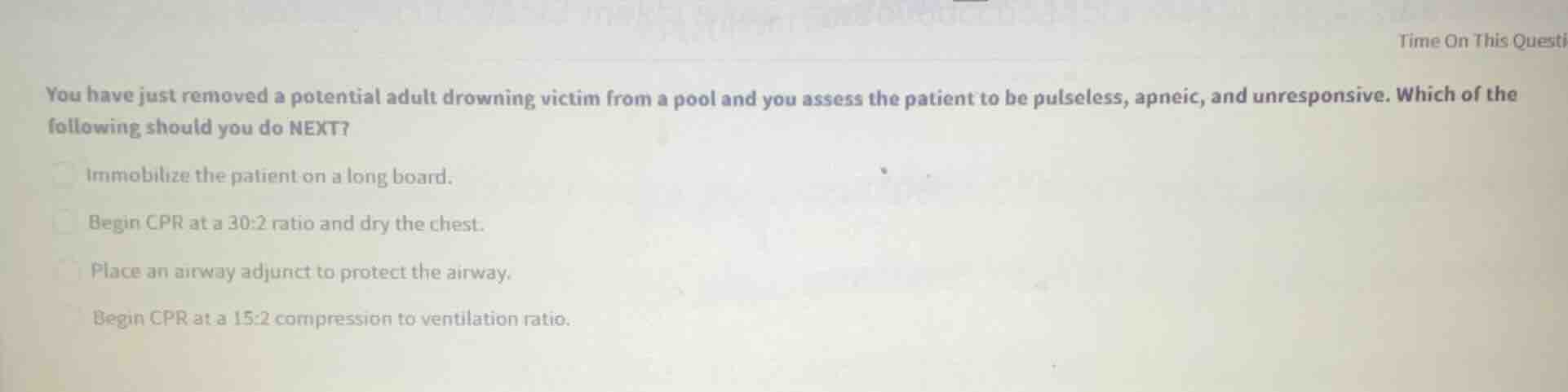
you have just removed a potential adult drowning victim from a pool and you assess the patient to be pulseless, apneic, and unresponsive. which of the following should you do next?
immobilize the patient on a long board.
begin cpr at a 30:2 ratio and dry the chest.
place an airway adjunct to protect the airway.
begin cpr at a 15:2 compression to ventilation ratio.
<pre_analysis>
{
"quality": "clear",
"question_count": 1,
"skills_matched": [
"direct_cot",
"multiple_choice_formatter",
"explain_then_answer",
"tutor"
],
"needs_drawing": false,
"concepts_used": [],
"new_concepts": [
"Drowning Resuscitation Protocols",
"Adult CPR Guidelines"
],
"current_concepts": [
"Drowning Resuscitation Protocols",
"Adult CPR Guidelines"
]
}
</pre_analysis>
<reasoning>
Analyze the patient's clinical presentation
The patient is an adult drowning victim who has been removed from the water. Assessment reveals the patient is unresponsive, pulseless, and apneic (not breathing). This clinical presentation indicates that the patient is in cardiac arrest.
Determine the immediate priority intervention
For any unresponsive, pulseless, and apneic adult patient, the immediate priority is to initiate cardiopulmonary resuscitation (CPR) to maintain perfusion to vital organs. According to standard American Heart Association (AHA) guidelines, the correct compression-to-ventilation ratio for a single rescuer performing adult CPR is 30:2.
Evaluate the role of drying the chest
Because the patient was just removed from a pool, their chest will be wet. While starting high-quality chest compressions and ventilations is the immediate priority, preparing for automated external defibrillator (AED) use is also critical. Drying the chest is a necessary step before applying AED pads to ensure proper adhesion and safety during shock delivery. Therefore, beginning CPR at a 30:2 ratio and drying the chest is the most appropriate next step.
Rule out incorrect options
- Immobilize the patient on a long board: Routine spinal immobilization is not indicated for drowning victims unless there is a clear mechanism of injury suggesting spinal trauma (e.g., diving into shallow water). Performing spinal immobilization delays critical, life-saving resuscitation.
- Place an airway adjunct to protect the airway: While airway management is important, basic CPR (compressions and ventilations) must be initiated immediately. Placing an advanced airway or adjunct should not delay the start of chest compressions.
- Begin CPR at a 15:2 compression to ventilation ratio: A 15:2 ratio is used for two-rescuer pediatric CPR, not for adult CPR. The standard ratio for adult CPR is always 30:2.
</reasoning>
<answer>
<mcq-option>Immobilize the patient on a long board.</mcq-option>
<mcq-correct>Begin CPR at a 30:2 ratio and dry the chest.</mcq-correct>
<mcq-option>Place an airway adjunct to protect the airway.</mcq-option>
<mcq-option>Begin CPR at a 15:2 compression to ventilation ratio.</mcq-option>
</answer>
<post_analysis>
{
"subject": "Natural Science",
"question_type": "Multiple Choice",
"knowledge_point": [
"Natural Science",
"Medicine and Health",
"Emergency Medical Services"
]
}
</post_analysis>
Snap & solve any problem in the app
Get step-by-step solutions on Sovi AI
Photo-based solutions with guided steps
Explore more problems and detailed explanations
<pre_analysis>
{
"quality": "clear",
"question_count": 1,
"skills_matched": [
"direct_cot",
"multiple_choice_formatter",
"explain_then_answer",
"tutor"
],
"needs_drawing": false,
"concepts_used": [],
"new_concepts": [
"Drowning Resuscitation Protocols",
"Adult CPR Guidelines"
],
"current_concepts": [
"Drowning Resuscitation Protocols",
"Adult CPR Guidelines"
]
}
</pre_analysis>
<reasoning>
Analyze the patient's clinical presentation
The patient is an adult drowning victim who has been removed from the water. Assessment reveals the patient is unresponsive, pulseless, and apneic (not breathing). This clinical presentation indicates that the patient is in cardiac arrest.
Determine the immediate priority intervention
For any unresponsive, pulseless, and apneic adult patient, the immediate priority is to initiate cardiopulmonary resuscitation (CPR) to maintain perfusion to vital organs. According to standard American Heart Association (AHA) guidelines, the correct compression-to-ventilation ratio for a single rescuer performing adult CPR is 30:2.
Evaluate the role of drying the chest
Because the patient was just removed from a pool, their chest will be wet. While starting high-quality chest compressions and ventilations is the immediate priority, preparing for automated external defibrillator (AED) use is also critical. Drying the chest is a necessary step before applying AED pads to ensure proper adhesion and safety during shock delivery. Therefore, beginning CPR at a 30:2 ratio and drying the chest is the most appropriate next step.
Rule out incorrect options
- Immobilize the patient on a long board: Routine spinal immobilization is not indicated for drowning victims unless there is a clear mechanism of injury suggesting spinal trauma (e.g., diving into shallow water). Performing spinal immobilization delays critical, life-saving resuscitation.
- Place an airway adjunct to protect the airway: While airway management is important, basic CPR (compressions and ventilations) must be initiated immediately. Placing an advanced airway or adjunct should not delay the start of chest compressions.
- Begin CPR at a 15:2 compression to ventilation ratio: A 15:2 ratio is used for two-rescuer pediatric CPR, not for adult CPR. The standard ratio for adult CPR is always 30:2.
</reasoning>
<answer>
<mcq-option>Immobilize the patient on a long board.</mcq-option>
<mcq-correct>Begin CPR at a 30:2 ratio and dry the chest.</mcq-correct>
<mcq-option>Place an airway adjunct to protect the airway.</mcq-option>
<mcq-option>Begin CPR at a 15:2 compression to ventilation ratio.</mcq-option>
</answer>
<post_analysis>
{
"subject": "Natural Science",
"question_type": "Multiple Choice",
"knowledge_point": [
"Natural Science",
"Medicine and Health",
"Emergency Medical Services"
]
}
</post_analysis>