QUESTION IMAGE
Question
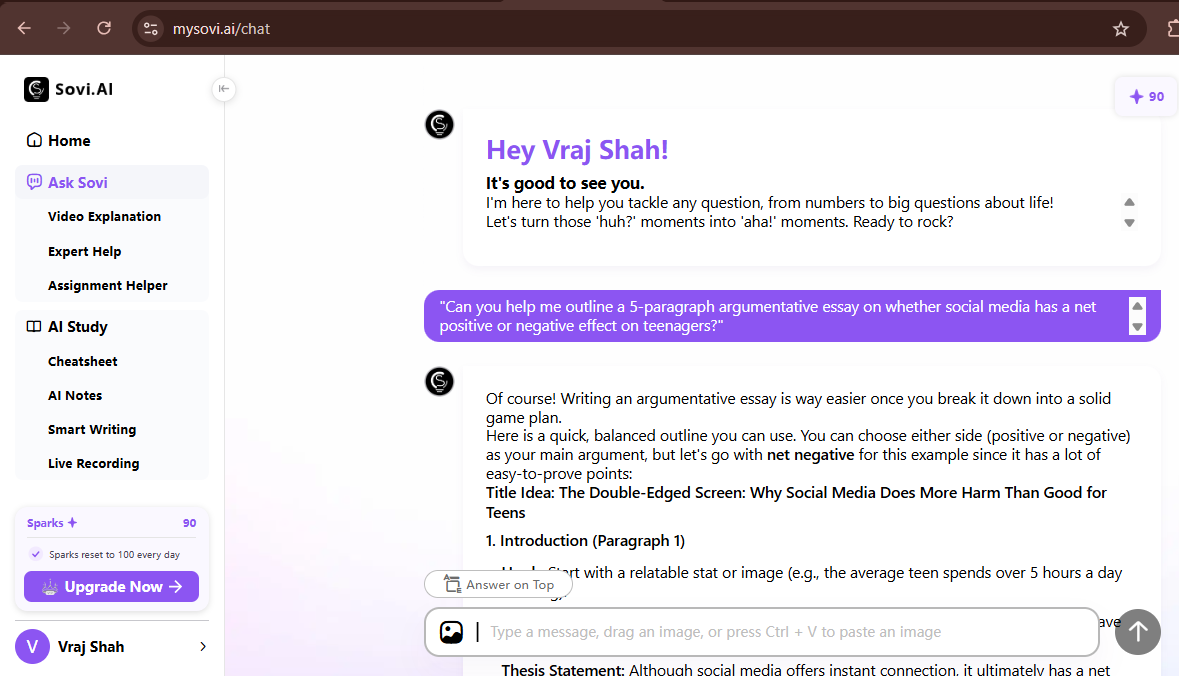
can you help me outline a 5-paragraph argumentative essay on whether social media has a net positive or negative effect on teenagers?
🆕 New Concept Discovered: Argumentative Essay Structure
Organizing a balanced, persuasive five-paragraph argument.
Step 1: Understand the Goal
An argumentative essay aims to persuade the reader of a specific point of view using evidence and reasoning. A standard 5-paragraph structure consists of:
- Introduction: Hooks the reader, introduces the topic, and presents a clear thesis statement.
- Body Paragraph 1: First supporting point with evidence.
- Body Paragraph 2: Second supporting point with evidence.
- Body Paragraph 3: Counterargument and rebuttal (acknowledging the opposing view and showing why your side is still stronger).
- Conclusion: Restates the thesis in a new way, summarizes main points, and leaves a lasting final thought.
---
Step 2: Outline the Introduction (Paragraph 1)
- Hook: Start with an engaging hook, such as a surprising statistic or a relatable scenario.
- Example: "The average teenager spends over 5 hours a day on social media platforms."
- Background Info: Briefly introduce the debate (social media connects us but also brings challenges).
- Thesis Statement: State your main argument clearly.
- Example: "Although social media offers instant connection, it ultimately has a net negative effect on teenagers due to its impact on mental health and the rise of cyberbullying."
---
Step 3: Outline the Body Paragraphs (Paragraphs 2 & 3)
- Body Paragraph 1 (Mental Health):
- Topic Sentence: Social media platforms contribute significantly to increased anxiety and depression among teens.
- Supporting Evidence: Mention studies linking high screen time to poor sleep and constant social comparison ("FOMO").
- Body Paragraph 2 (Cyberbullying & Safety):
- Topic Sentence: The anonymity and reach of online platforms amplify the frequency and severity of bullying.
- Supporting Evidence: Discuss how online harassment is harder to escape than traditional schoolyard bullying.
---
Step 4: Outline the Counterargument & Rebuttal (Paragraph 4)
- The Counterargument (The Opposing View): Acknowledge that supporters argue social media helps teens build communities and find support systems.
- The Rebuttal (Your Response): Explain why this benefit is outweighed by the negatives.
- Example: While digital communities exist, they often lack the depth of real-world relationships and expose teens to toxic online environments.
---
Step 5: Outline the Conclusion (Paragraph 5)
- Restate Thesis: Rephrase your main argument using different words.
- Summary of Main Points: Briefly remind the reader of the mental health and safety concerns discussed.
- Final Thought: Leave the reader with a powerful concluding statement or a call to action.
- Example: "To protect the well-being of the next generation, we must encourage healthier digital boundaries and prioritize face-to-face connections."

Snap & solve any problem in the app
Get step-by-step solutions on Sovi AI
Photo-based solutions with guided steps
Explore more problems and detailed explanations
5-Paragraph Argumentative Essay Outline
- Title Idea: The Double-Edged Screen: Why Social Media Does More Harm Than Good for Teens
- Paragraph 1: Introduction
- Hook: A statistic about teen screen time.
- Background: The rise of social platforms in daily life.
- Thesis: Although social media offers instant connection, it ultimately has a net negative effect on teenagers due to its impact on mental health and the rise of cyberbullying.
- Paragraph 2: Body Paragraph 1 (Mental Health)
- Focus: Anxiety, depression, and sleep deprivation caused by constant comparison and screen time.
- Paragraph 3: Body Paragraph 2 (Cyberbullying)
- Focus: How online anonymity facilitates harassment and makes bullying inescapable.
- Paragraph 4: Counterargument & Rebuttal
- Counterargument: Social media helps teens find supportive online communities.
- Rebuttal: These digital spaces often lack real-world depth and expose users to toxic interactions.
- Paragraph 5: Conclusion
- Restate Thesis: Reiterate that the negative psychological impacts outweigh the benefits of digital connection.
- Final Thought: A call to action for healthier screen boundaries.