Sovi.AI - AI Math Tutor

Scan to solve math questions

QUESTION IMAGE

you are called to treat a 24-year-old female reported to have had a sei…

Question

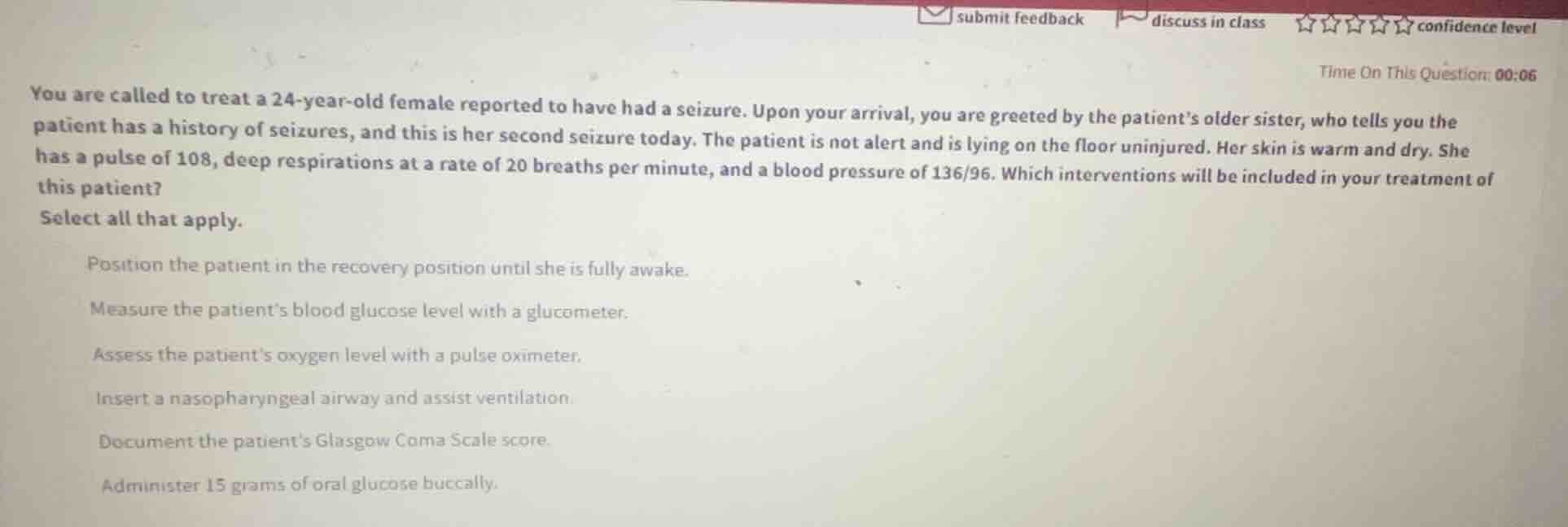
you are called to treat a 24-year-old female reported to have had a seizure. upon your arrival, you are greeted by the patients older sister, who tells you the patient has a history of seizures, and this is her second seizure today. the patient is not alert and is lying on the floor uninjured. her skin is warm and dry. she has a pulse of 108, deep respirations at a rate of 20 breaths per minute, and a blood pressure of 136/96. which interventions will be included in your treatment of this patient?
select all that apply.

position the patient in the recovery position until she is fully awake.
measure the patients blood glucose level with a glucometer.
assess the patients oxygen level with a pulse oximeter.
insert a nasopharyngeal airway and assist ventilation.
document the patients glasgow coma scale score.
administer 15 grams of oral glucose buccally.

Explanation:

Response

<pre_analysis>
{
"quality": "clear",
"question_count": 1,
"skills_matched": [
"direct_cot",
"multiple_choice_formatter",
"explain_then_answer",
"tutor"
],
"needs_drawing": false,
"concepts_used": [
"Postictal State Assessment",
"Altered Mental Status Management",
"Oral Glucose Contraindications"
],
"new_concepts": [
"Postictal Care Protocols",
"Seizure Management Interventions"
],
"current_concepts": [
"Postictal State Assessment",
"Altered Mental Status Management",
"Oral Glucose Contraindications",
"Postictal Care Protocols",
"Seizure Management Interventions"
]
}
</pre_analysis>

<reasoning>

Analyze the patient's clinical presentation

The patient is a 24-year-old female who is currently in a postictal state following her second seizure of the day. She is uninjured, lying on the floor, and "not alert." Her vital signs are:

  • Pulse: 108 bpm (mild tachycardia, common post-seizure)
  • Respirations: 20 breaths per minute, deep (adequate rate and depth; no immediate respiratory failure)
  • Blood pressure: 136/96 mmHg
  • Skin: Warm and dry

Evaluate airway and positioning interventions

Using the Postictal State Assessment knowledge point, a patient who is not fully alert after a seizure is at risk for airway compromise from the tongue or secretions.

  • Position the patient in the recovery position until she is fully awake: This is a standard, crucial intervention to protect her airway and prevent aspiration.
  • Insert a nasopharyngeal airway and assist ventilation: This is incorrect. Her respirations are 20 breaths per minute and deep, indicating adequate breathing. Invasive airway adjuncts and assisted ventilation (BVM) are not indicated.

Evaluate diagnostic and assessment interventions

In any patient with altered mental status or post-seizure activity, identifying underlying metabolic causes and establishing a neurological baseline are standard protocols.

  • Measure the patient's blood glucose level with a glucometer: Hypoglycemia is a common, reversible cause of seizures and altered mental status. Checking blood glucose is a standard assessment step.
  • Assess the patient's oxygen level with a pulse oximeter: Monitoring oxygen saturation (\(\text{SpO}_2\)) is vital to ensure adequate oxygenation during the postictal recovery phase.
  • Document the patient's Glasgow Coma Scale score: Establishing a baseline GCS score is necessary to monitor her neurological status and track improvement or deterioration over time.

Evaluate metabolic interventions

Using the Altered Mental Status Management and Oral Glucose Contraindications knowledge points, we must assess the safety of administering oral medications.

  • Administer 15 grams of oral glucose buccally: This is highly contraindicated. The patient is "not alert." Administering anything by mouth to a patient with a compromised airway or altered mental status poses a severe risk of aspiration. Oral glucose should only be given to patients who are awake, alert, and able to swallow safely.

</reasoning>

<answer>
<mcq-correct>Position the patient in the recovery position until she is fully awake.</mcq-correct>
<mcq-correct>Measure the patient's blood glucose level with a glucometer.</mcq-correct>
<mcq-correct>Assess the patient's oxygen level with a pulse oximeter.</mcq-correct>
<mcq-option>Insert a nasopharyngeal airway and assist ventilation.</mcq-option>
<mcq-correct>Document the patient's Glasgow Coma Scale score.</mcq-correct>
<mcq-option>Administer 15 grams of oral glucose b…

Answer:

<pre_analysis>
{
"quality": "clear",
"question_count": 1,
"skills_matched": [
"direct_cot",
"multiple_choice_formatter",
"explain_then_answer",
"tutor"
],
"needs_drawing": false,
"concepts_used": [
"Postictal State Assessment",
"Altered Mental Status Management",
"Oral Glucose Contraindications"
],
"new_concepts": [
"Postictal Care Protocols",
"Seizure Management Interventions"
],
"current_concepts": [
"Postictal State Assessment",
"Altered Mental Status Management",
"Oral Glucose Contraindications",
"Postictal Care Protocols",
"Seizure Management Interventions"
]
}
</pre_analysis>

<reasoning>

Analyze the patient's clinical presentation

The patient is a 24-year-old female who is currently in a postictal state following her second seizure of the day. She is uninjured, lying on the floor, and "not alert." Her vital signs are:

  • Pulse: 108 bpm (mild tachycardia, common post-seizure)
  • Respirations: 20 breaths per minute, deep (adequate rate and depth; no immediate respiratory failure)
  • Blood pressure: 136/96 mmHg
  • Skin: Warm and dry

Evaluate airway and positioning interventions

Using the Postictal State Assessment knowledge point, a patient who is not fully alert after a seizure is at risk for airway compromise from the tongue or secretions.

  • Position the patient in the recovery position until she is fully awake: This is a standard, crucial intervention to protect her airway and prevent aspiration.
  • Insert a nasopharyngeal airway and assist ventilation: This is incorrect. Her respirations are 20 breaths per minute and deep, indicating adequate breathing. Invasive airway adjuncts and assisted ventilation (BVM) are not indicated.

Evaluate diagnostic and assessment interventions

In any patient with altered mental status or post-seizure activity, identifying underlying metabolic causes and establishing a neurological baseline are standard protocols.

  • Measure the patient's blood glucose level with a glucometer: Hypoglycemia is a common, reversible cause of seizures and altered mental status. Checking blood glucose is a standard assessment step.
  • Assess the patient's oxygen level with a pulse oximeter: Monitoring oxygen saturation (\(\text{SpO}_2\)) is vital to ensure adequate oxygenation during the postictal recovery phase.
  • Document the patient's Glasgow Coma Scale score: Establishing a baseline GCS score is necessary to monitor her neurological status and track improvement or deterioration over time.

Evaluate metabolic interventions

Using the Altered Mental Status Management and Oral Glucose Contraindications knowledge points, we must assess the safety of administering oral medications.

  • Administer 15 grams of oral glucose buccally: This is highly contraindicated. The patient is "not alert." Administering anything by mouth to a patient with a compromised airway or altered mental status poses a severe risk of aspiration. Oral glucose should only be given to patients who are awake, alert, and able to swallow safely.

</reasoning>

<answer>
<mcq-correct>Position the patient in the recovery position until she is fully awake.</mcq-correct>
<mcq-correct>Measure the patient's blood glucose level with a glucometer.</mcq-correct>
<mcq-correct>Assess the patient's oxygen level with a pulse oximeter.</mcq-correct>
<mcq-option>Insert a nasopharyngeal airway and assist ventilation.</mcq-option>
<mcq-correct>Document the patient's Glasgow Coma Scale score.</mcq-correct>
<mcq-option>Administer 15 grams of oral glucose buccally.</mcq-option>
</answer>

<post_analysis>
{
"subject": "Natural Science",
"question_type": "Multiple Choice",
"knowledge_point": [
"Natural Science",
"Medicine",
"Emergency Medical Services"
]
}
</post_analysis>