QUESTION IMAGE
Question
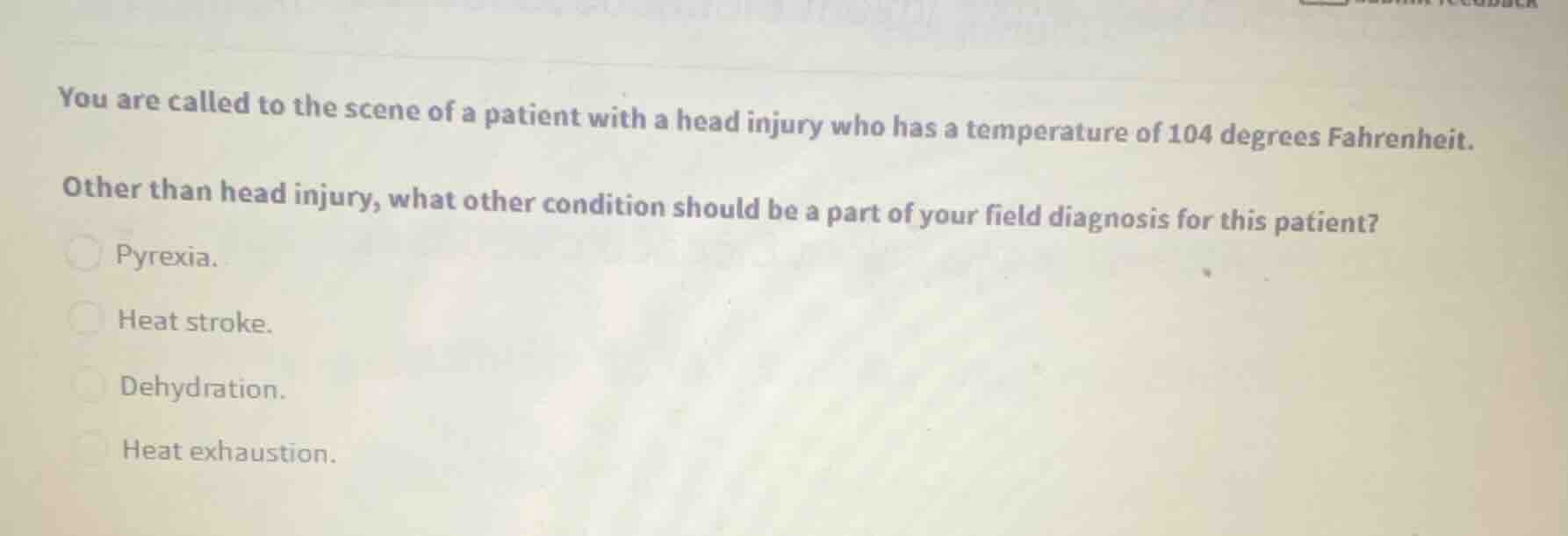
you are called to the scene of a patient with a head injury who has a temperature of 104 degrees fahrenheit.
other than head injury, what other condition should be a part of your field diagnosis for this patient?
pyrexia.
heat stroke.
dehydration.
heat exhaustion.
Analyze the clinical presentation
Using the Thermoregulation Pathophysiology knowledge point
The patient presents with a head injury and a core body temperature of \(104^\circ\text{F}\) (\(40^\circ\text{C}\)). A body temperature of \(104^\circ\text{F}\) or higher represents a critical elevation in core temperature.
Differentiate between hyperthermia and pyrexia
Using the Classic Heat Stroke knowledge point
- Pyrexia (fever) is an elevation in body temperature mediated by a systematic upward displacement of the hypothalamic thermoregulatory set-point, typically in response to pyrogens (like infections).
- Heat stroke is a life-threatening form of hyperthermia characterized by a core body temperature of \(104^\circ\text{F}\) (\(40^\circ\text{C}\)) or greater, accompanied by central nervous system dysfunction (which can be caused or exacerbated by the head injury or vice versa).
- Heat exhaustion typically presents with a lower core temperature (usually under \(104^\circ\text{F}\)) and intact neurological function.
- Dehydration is a state of fluid deficit that can accompany heat-related illnesses but is not itself the primary temperature-defining condition.
Given the extreme temperature of \(104^\circ\text{F}\), the field diagnosis must include heat stroke.

Snap & solve any problem in the app
Get step-by-step solutions on Sovi AI
Photo-based solutions with guided steps
Explore more problems and detailed explanations
- Pyrexia.
- Heat stroke. (Correct answer)
- Dehydration.
- Heat exhaustion.